Key highlights:
- US Republican senators have released their version of the CLARITY Act, barring Trump from issuing digital assets.
- The White House has agreed to the new ethical provisions, with the DOJ tapped to enforce the bill.
- A pathway for CLARITY Act’s passage has emerged, but some Democrats are kicking against the bill.
US President Donald Trump has agreed to tighter ethical restrictions under the updated text of the CLARITY Act released on Wednesday. The ethical provisions prohibit Trump and his spouse from issuing digital assets, but critics say the revised text still leaves a loophole for public officials to profit unfairly.
Trump agrees to ethical requirements under CLARITY Act
Senate Republicans have released an updated version of the CLARITY Act, a robust piece of legislation to regulate the burgeoning digital asset industry in the US. The 616-page bill builds on the earlier version passed by the Senate Banking and Agriculture committees and addresses key sticking points that threaten final passage.
Right off the bat, the updated text addressed concerns that public office holders could use the CLARITY Act to make unfair profits from digital assets. Under the updated ethical requirements, public officials, spouses, and their employees are barred from issuing or sponsoring a digital asset.
Back in 2025, Trump launched the $TRUMP memecoin, netting over $600 million via a licensing agreement. US first lady Melania Trump also released her own memecoin, drawing heavy criticism from opposition figures. Meanwhile, recent financial disclosures revealed that Trump earned over $1 billion from his family’s crypto ventures in 2015 alone.
Apart from restricting public officials from issuing digital assets, the updated CLARITY Act text directs the Attorney General to bring enforcement actions against individuals in violation of the ethical requirement.
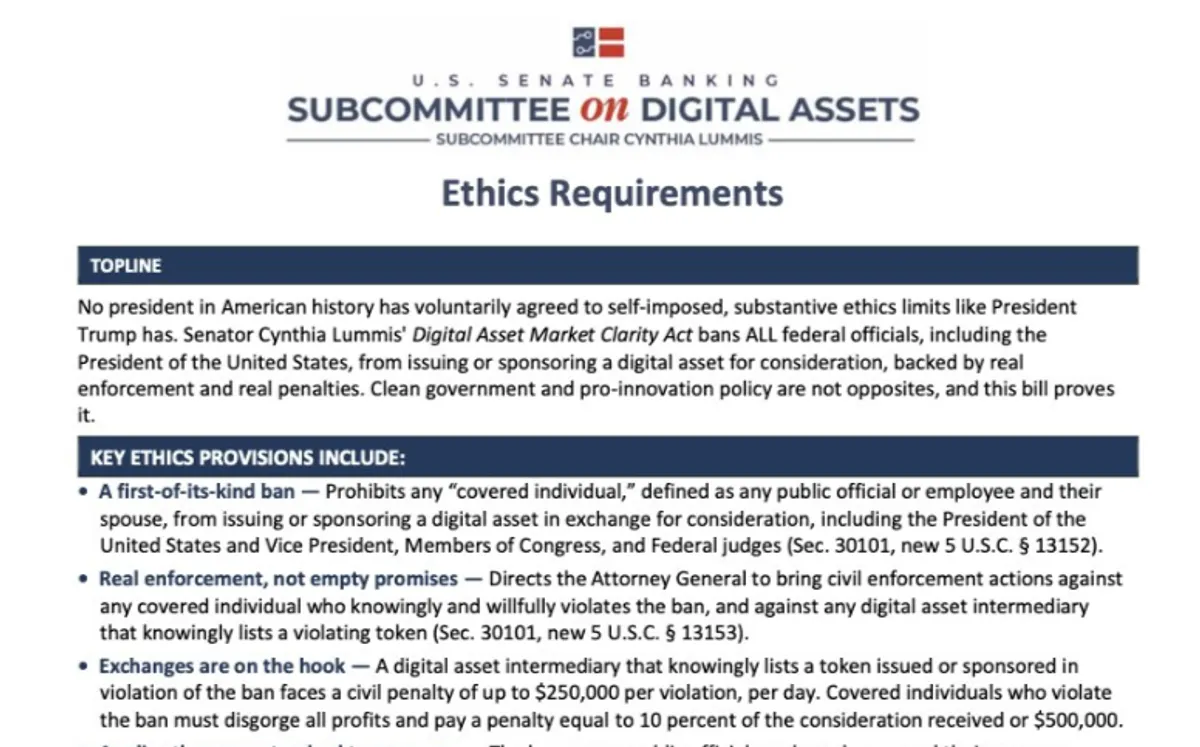
Source: Cynthia Lummis on X
Meanwhile, the ban sunsets on January 20, 2029, coinciding with the end of Trump’s presidential term, suggesting a “self-imposed” restriction on digital assets. US Senator Cynthia Lummis hailed the move as a “first-of-its-kind” ban, clearing the path for the CLARITY Act’s passage into law.
“History will remember this as the moment a president chose a higher standard of ethics than the law required of him,” said Lummis.
Democrats oppose the Republican version of the CLARITY Act
Hours after the release of the updated text, a faction of Democratic Senators slammed the Republican version for falling short on key provisions. The senators noted that they will continue to work with their colleagues on the other side of the aisle to pass the CLARITY Act despite their differing opinions.
“The Republican-proposed text of the CLARITY Act as it currently stands falls short,” read a joint statement. “Key provisions including those addressing ethics for elected officials, consumer protection, illicit finance, conflicts of interest and market integrity must be strengthened.”
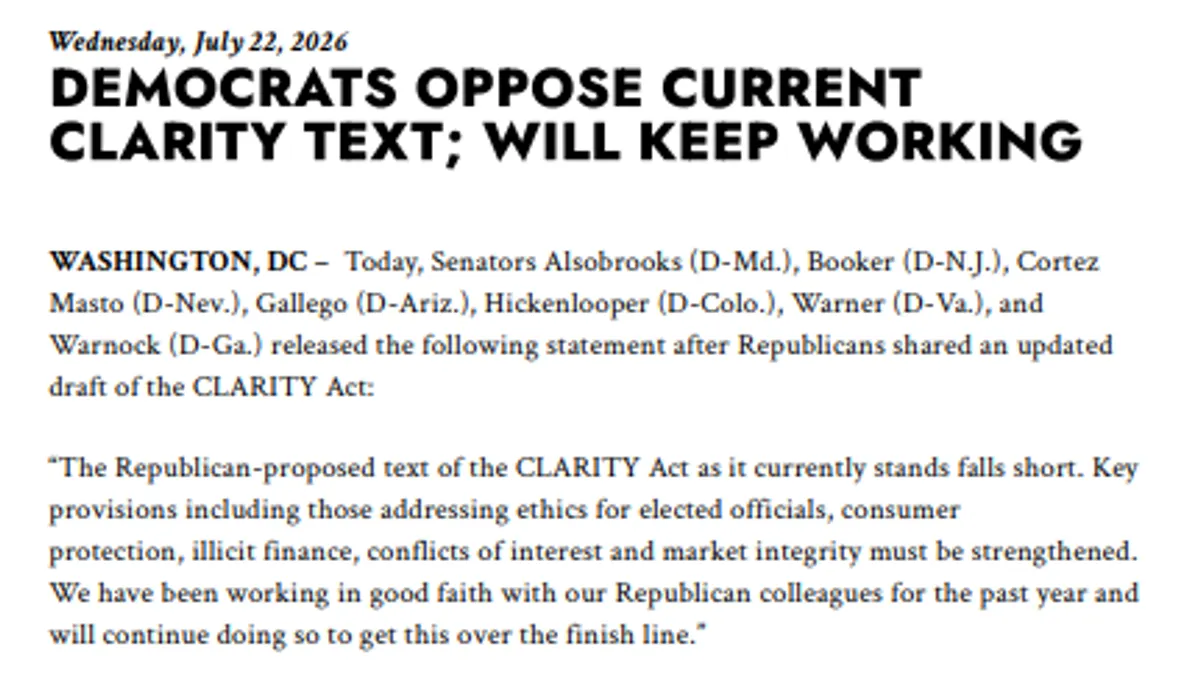
Source: US Senator Ruben Gallego
While not expressly stated by the Democrat Senators, the omission of children of public office holders in the update has garnered criticism from several quarters. Senator Alsobrooks took swipes at the text for empowering the Department of Justice to enforce the ethical provision while pushing for state attorneys general to lead enforcement instead.
However, critics have bashed the Democrat Senators for opposing the updated text, terming the new provisions as adequate.
Sources say the CLARITY Act is now set for a full Senate floor vote in the coming weeks. However, it requires a 60-vote majority in the Senate as interested parties work behind the scenes to secure bipartisan support for the bill.