With the cryptocurrency markets being in a constant state of unpredictability, many crypto investors are wondering if it’s time to sell in order to secure their profits, or continue to hold, or even accumulate, to benefit from a potential price rally that could be in the store in the short to medium term.
Even though the crypto markets have always recovered from their bearish periods so far, every bear market has its “casualties” that never make a strong recovery. Therefore, it’s important to choose quality crypto projects that have a good chance of surviving the bear market and thriving when the market sentiment is bullish.
We’ve analyzed 200 of the top cryptocurrencies based on their liquidity and availability, technology, sector leadership, tokenomics, and other key factors. You can read more about our criteria a bit further down in the article.
By doing so, we’ve narrowed the list down to a dozen cryptocurrencies that present the most compelling opportunities at the moment. The top three coins on our list are updated weekly to reflect the most up-to-date developments in the crypto and blockchain sectors.
List of the best cryptocurrencies to invest in July 2026:
- Bitcoin – Decentralized peer-to-peer cryptocurrency
- NEAR Protocol – AI and scalability focused blockchain
- Ethereum – The leading blockchain for smart contracts
- Hyperliquid – Leading decentralized futures trading platform
- Zcash – Privacy coin based on zero-knowledge technology
- Solana – High-performance blockchain platform for smart contracts
- XRP – Highly efficient digital currency
- Bittensor – Decentralized platform for machine intelligence
- Chainlink – The leading decentralized oracle network
- Uniswap – The pioneering automated market maker protocol
- Sky – A key decentralized finance project
- BNB – A popular cryptocurrency utilized in the Binance ecosystem
Examining the best cryptos to buy right now
Let’s start off by highlighting three cryptocurrency projects that have seen important developments recently or have big events coming up in the near future. We update these highlighted coins on a weekly basis to reflect the latest developments in the world of crypto and blockchain.
Before we dive into our list of the best cryptos to buy, we should note that choosing which crypto to buy is only the first step in your crypto investment journey. It's also important to choose the right platform to buy crypto, and you also have to decide how you will be storing your cryptocurrency.
In our opinion, the best way to invest in crypto is to transfer your coins to a hardware wallet after you buy it on an exchange. A great starting point is to buy cryptocurrency on KuCoin and store it in a Ledger hardware wallet.
1. Bitcoin
Bitcoin is a decentralized peer-to-peer cryptocurrency that was initially described in 2008 and launched in early 2009. Bitcoin was invented by a person using the pseudonym Satoshi Nakamoto, whose real identity is still unknown.
Bitcoin introduced the concept of a blockchain and provides a fully decentralized digital currency that’s extremely secure. It implements Proof-of-Work to make it very difficult to alter the history of transactions or double-spend coins. The network is secured by miners, who are rewarded with BTC coins for adding blocks to the Bitcoin blockchain.
BTC can be sent anywhere in the world on a 24/7 basis, and transactions cannot be blocked by any intermediaries. By holding their own private keys, users can self-custody their Bitcoin without requiring institutions such as banks.
Even though countless cryptocurrencies and blockchain platforms have been released after Bitcoin, BTC is still easily the largest cryptocurrency by market capitalization.
Why Bitcoin?
Bitcoin is worth watching closely this week as several major policy and macroeconomic events could create significant volatility across the crypto market. The most immediate catalyst is the Senate vote on the CLARITY Act on September 15. The bill needs 60 votes to clear a key procedural hurdle, meaning some Democratic support will be required despite Republicans holding 53 Senate seats. A successful vote could strengthen expectations that comprehensive U.S. crypto market structure legislation is finally moving toward passage.
🚨Clarity Act Update!
Tuesday at 2:15 p.m. ET, the Senate takes its first procedural vote on the Clarity Act.
This is not a vote on final passage. It is a vote to end debate on whether the United States Senate should even consider a bill to regulate digital assets.
We have…— Bernie Moreno (@berniemoreno) September 13, 2026
Monetary policy could be just as important. The Federal Reserve is set to announce its latest rate decision on Wednesday, with markets increasingly expecting a rate hike amid inflationary pressure and rising oil prices. A more hawkish Fed could weigh on Bitcoin and other risk assets. The Bank of England follows on September 17, while the Bank of Japan is expected to make its decision on Friday, giving traders several potential sources of macro-driven volatility in a matter of days.
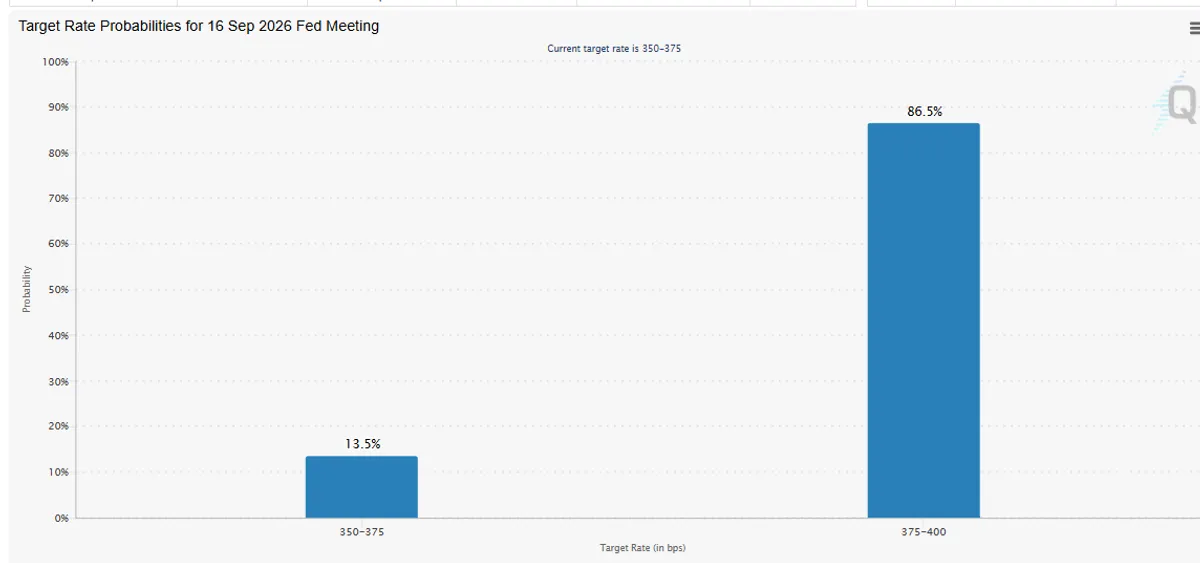
The current market odds of the U.S. Fed hiking rates in September. Source: CME FedWatch tool
Bitcoin is also approaching an important technical and on-chain test following its recent recovery. CryptoQuant identifies the 365-day moving average, currently around $81,700, as a particularly important level, with sustained closes above it historically associated with the establishment of Bitcoin bull markets. Before reaching that level, however, BTC must overcome a substantial supply zone between roughly $77,100 and $80,200, where long-term holders reportedly sold as much as 539,000 BTC during 2026.
The combination of political catalysts, central bank decisions and major resistance levels makes this an unusually important week for Bitcoin. A convincing breakout could strengthen the case that its recent recovery represents a broader trend reversal, while renewed selling pressure or unexpectedly hawkish monetary policy could quickly challenge that narrative.
2. NEAR Protocol
NEAR Protocol is a high-throughput blockchain platform that leverages sharding to deliver robust scalability. The project places a strong emphasis on AI-focused applications, made possible by the network’s dynamic sharding, rapid finality, and private execution features. Together, these characteristics make NEAR well suited for supporting AI agents.
Smart contracts on NEAR can be developed using widely adopted programming languages such as Rust and JavaScript. The protocol also provides a built-in incentive for builders, as developers receive 30% of the gas fees that are burned whenever their smart contracts are executed on the network.
Among the most notable innovations emerging from the NEAR ecosystem is NEAR Intents, a multichain transaction framework that lets users specify their desired result while external parties compete to fulfill it in the most efficient way. In real-world use, NEAR Intents are most commonly applied to frictionless cryptocurrency swaps across multiple blockchain networks.
Why NEAR Protocol?
NEAR Protocol is worth watching as it pushes ahead with one of the blockchain industry’s more developed roadmaps for preparing against future quantum-computing threats. NEAR began its post-quantum upgrades in Q2 2026 by adding support for the ML-DSA, or Dilithium, quantum-safe signature scheme. The change allows users to secure their NEAR accounts with post-quantum signatures and, through Chain Signatures, potentially extend that protection to assets held across more than 30 other blockchains.
Through Chain Signatures, a NEAR account with a quantum-safe ML-DSA key can hold and protect assets from other chains, including chains that have not yet upgraded to post-quantum signing.
NEAR's roadmap to quantum security, from consensus to cross-chain:https://t.co/Qsipp0ld2j— NEAR Protocol (@NEARProtocol) September 10, 2026
The roadmap goes considerably further than protecting individual accounts. Near One is working toward eventually making the network’s consensus mechanism post-quantum secure as well, although the technical challenges are significantly greater because current quantum-resistant signature schemes can be costly in terms of computation and bandwidth. The team currently expects a suitable solution to emerge within roughly 12 months and is targeting post-quantum consensus by the end of 2027. NEAR is also prioritizing quantum-secure cross-chain infrastructure so that NEAR Intents and Chain Signatures can remain interoperable as other blockchains adopt their own approaches.
At the same time, NEAR is gaining exposure to two other major crypto themes: artificial intelligence and privacy. NEAR AI has introduced staking-based payments that allow users to stake NEAR and receive credits for confidential AI inference and agent hosting while retaining ownership of their underlying tokens. Confidential inference runs through Trusted Execution Environments, providing hardware-backed attestations that computations were performed inside protected environments.
Confidential Intents TVL is approaching the $70M threshold that triggers the snapshot for NEAR@3.33 Drop 1.
Eligible accounts: hold a confidential balance above $100 on near.com and at execute least one confidential swap.
Full details: https://t.co/rqGz98yEdX— NEAR Protocol (@NEARProtocol) September 11, 2026
NEAR’s Confidential Intents technology adds another dimension by bringing privacy to cross-chain DeFi activity. The system is designed to conceal information such as trade size, direction and timing, helping prevent front-running and MEV while still allowing selective disclosure for compliance purposes. With confidential intents nearing $70 million in total value locked, NEAR is increasingly positioned at the intersection of post-quantum security, AI infrastructure, cross-chain interoperability and privacy.
3. Ethereum
Ethereum is a blockchain that supports smart contracts, enabling more complex use cases such as decentralized lending protocols and non-fungible tokens. The Ethereum project was founded by Vitalik Buterin, who published the Ethereum whitepaper in late 2013. The Ethereum blockchain launched in July 2015.
One of the first use cases enabled by Ethereum that gained a lot of traction was the ability to issue custom tokens that could be transacted over the Ethereum blockchain. This feature was utilized by many projects to conduct fundraising through Initial Coin Offerings (ICOs) and other types of token sales.
Today, Ethereum has an extremely vibrant ecosystem of decentralized applications – including decentralized financial services, NFT marketplaces, publishing platforms, decentralized cryptocurrency exchanges, and more.
ETH is the native asset of the Ethereum blockchain, providing an incentive for users to secure the network. The Ethereum network originally implemented a Proof-of-Work consensus mechanism but switched over to Proof-of-Stake in September of 2022.
Why Ethereum?
Ethereum is worth watching as developers move forward with EIP-8141, or Frame Transactions, for the planned 2027 Hegotá upgrade. The proposal could significantly simplify how users interact with Ethereum by allowing wallets and applications to cover ETH gas fees on a user’s behalf while accepting payment in another token, such as USDC or USDT. Users could therefore transact with stablecoins without first having to acquire ETH specifically to pay network fees.
A lot of important progress on Frames (EIP-8141) has been quietly happening over the last few months. Highly recommend reading this, also the updated EIP https://t.co/jYqeS55j6P
https://t.co/CPYONKnWZc— vitalik.eth (@VitalikButerin) September 5, 2026
Frame Transactions could also improve Ethereum’s broader account experience. By separating authorization, fee payment and execution, EIP-8141 would allow multiple actions to be bundled into atomic transactions that either all succeed or all fail together. It could additionally support programmable authorization rules, key rotation and new signature systems without forcing users to move their assets to a new address. The proposal has been given high priority by the Ethereum Foundation, although it remains a draft and still requires further security work and testing.
Quantum resistance is becoming another major focus. The Ethereum Foundation has set a broader target of making Ethereum’s execution, consensus and data layers resistant to quantum-computing threats by December 2029. Rather than waiting until quantum computers become an immediate danger, Ethereum researchers are pushing for post-quantum readiness well in advance, making the issue an increasingly important part of the network’s long-term technical roadmap.
Institutional demand provides another reason to monitor ETH in the near term. Bitmine added another 27,180 ETH last week, bringing its holdings to almost 6 million ETH as it approaches its target of owning roughly 5% of the cryptocurrency’s supply. Chairman Tom Lee has also pointed to Ethereum’s growing role in Wall Street tokenization and potentially agentic AI, while this week’s expected Senate vote on the CLARITY Act adds another major policy catalyst that could affect sentiment around Ethereum and the broader crypto market.
🧵
1/
BitMine provided its latest holdings update for September 14, 2026
$15.8 billion in total crypto + "moonshots":
- 5,956,378 ETH at $2,513 per ETH (per @coinbase)
- 212 Bitcoin (BTC)
- $180 million stake in Beast Industries @MrBeast
- $98 million stake in Eightco Holdings…— Bitmine (NYSE-BMNR) $ETH $BMNP (@BitMNR) September 14, 2026
4. Hyperliquid
Hyperliquid is a layer 1 blockchain that’s designed to enable decentralized trading with very low fees and slippage. With the ability to handle around 100,000 orders per second, Hyperliquid provides a decentralized trading platform with an orderbook that offers a user experience similar to a centralized exchange.
The platform offers a broad range of crypto assets for trading and provides up to 50x leverage on select pairs. Hyperliquid also has copy trading functionality, which is a fairly unique feature in the decentralized finance ecosystem.
In November 2024, the Hyperliquid project launched its HYPE token via an airdrop to more than 90,000 users. The community responded positively, largely due to the generous token distribution and the absence of venture capital involvement.
HYPE functions as both a utility and governance token within the Hyperliquid ecosystem. It has a capped supply of 1 billion tokens, with over 76% allocated to the Hyperliquid user community.
Why Hyperliquid?
HYPE recently put in a fresh all-time high at $89.47, and has not seen a major correction as the token is changing at about $87 at the time of writing.
Hyperliquid is drawing attention this week as its push into the U.S. derivatives market appears to be gaining momentum. Hyperliquid Labs is reportedly working with Payward, Kraken’s parent company, on a structure that could allow U.S. traders to access perpetual futures linked to Hyperliquid markets through Bitnomial, a CFTC-regulated derivatives platform.
Payward has already presented the proposed framework to the CFTC, although final regulatory approval is still pending.
The development is particularly significant because perpetual futures remain one of the most important products in crypto trading, while U.S. access has historically been constrained by regulation. A compliant route into the U.S. could materially expand Hyperliquid’s addressable market and reinforce its position as a major player in crypto derivatives.
The regulatory backdrop also appears increasingly favorable, with the Hyperliquid Policy Center pushing for clearer rules and President Donald Trump recently highlighting efforts by CFTC Chair Michael Selig to bring Hyperliquid into the U.S. in a fully compliant manner.
HYPE is also benefiting from signs of growing institutional interest. Regulatory filings reviewed by Bloomberg Intelligence show that UBS, Bank of Montreal, Jane Street and several investment firms held positions in U.S.-listed Hyperliquid ETFs at the end of June.
NEW: Earlier this week i took a look at the Hyperliquid ETFs and their 13F reporting. Here's a look at all the known holders of the three ETFs. hyperliquid:native pic.twitter.com/99rcQ8bsFs
— James Seyffart (@JSeyff) September 4, 2026
Wealth High Governance Asset Management reported the largest disclosed position in 21Shares’ HYPE fund, worth nearly $24 million, while other notable holders included Brevan Howard and Balyasny.
5. Zcash
Initially proposed in a publication entitled "Zerocash" in 2014, Zcash is a decentralized public peer-to-peer cryptocurrency launched in 2016 that offers features similar to Bitcoin with a twist of unique privacy and security features found only in a handful of public digital currencies.
More specifically, ZEC was the first cryptocurrency to leverage 'zk-SNARKS', a zero-knowledge protocol that was considered among the top 10 breakthrough technologies of 2018 according to MIT's Technology Review.
New ZEC coins are introduced into the circulating supply through mining - Zcash is a cryptocurrency based on Proof-of-Work. Tokenomics-wise, Zcash has kept the same 21 million total supply cap introduced by Bitcoin. Similarly to Bitcoin, Zcash also has a halving mechanism. The first Zcash halving happened at block height 1,046,400 in 2020.
The Zcash project is very likely to adopt a Proof-of-Stake consensus mechanism in the future, as Zcash’s main developer Electric Coin Company and the majority of the Zcash community have expressed support for transitioning away from Proof-of-Work.
Why Zcash?
Zcash delivered new highs over the weekend, peaking at $1,245 in an explosive move on Sunday. With the new push, ZEC has extended its monthly gains to a whopping +135%, the strongest monthly performance among all the coins in the cryptocurrency top 100.
Besides the strengthening narrative about the importance of privacy, Zcash is also benefiting from the launch of the first spot Zcash ETF in the United States, which has provided an alternative avenue for investors who wish to get exposure to ZEC. The fund currently holds $463 million worth of ZEC, which is 2.3% of Zcash’s market capitalization.
The ETF launch also arrives alongside continued improvements to Zcash’s underlying technology. The recent Ironwood upgrade strengthened the network’s privacy and security capabilities, while developers have been working on making shielded transactions significantly faster and more practical for everyday use.
One particularly notable development is Zakura Common, a new set of cryptographic tools designed to dramatically reduce the computational work required to create private transactions.
According to its developers, transaction preparation times can fall from several seconds to below 200 milliseconds in some cases, with substantial performance improvements on both mobile and desktop devices. Because the libraries can be adopted by wallets without requiring another Zcash protocol upgrade, these improvements could reach users relatively quickly.
Meanwhile, the Zcash network’s hashrate has also been climbing rapidly, recently hitting a new all-time high at 29.1 Gh/s. Zcash’s hashrate has seen a growth of roughly 3.7x in the last year.
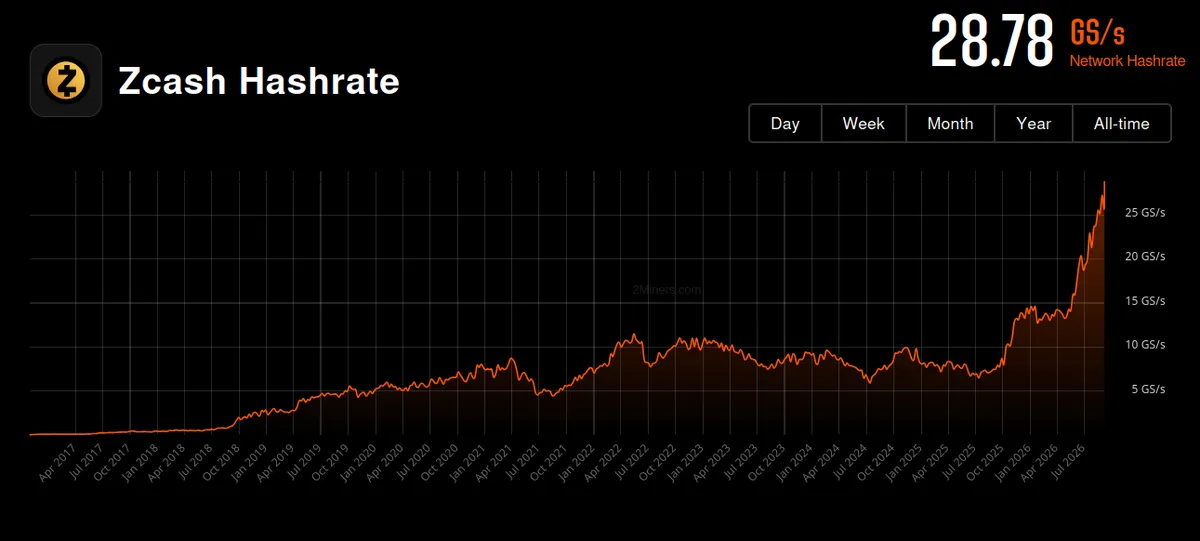
Zcash hashrate chart. Source: 2miners
6. Solana
Solana is a smart contracts platform with a unique architecture that allows it to process thousands of transactions per second while keeping costs extremely low. Solana achieves this by utilizing a unique Proof-of-History algorithm and a Proof-of-Stake consensus mechanism. SOL is among the cheapest cryptos to transfer on the market, as users pay less than $0.001 per transaction on average.
Solana was founded in 2018 by Anatoly Yakovenko. The platform’s mainnet launched in March 2020 and saw a huge boost in adoption in 2021. While SOL has lost a lot of its value in the 2022 bear market, Solana still has one of the most impressive ecosystems in the cryptocurrency sector and is potentially still one of the next cryptos to explode.
Why Solana?
Solana investors have several major developments to watch this week, covering network performance, institutional accessibility, and tokenomics. Taken together, they highlight continued efforts to improve Solana’s technical capabilities while making SOL more accessible to mainstream investors and reducing the pace of future token issuance.
On the infrastructure side, Solana has begun a staged reduction in block slot times from 400 milliseconds toward a 200ms target, with the first mainnet step lowering the figure to around 350ms. Testnet results have already approached the final target, suggesting the upgrade is technically achievable. Faster slots could improve responsiveness for trading, payments, and DeFi, although the change will also put greater demands on validator hardware, networking, and client efficiency.
Solana is also gaining additional exposure through traditional finance. Charles Schwab plans to add SOL to its crypto trading platform alongside Avalanche and Chainlink, expanding beyond the Bitcoin and Ethereum support it launched earlier this year. Schwab described the new additions as established cryptocurrencies that met its selection criteria, potentially bringing Solana within easier reach of a broader base of brokerage clients.
Meanwhile, Solana validators have approved a major change to the network’s monetary policy, doubling the annual disinflation rate from 15% to 30%.
BREAKING: SOLANA DISINFLATION PROPOSAL PASSES, FLIPPED IN THE LAST 5 MINUTES BEFORE END OF VOTE
66.7% NEEDED 67% FOR
INSANE LAST FEW MINUTES pic.twitter.com/TDv2olcKuD— gum (@gumsays) August 28, 2026
This means Solana is expected to reach its long-term 1.5% inflation floor in 2029 rather than 2032, resulting in substantially less new SOL being issued over the coming years. The tradeoff is that staking yields are also expected to decline, making the impact on validator economics and staking participation an important factor for investors to monitor.
7. XRP
XRP is a cryptocurrency that was launched in June of 2012. It was developed by David Schwartz, Jed McCaleb and Arthur Britto, who started a company called OpenCoin together with Chris Larsen. 80% of the XRP supply was gifted to the company by the developers of XRP. OpenCoin has since been renamed to Ripple, and the company has put the majority of its XRP holdings into escrow.
XRP provides very fast and low-cost transfers, making it suitable for use cases like remittances. It uses neither Proof-of-Work nor Proof-of-Stake but instead implements the XRP Ledger Consensus Protocol. Every participant in the XRP network can choose a set of validators that they trust to behave honestly.
Ripple has implemented the XRP cryptocurrency into its products, most notably On-Demand Liquidity (ODL). ODL works in partnership with cryptocurrency exchanges and uses XRP to provide efficient cross-border money transfers.
Why XRP?
The XRP Ledger is preparing five protocol amendments for the upcoming xrpld 3.3.0 upgrade, with a focus on expanding its support for tokenized assets and institutional financial applications. The upgrades are designed to enable tokenized assets to be used in areas such as global transfers, trading, collateral and settlement, rather than only for basic issuance.
XRPL has already proven it can support tokenized assets at scale. Now it’s time to put these assets to use: global transfers, trading, collateralizing, and settling.
The upcoming release of xrpld 3.3.0 includes five amendments that move XRPL significantly closer to that goal.…— Jazzi Cooper (@jazzicoop) July 31, 2026
Key additions include privacy protections for Multi-Purpose Tokens, sponsored transaction fees and reserves, and greater flexibility for issuers to modify certain token properties. The release also reintroduces Batch transactions and Permission Delegation after earlier security issues were addressed. Each amendment will need at least 80% validator support for two consecutive weeks before becoming active.
Meanwhile, Ripple is strengthening its position in global capital markets through investments in ZILO and Licuido, adding regulated transfer agency, fund administration, digital asset issuance and collateral mobility to the XRP Ledger ecosystem. The move is part of Ripple’s broader plan of turning the XRP Ledger into infrastructure for tokenized finance rather than limiting it to payments or basic asset issuance.
Deepening our push into capital markets, we are investing in ZILO and Licuido to add regulated transfer agency, issuance and collateral mobility to our capital markets infrastructure built on the XRPL. This comes on the heels of Aviva Investors tokenising its US Dollar Liquidity…
— Ripple (@Ripple) August 3, 2026
Ripple’s institutional platform is designed to support the full lifecycle of tokenized assets, including issuance, custody, trading, collateral management and atomic settlement. Its RLUSD stablecoin serves as a regulated settlement asset, enabling delivery-versus-payment transactions in which assets and payments are exchanged simultaneously, reducing settlement delays and counterparty risk.
ZILO will provide the compliant ownership records and administrative systems needed for tokenized funds, while Licuido will help assets move between regulated markets and be used more efficiently as collateral. Combined with initiatives involving Aviva Investors, Franklin Templeton, DBS and Ripple Prime, the investments position XRP Ledger as a potential bridge between blockchain-based finance and traditional capital markets.
8. Bittensor
Bittensor is a decentralized platform that provides a peer-to-peer market for machine intelligence. Bittensor consists of multiple subnets, which are specialized for particular tasks, for example text prompting, transcription or audio generation. There are currently more than 30 Bittensor subnets in operation.
Bittensor incorporates a very unique consensus mechanism called Yuma Consensus, which allows validators on different subnets to shape what the network should learn.
The computational resources required to perform machine learning tasks on the Bittensor network are provided by miners, and TAO tokens are used to incentivize them. Users who require machine learning services have to pay with TAO tokens to access them.
By providing a decentralized and cost-effective network of machine learning algorithms, Bittensor makes these advanced solutions accessible to everyday users.
Why Bittensor?
The Kraken crypto exchange has completed native integration of Bittensor’s dTAO model and plans to list subnet tokens soon. The exchange highlighted 7 subnet tokens: Chutes, Targon, Vanta, Score, Lium, Ridges AI and Hippius.
This could make individual Bittensor subnet economies more accessible to traders and investors, increasing liquidity and visibility for the broader ecosystem.
This is a very big deal for Bittensor $TAO
Kudos @krakenfx https://t.co/sYxbnCz6Gs— Barry Silbert (@BarrySilbert) June 29, 2026
The dTAO model gives each Bittensor subnet its own token, allowing investors to gain exposure to specific markets within the network, such as machine intelligence, model training, data, or compute, rather than only holding TAO as the base asset.
Since subnet tokens can also be staked to validators and earn a share of emissions generated by subnet activity, Kraken’s upcoming listings could draw more attention to Bittensor’s expanding token economy and its role in decentralized AI infrastructure.
It’s also worth highlighting that Yuma, a Digital Currency Group subsidiary focused on the Bittensor ecosystem, recently launched the Yuma Total Market Fund. The fund is designed to give institutional investors broad exposure to TAO as well as Bittensor’s subnets.
Today we’re introducing the Yuma Total Market Fund. One allocation to access $TAO and the full Bittensor subnet ecosystem.
AI exposure is expanding beyond public equities and venture. https://t.co/TCeo4fZqHh— Yuma (@YumaGroup) June 25, 2026
9. Chainlink
Chainlink is a decentralized oracle network that allows blockchains and smart contracts to securely retrieve reliable information from external sources. It addresses the so-called “oracle problem,” which refers to the difficulty blockchains face when accessing data that exists outside their native environments. By connecting on-chain applications with off-chain information, Chainlink supports use cases that would not be possible using blockchain data alone.
Chainlink has become the leading oracle solution in decentralized finance and is increasingly being adopted in areas such as real-world asset tokenization. DeFi protocols can use Chainlink to supply smart contracts with cryptocurrency prices from centralized exchanges, while RWA platforms can access accurate market valuations with reduced risk of manipulation. This can help tokenized real estate, commodities, and other assets maintain reliable, up-to-date valuations on-chain.
Why Chainlink?
Crypto investors should be paying attention to Chainlink because it is increasingly becoming core infrastructure for tokenized finance. BitGo’s decision to make Chainlink CCIP (Cross-Chain Interoperability Protocol) the exclusive cross-chain infrastructure for WBTC and future BitGo-issued assets is a strong sign of institutional confidence in its security and interoperability tech.
NEW: @BitGo (NYSE: BTGO) migrates $7.7B+ Wrapped Bitcoin (WBTC) to Chainlink CCIP.
After a rigorous review, BitGo deprecated its legacy bridging provider & chose CCIP as its exclusive cross-chain infra given it’s the only solution that meets institutional security requirements. https://t.co/ceIBKawZm8 pic.twitter.com/oEYtZtNuFU— Chainlink (@chainlink) August 4, 2026
Chainlink already operates at significant scale. Its infrastructure has enabled more than $32 trillion in transaction value, secures over $110 billion across DeFi and cross-chain applications, and supports roughly 70% of oracle-dependent DeFi value globally. CCIP is also growing quickly, with quarterly volume reaching $4.9 billion in Q2 2026.
The larger opportunity is the growth of real-world asset tokenization. Standard Chartered expects tokenized assets onchain to reach $4 trillion by the end of 2028 and argues that Chainlink is uniquely positioned to provide the data, interoperability, and compliance infrastructure these assets will require.
That outlook led Standard Chartered to set a $200 price target for LINK by the end of 2030, based partly on expectations that Chainlink’s fee generation could rise around 25-fold. The $200 target represents upside of over 2,300% compared to LINK’s current price.
Chainlink’s growing list of institutional relationships including Swift, DTCC, JPMorgan, Mastercard, UBS, Fidelity and BitGo adds further credibility to the thesis. The investment case is therefore simple: if more of the global financial system moves onchain, Chainlink could become one of the key infrastructure providers powering that transition.
10. Uniswap
Uniswap is a decentralized exchange that pioneered the AMM (Automated Market Maker) model for swapping tokens trustlessly. Uniswap works through liquidity pools, where users can deposit funds to provide liquidity for those who want to swap between tokens.
The Uniswap protocol provides a simple yet powerful way of swapping between different tokens directly on the blockchain without the need for any intermediaries. There’s no need to open an account or provide personal information, as Uniswap functions entirely through smart contracts on the blockchain.
The governance of Uniswap is controlled by UNI token holders, who have the power to propose and vote on governance decisions. UNI was initially distributed to early users of the Uniswap platform through an airdrop in 2020 and is currently tradable on both decentralized and centralized exchanges.
Why Uniswap?
Geoffrey Kendrick, Standard Chartered’s global head of digital assets research, says his $100 price target for Uniswap’s UNI token by the end of 2030 may be too conservative. His reassessment follows a faster-than-expected increase in UNI token burns, driven largely by trading activity on Robinhood Chain. Meanwhile, large investors have been accumulating UNI, with whale holdings reaching a five-year high this month.
Robinhood Chain launched on July 2, and Uniswap has quickly become one of its main sources of liquidity. According to DefiLlama data cited in the report, Uniswap accounts for roughly 76% of trading activity on the network, with daily volume reaching as high as $409 million. The protocol has also generated about $1.81 million of the chain’s $2.28 million in daily fees.
Those fees have become increasingly important since Uniswap introduced a mechanism in December 2025 that directs part of its revenue toward buying back and burning UNI. A second burn mechanism was introduced on Robinhood Chain on July 27, after which the pace of token destruction reportedly doubled. Burns are now running at an annualized rate of around $90 million, equivalent to roughly 25.7 million UNI at the token’s current price.
With approximately 624 million UNI in circulation, the current pace would remove about 4.1% of supply each year. Kendrick argues that such a burn rate is difficult to sustain at UNI’s current valuation. Even if UNI reaches his $6.50 target for the end of 2026, he estimates around 2.2% of supply could still be burned annually. That stronger-than-expected supply reduction prompted him to suggest that his long-term $100 UNI target may ultimately prove too low.
11. Sky
Sky is a decentralized finance protocol that issues and manages USDS, a decentralized stablecoin pegged to the US dollar. Users that hold assets that are supported as collateral (for example, ETH) can lock their coins into Sky’s smart contracts in order to issue USDS. The protocol also incorporates the SKY token, which facilitates decentralized governance.
The system is overcollateralized—in order to mint USDS, users need to provide collateral that exceeds the value of minted USDS, and users are required to monitor the value of their collateral in order to avoid liquidation.
Sky was founded under the name Maker in 2014, and the platform’s stablecoin was first launched in late 2017 under the name Dai. Initially, the protocol only supported ETH as collateral. With the launch of Multi-Collateral Dai in 2019, it also became possible to use other forms of collateral. Today, Sky’s stablecoin USDS is backed by a diverse range of assets.
Why Sky?
SKY has been a solid performer recently, gaining a modest 1% in the last week while most major crypto assets sustained losses. The Sky decentralized ecosystem is on a positive trajectory, as evidenced by its performance in 2025.
.@SkyEcosystem Q4 Update and 2026 Outlook
The full report 🧵⤵️ pic.twitter.com/RdC6Wb6guH— Sky Ecosystem Insights (@SkyEcoInsights) February 3, 2026
Sky DeFi delivered breakout growth in 2025 while becoming meaningfully more efficient. Protocol revenue climbed to $338M, driven by strong growth of the USDS stablecoin, whose supply rose 74% YoY to $9.2B, clearly outperforming broader stablecoin market growth.
At the same time, Sky sharply reduced costs as core operating expenses fell 63% YoY, reaching just $8.8M in Q4. Growth initiatives were delegated to autonomous Sky Agents and the core protocol remained lean. With one-off transformation costs related to the project’s rebrand now behind it, the Sky Ecosystem heads into 2026 structurally more efficient.
USDS strengthened its position as a capital-efficient institutional stablecoin. Sky maintained over $4B in instant redemption liquidity via the Peg Stability Module, while zero-slippage USDC–USDS swaps reinforced USDS’s role as a low-friction settlement and liquidity asset.
Adoption remained resilient despite a lower-yield environment. Even as DeFi rates compressed and the Sky Savings Rate declined from 12.5% to 4%, USDS continued to attract users. The number of holders grew from 509K to 582K, while grewy from $5.3B to $9.2B.
12. BNB
BNB is a token that was launched by the Binance cryptocurrency exchange in 2017. BNB serves two primary functions. Holders of the token get access to special benefits when using Binance – this includes lower trading fees, access the exchange’s Launchpad and Launchpool programs, cashback on Binance Visa card purchases, and more.
The token is also used as the native asset of the BNB Chain blockchain. BNB Chain is a variant of Ethereum that offers significantly lower transaction fees to users, and it allows developers to easily deploy EVM-compatible decentralized applications. Previously known as Binance Coin, BNB has now gone through an extensive rebranding.
Why BNB?
Recently, the 33rd quarterly BNB token burn has been completed, in which 1.44 million BNB (worth approximately $12 billion at the time of the burn) was permanently removed from circulation.
The 33rd quarterly $BNB token burn has been completed directly on BNB Smart Chain (BSC).
1.44M #BNB has been burned 🔥
View the details of the burn below ⬇️https://t.co/GPfpeZ5fBT pic.twitter.com/kTQIHTfKvA— BNB Chain (@BNBCHAIN) October 27, 2025
Compared to the 32nd quarterly BNB burn (1.59 million BNB worth $1 billion), the most recent burn was smaller in terms of BNB burned, but larger in terms of the dollar value.
The burn has reduced the supply of BNB to 137.7 million tokens (the goal is to cut the supply to 100 million). The supply reduction was conducted using the BNB Auto-Burn mechanism, which is based on two parameters: the BNB price and the number of blocks produced by BNB Chain during the given quarter.
BNB has been by far the strongest performer among major cryptocurrencies recently, gaining 20.6% against the US dollar in the last 30 days. In the same time frame, Bitcoin gained 5.2% and Ethereum gained 3.8%.
Recently, BNB was listed on Coinbase, a major cryptocurrency exchange that trades on the NASDAQ. This news is especially notable since Binance (which still plays a key role in the BNB ecosystem) is a major competitor to Coinbase.
The listing is also a signal of a favorable regulatory environment for the token, as BNB has always been controversial from a securities law standpoint since it was initially created and sold by Binance.
| Native asset | Launched in | Description | Market cap* | |
|---|---|---|---|---|
| Bitcoin | BTC | 2009 | Decentralized peer-to-peer cryptocurrency | $1.58 trillion |
| NEAR Protocol | NEAR | 2020 | AI and scalability focused blockchain | $3.1 billion |
| Ethereum | ETH | 2015 | The leading blockchain for smart contracts | $305 billion |
| Hyperliquid | HYPE | 2024 | Leading decentralized futures trading platform | $20 billion |
| Zcash | ZEC | 2016 | Privacy coin based on zero-knowledge technology | $19.2 billion |
| Solana | SOL | 2020 | High-performance blockchain for smart contracts | $59.7 billion |
| XRP | XRP | 2012 | Highly efficient digital currency | $88 billion |
| Bittensor | TAO | 2021 | Decentralized platform for machine intelligence | $2.6 billion |
| Chainlink | LINK | 2017 | The leading decentralized oracle network | $8.5 billion |
| Uniswap | UNI | 2020 | The pioneering automated market maker protocol | $3.9 billion |
| Sky | SKY | 2015 | A key decentralized finance project | $1.5 billion |
| BNB | BNB | 2017 | BNB Chain's native asset and token used in Binance ecosystem | $96 billion |
*Data as of September 14, 2026, at 15:05 UTC.
Best crypto to buy for beginners
If you're a new entrant in the cryptocurrency space, it's probably best to stick to cryptocurrencies that have been around for a longer period of time and have a well-developed ecosystem of resources for users. This will make it easier for you to set up your wallet and find answers if you encounter any problems along the way.
If you're a beginner, consider sticking to cryptocurrencies that satisfy the following criteria:
- The coin has a significant market capitalization ($1 billion and up)
- The coin is listed on many cryptocurrency exchanges and can easily be exchanged against fiat currencies
- The coin has solid liquidity (at least $100 million in 24-hour trading volume)
- The coin is already a working product and is not based on future promises
If you stick to coins that meet these criteria, you'll automatically be filtering out a lot of low-quality projects and reducing your chances of falling victim to scams. You will also easily be able to sell your coins and convert them to fiat currency if you ever decide to do so.
Here are a few examples of cryptocurrencies that are worth considering for beginner investors in crypto. These coins have a lot of liquidity, well-developed ecosystems, and a lot of educational resources and tools that will help beginners get up to speed.
Please note that cryptocurrencies are risky investments and typically display a lot of price volatility. This is true even for established cryptocurrencies with multi-billion dollar market capitalizations. Never invest more than you are willing to lose.
Best crypto to buy for long-term investors
Many crypto investors prefer to passively hold their cryptocurrencies over the long term instead of actively trading them. Frankly, this is a good decision if you don't want to put a lot of time and effort into following everything that's happening in the crypto and blockchain space.
If you're trying to invest in crypto for the long term, we recommend that you only stick to the most established cryptocurrencies such as Bitcoin and Ethereum. While they are still risky, their fundamentals are much more robust than projects that heavily depend on just a few developers and community leaders.
In order to invest in crypto successfully over the long term, we recommend that you store your coins safely using a hardware crypto wallet. Although there are plenty of high-quality hardware wallets out there, Ledger's devices stand out as the best choice overall, in our opinion.
How we chose the best cryptocurrencies to buy
With thousands of different cryptocurrencies on the market, it can be challenging to narrow down the list to only about a dozen coins. When creating this list, we aimed to showcase a variety of cryptocurrency projects, ranging from well-established projects to more speculative projects that could potentially have a lot of upside. Here are the factors we considered when deciding which cryptocurrencies to feature.
Availability
It's important for a cryptocurrency to be easily available across a variety of cryptocurrency exchanges, including both centralized and decentralized options. We also considered whether the cryptocurrency can be traded directly against fiat currencies, which makes the process of buying and selling much more straightforward.
Market capitalization
The coins featured on our list of the best cryptocurrencies to buy in 2023 are all among the 100 largest crypto assets by market capitalization. By itself, a large market capitalization doesn't mean that the project is of high quality. However, it is a good indication that there's a lot of community interest in the project, and coins with a larger market cap are more resilient to market manipulation attempts, as moving the market requires large amounts of capital.
Sector leadership
The cryptocurrency market can be divided into several sectors. For example, we have Proof-of-Work cryptocurrencies and Proof-of-Stake cryptocurrencies, which represent two of the main approaches towards achieving decentralized consensus. We can further identify other sectors such as decentralized finance, non-fungible tokens, layer 2 projects, meme coins and others.
We attempted to highlight projects that are leaders in their respective sectors in order to showcase the variety that can be found in the crypto and blockchain space.
Working products
It's important that the cryptocurrency we're featuring has a working product already and isn't simply based on future promises. When it comes to cryptocurrencies, we generally avoid highlighting coins that don't have a working mainnet yet. When it comes to tokens, we try to focus on tokens that are used as utility tokens in a working product or as governance tokens in an actively used decentralized protocol.
Occasionally, we will highlight coins that are about to launch their mainnet or key product soon. However, we try to limit this only to top-tier projects that are highly anticipated by the crypto community.
Team and development
Most high-quality crypto and blockchain projects are transparent about their team and their credentials. We prefer to highlight projects developed and managed by highly qualified individuals. In addition, we put a lot of value on activity. If a project is being developed actively, we're much more likely to feature it over a project that is only improved occasionally.
Of course, a project's team or founders being anonymous is not a dealbreaker in every single case. After all, we still don't know who created Bitcoin.
How to buy crypto for beginners
If you're new to crypto, the first step is to choose a reliable cryptocurrency exchange. We provide a list of the best crypto exchanges for beginners to help you get started. At the moment, the best all-around exchange for beginners is Kraken.
After you create your account on a cryptocurrency exchange, you'll have to deposit some funds to your account. Most high-quality exchanges will support various payment methods, including bank transfers and credit/debit card transfers.
Next, decide on the amount you would like to invest and the cryptocurrencies you want to buy. If you're a beginner, we recommend starting with smaller amounts and sticking to well-established cryptocurrencies such as Bitcoin and Ethereum. After you become more comfortable with how cryptocurrencies work and conduct some extra research, you might also become interested in altcoins with a lower market cap.
Next, place a buy order for the cryptocurrency you want to buy using either a market or limit order. For additional security, consider transferring your Bitcoin to your own wallet (preferably a hardware wallet) after completing your purchase instead of leaving it on the exchange.
The bottom line: What crypto to buy now?
What is the best crypto to buy now is mostly dependent on your own individual risk profile and investment goals. If you are interested in cryptocurrencies that have long-term potential, then staples like BTC and ETH are probably the right choice for you.
If your risk appetite is greater, you can try to pursue investments in cryptos under 1 cent or participate in the latest crypto presales if you are feeling especially frisky. We provide a number of resources that will help you identify interesting opportunities in the crypto market:
In any case, please keep in mind that the cryptocurrency market is highly volatile and that investing in cryptocurrency is subject to considerable risk. Always do your research and consider your financial situation before making any investment, and never invest more than you are willing to lose.