Key highlights:
- Uniswap governance has opened voting on proposals to activate v4 protocol fees across seven blockchains
- All proceeds will be directed to the UNI burn mechanism
- Early voting indicates an overwhelming support for the proposal, teeing them up for eventual passage
Uniswap governance has opened voting on two proposals to expand the protocol’s fee collection system. If passed, the measures will activate protocol fees for selected Uniswap v4 pools across multiple blockchains and extend fee collection to Robinhood, with all proceeds flowing to the UNI burn mechanism.
Governance weighs wider protocol fee rollout
The first proposal would activate protocol fees for selected Uniswap v4 pools on Ethereum, Arbitrum, Base, BNB Chain, Polygon, Optimism, and Robinhood Chain.
Unlike Uniswap v2 and v3, which rely on fixed fee tiers, v4 introduces hooks that allow pools to set dynamic fees. To manage that complexity, the proposal introduces a governance-controlled fee controller that categorizes pools into different families and automatically calculates protocol fees.
The proposal initially enables protocol fees for static-fee pools, Continuous Clearing Auction (CCA) pools, and aggregator hook pools. Fees collected on Layer 2 networks and alternative Layer 1 chains would ultimately be bridged back to the Ethereum mainnet before the corresponding UNI is sent to the burn address.
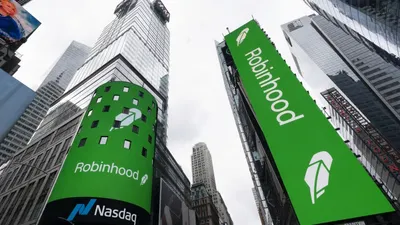
A separate governance proposal will extend Uniswap’s protocol fee infrastructure to Robinhood Chain. The proposal covers Uniswap v2 and v3 deployments on Robinhood Chain, while v4 activation on the network is included in the broader v4 fee proposal.
According to the proposal, Uniswap deployments on Robinhood Chain processed over $6 billion in cumulative swap volume within days of the network’s July 1 mainnet launch. If approved, fees generated on Robinhood Chain will accumulate in a TokenJar before conversion into UNI.
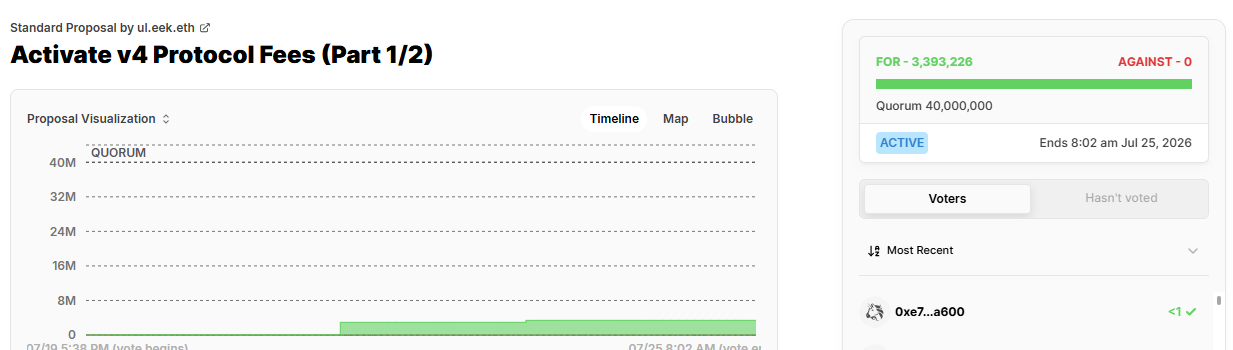
Voting on both proposals began on July 19 and is scheduled to conclude on July 26. Early voting indicates an overwhelming support for both proposals, with 100% of total votes backing the activation of protocol fees.
Source: Uniswap Foundation
UNI burns could accelerate
Uniswap founder Hayden Adams disclosed on X that the new proposals will increase the pace of burns. Adams hinged his forecast on the pace of trading activity on Robinhood Chain, with the blockchain briefly surpassing Ethereum and Base in DEX volumes.
“Both direct all new protocol fees into the existing UNI burn mechanism,” said Adams. “Based on current volumes, especially Robinhood, we expect the impact on UNI burn to be substantial.”
We just submitted two Uniswap governance proposals for final onchain vote:
1) v2 + v3 protocol fees on robinhood chain
2) v4 protocol fees on ethereum, base, arbitrum, robinhood, bnb, polygon, optimism
(third proposal with remaining v4 chains coming soon)
Both direct all new… pic.twitter.com/NUCXxegnte— Hayden Adams 🦄 (@haydenzadams) July 17, 2026
Both proposals build on Uniswap’s UNIfication governance overhaul approved in December 2025. The overhaul introduced protocol fee collection and directed the resulting revenue toward reducing UNI’s circulation supply through token burns.
Protocol fees are active across 11 chains, and governance documents note that the system burned a record 186,000 UNI in a single day last month. While the UNI price did not surge amid the news, previous proposals advancing token burns have sent the asset on a strong rally.