Key highlights:
- TSMC posted stronger-than-expected Q2 2026 results, with revenue climbing 33.7% year-over-year to $40.2 billion and net profit jumping 77.4% to $22.36 billion
- The company plans to invest another $100 billion in the United States, bringing its total U.S. commitment to roughly $265 billion as AI chip demand accelerates
- TSMC also lifted its capital expenditure outlook and forecast another quarter of robust growth, reinforcing confidence that AI infrastructure spending remains far from slowing down
Taiwan Semiconductor Manufacturing Company (TSMC), the world's largest contract chipmaker, has reinforced its position at the center of the artificial intelligence boom after delivering stronger-than-expected second-quarter earnings while announcing plans to expand its U.S. investments by another $100 billion.
The additional investment would increase TSMC's total U.S. commitment to approximately $265 billion, marking one of the largest semiconductor investment programs in American history as governments and technology companies race to secure advanced AI chip production.
The announcement comes as Nvidia, AMD, Apple and other leading technology firms continue relying heavily on TSMC's advanced manufacturing capacity to meet surging AI demand.
AI chip demand fuels another blockbuster quarter
TSMC reported Q2 2026 revenue of $40.2 billion, representing a 33.7% year-over-year increase, while net profit surged 77.4% to $22.36 billion, comfortably beating Wall Street expectations.
The company's gross margin reached 67.7%, slightly above analyst estimates, demonstrating that demand for premium AI chips continues to outweigh supply constraints.
Management also increased its capital expenditure forecast to $60 billion-$64 billion, up from the previous $52 billion-$56 billion guidance.
The company further noted that spending over the next three years will be "even more significantly higher" than during the previous three-year period.
For the third quarter, TSMC expects a revenue between $44.6 billion and $45.8 billion, Gross margin of 65%-67% and an operating margin of 56%-58%
The guidance exceeded market expectations and suggests AI infrastructure investment remains exceptionally strong.
High-bandwidth memory and AI remain the primary growth engines
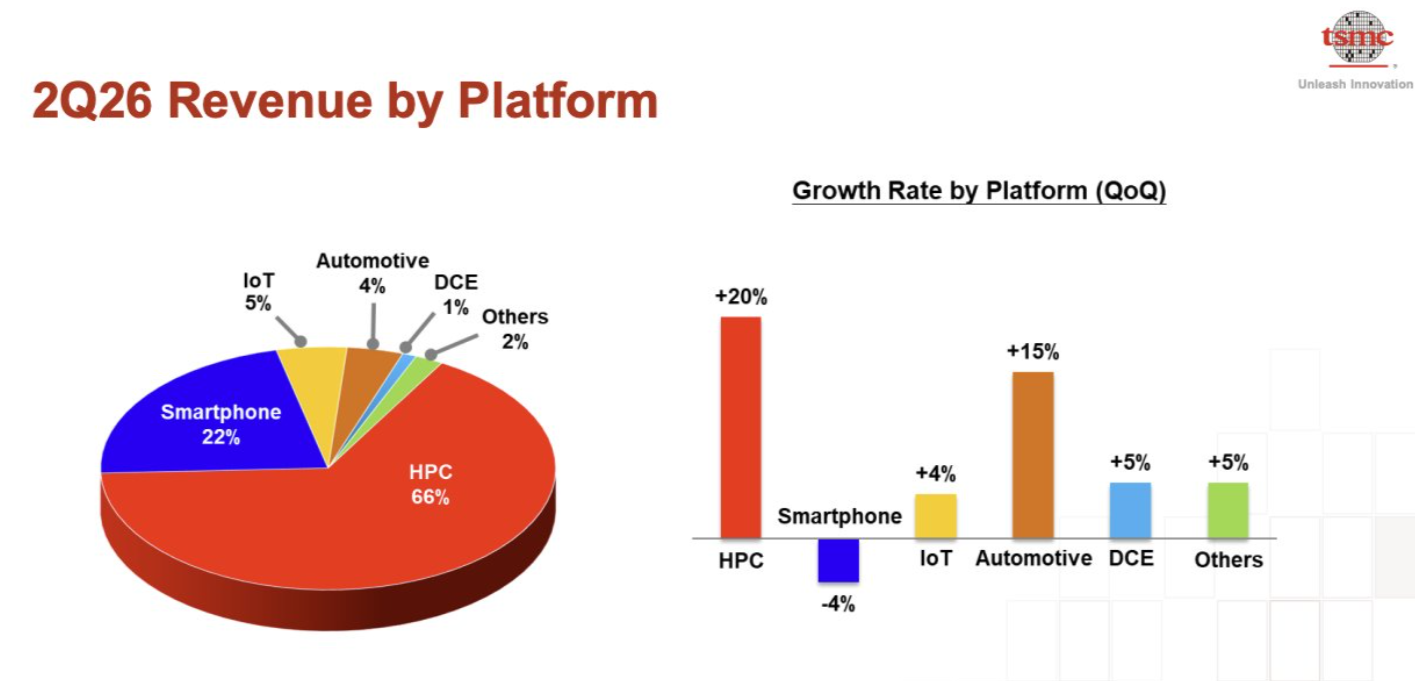
AI-related computing continues to dominate TSMC's business portfolios. According to the company's earnings breakdown, High Performance Computing (HPC) now accounts for 66% of total revenue, growing another 20% quarter-over-quarter.
Other business segments delivered mixed results with smartphone revenue accounting for 22%, Internet of Things contributed 5%, automotive revenue represented 4% and consumer electronics generated 1%.
HPC recorded the biggest gain of +20% while smartphones stood out as the only losing segment.
The figures underscore how rapidly AI chips have become TSMC's primary revenue driver, replacing smartphones as the company's biggest growth catalyst.
Massive U.S. expansion reflects long-term AI confidence
The additional $100 billion investment signals TSMC's confidence that AI demand will remain elevated for years rather than quarters.
The expanded U.S. investment brings the company's total American commitment to approximately $265 billion, supporting new fabrication plants, advanced packaging facilities and semiconductor manufacturing infrastructure.
The expansion also aligns with ongoing efforts by the U.S. government to strengthen domestic semiconductor production while reducing dependence on overseas supply chains.
As AI models continue becoming larger and more computationally intensive, demand for advanced nodes and packaging technologies is expected to remain exceptionally high.
Investors respond positively as TSMC shares climb
Investors welcomed both the earnings report and the stronger guidance.
TSMC stock gained roughly 1.2% during Thursday's trading session in Taiwan, closing around TWD 2,470, extending the stock's strong long-term performance.
The market reaction reflects growing confidence that AI infrastructure spending remains resilient despite broader macroeconomic uncertainty.
For investors, the results reinforce TSMC's position as perhaps the most critical supplier in the global AI ecosystem. With Nvidia, AMD and other AI chip designers continuing to depend on its manufacturing capabilities, the company's expanding investment plans and record capital spending suggest management expects today's AI boom to evolve into a multi-year semiconductor supercycle rather than a short-lived surge.