Solana has rolled out a major network upgrade that more than triples the amount of data developers can include in a single transaction, removing a long-standing constraint as the blockchain competes for more complex applications. Transaction V1 raises the maximum transaction size from 1,232 bytes to 4,096 bytes, opening the door to more sophisticated trades, multisignature wallets, and privacy-focused applications.
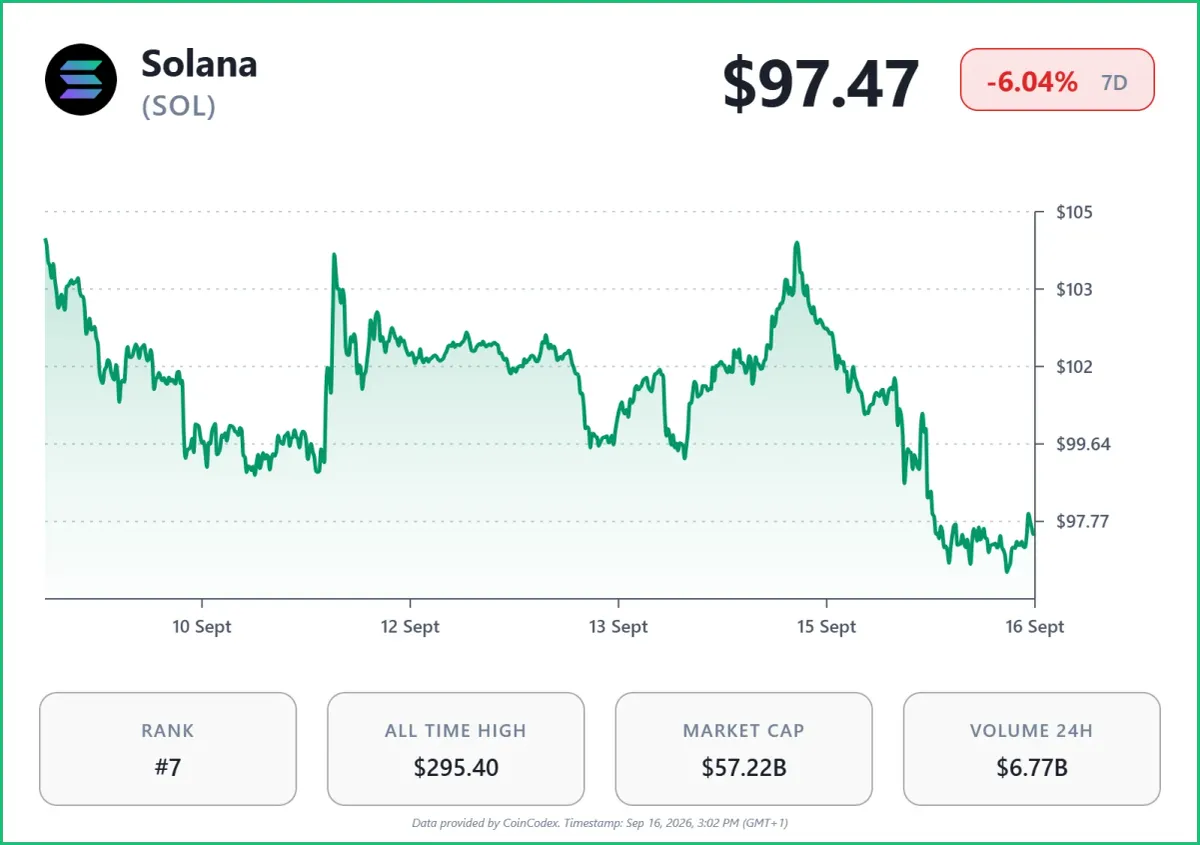
The upgrade arrives at an interesting moment for SOL. Solana is currently trading around $97.41, leaving the token just below the psychologically important $100 level as weaker ETF flows weigh on short-term sentiment. With SOL testing such an important price zone, traders are also watching how Solana top holders are positioned, since large wallet balances can provide additional context around the token's ownership concentration during periods of heightened volatility.
At the same time, network activity continues to provide a more constructive fundamental picture. Solana is expanding its technical capabilities and seeing rapid growth in areas such as tokenized equities even as SOL struggles to regain momentum above $100, creating a notable divergence between the token's price and developments taking place on the blockchain itself.
Solana Transaction V1 Removes a Major Network Constraint
Solana's Transaction V1 format went live on Tuesday at approximately 01:00 UTC, according to the Solana Foundation. The upgrade increases the maximum amount of information contained within an individual transaction to 4,096 bytes, more than three times the previous 1,232-byte ceiling.
Transactions V1 is now live on Solana, increasing max transaction sizes from 1,232 to 4,096 bytes.
Complex operations like ZK proofs, large multisigs, and confidential transfers that required multiple transactions now fit in one.
Full details from @anza_xyz:…— Solana (@solana) September 15, 2026
The change does not increase the number of transactions Solana can process per second. Instead, it allows individual transactions to contain substantially more instructions, signatures, and other information. That distinction is important because Solana's previous limit could force developers to divide complicated operations across several separate transactions.
Transaction V1 makes it possible to package more steps into a single atomic operation. In practical terms, every component of that transaction either succeeds together or fails together. This can be particularly useful for sophisticated trading operations and corporate wallets where several participants need to authorize the same transaction.
Zero-knowledge proofs are another potential beneficiary. These systems can require significant transaction data because they allow applications to verify information without exposing the underlying information itself. Increasing Solana's transaction capacity gives developers considerably more flexibility when building privacy and verification tools directly on the network.
Solana Narrows One of Its Gaps With Ethereum
Solana has traditionally competed with Ethereum through faster execution and substantially lower transaction costs, but the 1,232-byte limit represented a different type of constraint. Ethereum does not impose the same rigid transaction-size ceiling, allowing developers to execute data-heavy operations provided users are willing to pay the required gas fees.
Transaction V1 does not completely eliminate that structural difference. Ethereum retains greater flexibility because its model revolves around the block gas limit rather than a comparable fixed transaction cap. Still, increasing Solana's limit to 4,096 bytes materially reduces the practical gap for developers building more complicated applications.
There is also a transition period attached to the upgrade. Wallet infrastructure, trading platforms, analytics providers, and other services that read Solana blockchain data need to support V1 transactions. Older transaction formats remain available, but applications must still be capable of recognizing the new format when reading transactions and blocks.
The compatibility requirement could produce isolated errors for services that have not yet upgraded. However, those issues would reflect outdated infrastructure rather than a failure of Solana itself.
SOL Price Struggles Below $100 Despite Network Growth
The technical upgrade contrasts with SOL's relatively weak short-term market performance. At $97.41, Solana remains below the $100 psychological threshold that has repeatedly influenced price action during September.
The immediate technical picture leaves SOL in a sensitive position. A sustained recovery above $100 would put the $106 to $110 region back into focus, followed by a more substantial resistance area around $117 to $120. Clearing that zone would represent a much stronger signal that buyers have regained control than simply moving back into triple digits.
Downside risk becomes more significant if SOL loses support around the $97 to $98 area. Previous technical analysis has highlighted $80 to $85 as a potential downside region if the current support structure breaks and selling pressure accelerates.
This leaves SOL effectively caught between two narratives. Price momentum has weakened, but Solana's underlying network continues to expand its technical capabilities.
ETF Flows Cool While On-Chain Adoption Expands
Institutional demand provides another reason for the disconnect. Solana ETFs have accumulated approximately $1.3 billion in net inflows, while Bitwise's BSOL previously became the first U.S. Solana ETF to surpass $1 billion in assets. More recent daily flows, however, have become less consistent, reducing one of the catalysts that helped SOL move above $100 during the previous rally.
At the same time, other areas of the ecosystem continue to expand. The number of addresses holding tokenized equities on Solana reportedly exceeded 800,000 on September 12, compared with approximately 425,000 at the beginning of the month. That represents growth of roughly 88% in less than two weeks.
The combination is notable because SOL's market price is weakening at the same time that some measures of network adoption are accelerating. Whether that activity develops into persistent demand will be more important than the short-term spike itself, but tokenized assets represent one potential source of additional usage as blockchain infrastructure becomes more closely integrated with traditional financial markets.
Can Solana's Network Upgrade Help SOL Reclaim $100?
Transaction V1 does not provide an immediate reason for SOL to rise simply because transactions can now contain more data. Its significance is longer term. By removing a technical constraint that complicated multisignature transactions, privacy applications, and multi-step operations, Solana is giving developers more room to build applications that previously required workarounds.
For investors, the question is whether expanding technical capabilities eventually translate into greater usage, fees, liquidity, and demand for SOL. The rapid growth in tokenized-equity addresses provides an early example of the type of financial activity that could benefit from a network capable of handling increasingly sophisticated transactions.
Price remains the weaker part of the equation. SOL needs to establish itself above $100 before attention can shift convincingly toward $106 to $110 and eventually $120. Failure to defend the current $97 area would instead leave the token vulnerable to a deeper correction.
For now, Solana's fundamentals and market performance are moving in different directions. Transaction V1 strengthens the blockchain's technical foundation at a time when SOL is struggling for momentum, making the $100 level an increasingly important test of whether improving network conditions can eventually translate into renewed investor demand.