Key highlights:
- Zcash gained 5.1% to ~$1,202 as NU7 governance results showed 99.9% of participating ZEC backed cutting block times from 75 to 25 seconds while preserving the existing issuance rate
- Holders also rejected replacing Bitcoin-style halvings with a smooth issuance curve and backed launching NU7 ASAP
- The vote was conducted using homomorphic encryption on a dedicated voting chain, with ballots split into 16 unlinkable pieces
Zcash is gaining momentum as holders back a major network change that would cut block times from 75 seconds to 25 seconds while keeping the privacy coin’s Bitcoin-style halving schedule.
Zcash is up 11% in the last 24 hours and is currently trading at roughly $1,260, in striking distance of its $1,290 cycle high.
Notably, the price move comes as Zcash coinholders delivered a strong vote of confidence in the direction of the network’s upcoming NU7 upgrade.
The Zcash Community Forum’s published NU7 results show nearly 2.4 million ZEC participated in the private governance poll, representing about 66% of the roughly 3.6 million ZEC in the eligible Ironwood pool at the time of the snapshot.
Zcash holders back 25-second blocks while keeping the issuance rate unchanged
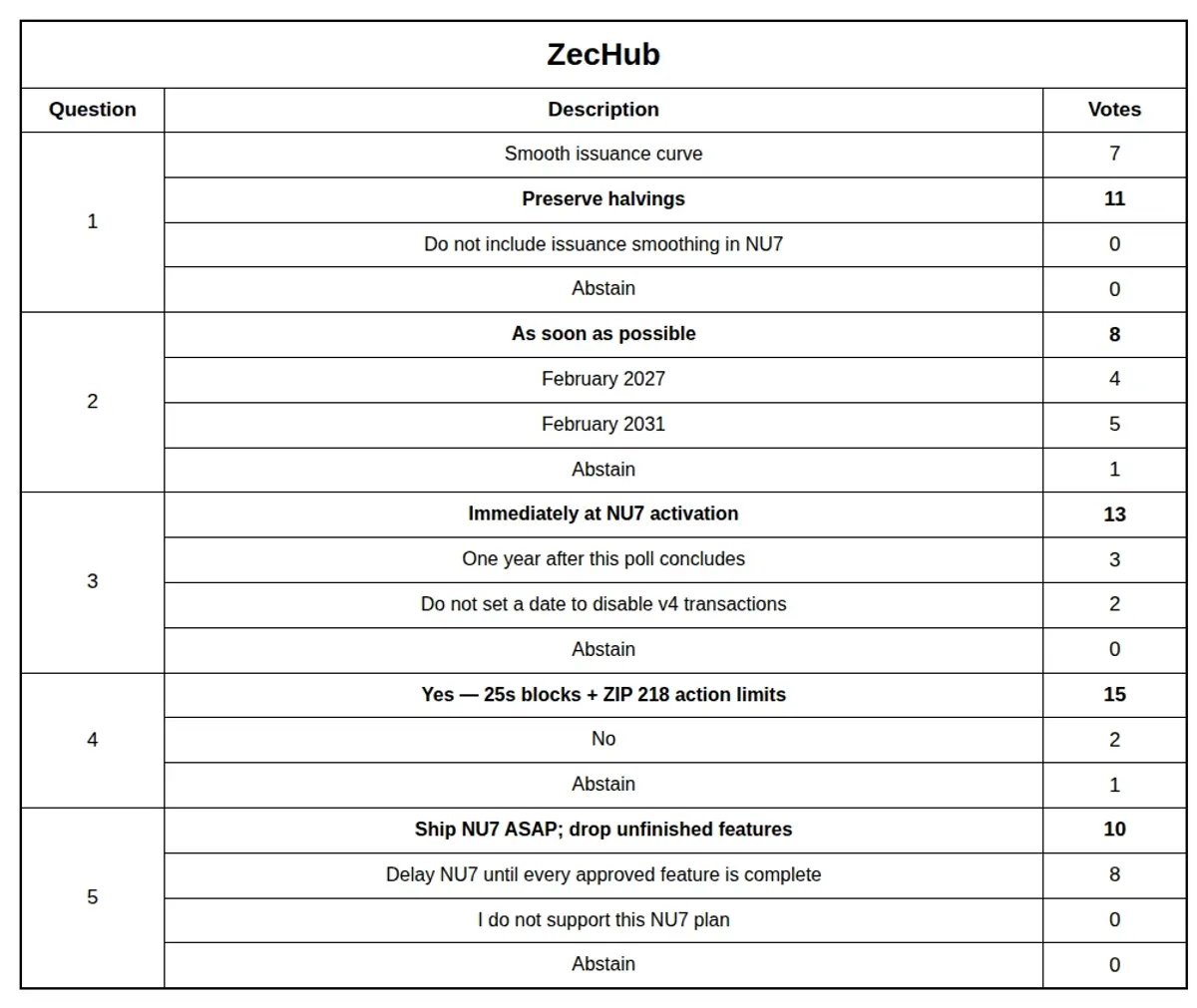
About 99.9% of participating ZEC supported reducing the block target from 75 seconds to 25 seconds under ZIP 218. The change would produce blocks three times more frequently, but it would not create three times as much new ZEC.
Also, the proposed per-block subsidy would be reduced accordingly to preserve the existing issuance rate over time.
The practical effect for users would be shorter intervals between blocks and potentially faster confirmation of transactions.
The zcash coin holder vote results are in!
Record high participation levels, 2.4M zec voted, and for context the pool had 3.6M zec at snapshot height. Record high (66%) levels of participation!
The results!— Dev (@zkDragon) September 14, 2026
The change also fits into broader development work aimed at improving the speed of Zcash’s shielded transactions, an important consideration for a network built around private payments.
Notably, coinholders also rejected a proposal to replace the existing Zcash halving structure with a smoother issuance curve. Roughly 98.9% of participating ZEC backed keeping the scheduled halvings, thereby preserving one of Zcash’s closest links to Bitcoin’s monetary design.
The alternative, outlined in ZIP 234, would gradually reduce the block subsidy instead of relying on larger predetermined cuts.
However, under a halving model, the amount of newly issued cryptocurrency paid to miners falls at predetermined intervals.
Support for keeping that structure means the majority of participating ZEC favored predictable supply reductions over a continuously declining issuance curve.
Holders back NU7 upgrade, but why delay the return of ZEC?
The governance vote also showed strong support for advancing the NU7 upgrade rather than waiting for every proposed feature to be completed.
About 99.3% of participating ZECs backed launching the upgrade as soon as possible while dropping unfinished features after the September 30 readiness deadline.
Participants also supported disabling version 4 transactions and remaining Sprout functionality with NU7.
Sprout deposits are already disabled, while the Sprout pool holds fewer than 23,000 ZEC, and version 4 transactions account for less than 0.1% of transaction volume.
Another important result from the voting process is that Zcash holders also backed delaying the return of ZEC removed from circulation through the Network Sustainability Mechanism (NSM), with 96.6% of participating ZEC supporting February 2031 as the start date for reissuance.
The NSM is designed to remove at least 60% of transaction fees from circulation and potentially return those coins through future block rewards without increasing Zcash’s maximum supply.
Coinholders favored allowing the mechanism to accumulate for several years before reissuance begins.
Zcash used a privacy-focused voting system
Another notable aspect was how the Zcash ecosystem conducted the vote. The process was built around Zcash’s privacy technology, allowing voting power to reflect economic stakes without publicly linking a voter’s balance to their ballot.
Valar Group created a dedicated voting chain using homomorphic encryption, allowing validators to calculate the aggregate result without exposing individual votes.
Each vote was divided into 16 unlinkable pieces, while at least 10 validators held separate decryption key shares. Two thirds of the shares were required to recover the final tally.
Project Tachyon, Valar Group, the Zcash Foundation, Zodl, and Shielded Labs participated in the coordinator structure, while Vizor and Zodl supported voting through their wallets.
The system became possible after Zcash activated Ironwood in July, replacing the Orchard shielded pool and introducing stronger supply controls. Only spendable shielded funds held in Ironwood at the Aug. 24 snapshot were eligible to vote.
Following the mixed result, representatives agreed to target February 2031 for implementation, while leaving open the possibility of another vote for an earlier launch.
The poll does not immediately change Zcash’s consensus rules. Developers must still finalize the technical specifications, implement and test the changes, and determine the activation parameters.