Key highlights:
- JPMorgan upgraded IREN to Overweight with a $65 price target, citing its vertically integrated neocloud model, Nvidia partnership, and rising pricing
- IREN raised its 2026 ARR target to $4B with operating ARR at ~$1B, backed by $3.6B in Microsoft-linked GPU financing and $2.8B for other deployment
- IREN plans to fully exit mining by December 2026 as hashprice has fallen to $38.56/PH/s from $53 a year ago
JPMorgan has turned more bullish on IREN Ltd., upgrading the Bitcoin miner-turned-AI infrastructure company to Overweight and raising its price target to $65 from $46, as the bank sees stronger prospects for its growing AI cloud business.
The upgrade came as IREN continued to shift its business away from Bitcoin mining and toward supplying computing infrastructure for artificial intelligence companies.
JPMorgan analyst Richard Choe said IREN is establishing itself as a “top-tier” neocloud provider, helped by its strategic partnership with Nvidia and a growing list of AI customers.
JPMorgan sees 48% upside for IREN as AI infrastructure demand grows
IREN shares closed at $43.83 on September 11, up 0.44%, putting JPMorgan’s new price target at roughly 48% above the stock’s latest close.
The stock had gained about 5% over the previous five trading sessions and 10.46% over the past month. However, shares fell about 4% in premarket trading on September 14 to $42.08 at 9:25 a.m. EDT as technology and AI-related stocks came under broader pressure.
JPMorgan’s bullish view is largely based on IREN’s shift from Bitcoin mining toward artificial intelligence infrastructure. The company is repurposing infrastructure built for Bitcoin mining to meet growing demand for AI computing.
IREN operates a vertically integrated model, controlling land and power connections while developing data centers, purchasing GPUs, and operating the computing infrastructure it provides to customers.
JPMorgan sees that structure as an advantage because IREN controls more of the infrastructure chain than companies that depend heavily on third-party data centers.
The bank also expects stronger pricing in the neocloud market to support IREN’s expansion.
JPMorgan said pricing has risen from roughly $10 to $15 per watt to between $15 and $20 per watt, depending on factors such as GPU generation, delivery timelines, and contract length.
The bank expects IREN’s planned 0.5 gigawatt expansion for 2027 could command prices above the $12 to $15 per watt range of some earlier agreements.
IREN has raised its 2026 annual recurring revenue target to $4 billion from $3.4 billion. Its operating ARR has already reached about $1 billion, while the company has delivered the first of four 50-megawatt buildings under its Microsoft agreement.
IREN has signed $2.8bn in new multi-year AI Cloud services contracts with leading AI developers and raised its year-end 2026 AI Cloud ARR target from $3.7bn to over $4.0bn.
“Our vertically integrated AI Cloud platform is scaling at pace. In the past 12 months we have expanded… pic.twitter.com/sdSXp3zAFx— IREN (@IREN_Ltd) July 20, 2026
Notably, the remaining 150 megawatts are expected to be delivered by the end of 2026. Its customer base has also expanded beyond Microsoft and Nvidia to include Perplexity, Together AI, Cohere, Figure AI, Fluidstack, Hume AI, Fireworks AI, Fal AI, and Higgsfield.
IREN has also signed a multi-year agreement with a leading frontier AI laboratory.
Can IREN’s AI cloud push offset falling Bitcoin mining economics?
IREN’s shift toward AI is reshaping its revenue mix, with AI Cloud Services revenue jumping 110% sequentially to $70.5 million in the fiscal fourth quarter, while Bitcoin mining revenue fell 40% to $66.7 million.
Total revenue reached $137.2 million, down from $144.8 million in the previous quarter but above the $100 million estimate from Compass Point.
“The digital world scales almost instantly. The physical world does not.” @danroberts0101, Co-Founder and Co-CEO.
FY26 marked a significant step forward in IREN’s AI Cloud expansion.
We secured new multi-year AI Cloud contracts, including with a leading frontier AI lab, and now… pic.twitter.com/VhLQaOKV7J— IREN (@IREN_Ltd) August 30, 2026
The transition came with significant costs, as IREN reported a $684 million net loss, largely due to a $450.4 million noncash impairment charge tied to mining hardware. Adjusted EBITDA also fell 67.7% to $19.2 million.
Despite the losses, IREN plans to invest $25 billion to $30 billion in fiscal 2027, with a data center pipeline exceeding 5 gigawatts.
The company has also secured billions in GPU financing, including $3.6 billion linked to its Microsoft agreement and another $2.8 billion for other deployments.
IREN’s strategy reflects a broader shift among publicly traded Bitcoin miners, with companies such as Core Scientific, TeraWulf, and Hut 8 increasingly using their access to power, land, and data center infrastructure to pursue AI and high-performance computing opportunities as Bitcoin mining economics become more challenging.
A year ago in September, Bitcoin’s hashprice was above $53 per PH/s per day, but it has since fallen to $38.56, while network difficulty currently stands at 127.45 trillion.
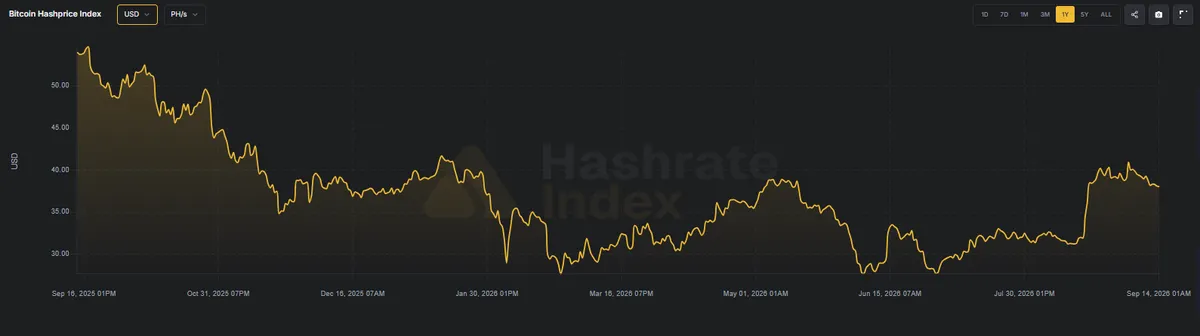
Notably, IREN still has exposure to Bitcoin mining, but management plans to wind down the business by December 2026 as AI cloud becomes its primary growth engine.