Key highlights:
- August CPI matched at 3.4% YoY, but core came in at +0.3% MoM, pushing Sept. Fed hike odds to 87%
- Brent at $105 and U.S. diesel hitting $6/gallon complicate the Fed's call as energy drove 1/3 of August's monthly CPI gain, with gasoline up 27.4% YoY
- Bitcoin recovered to $79K (+2.7% daily); analysts flag $80K as the key trigger, and a 5% break above could force ~$1.56B in dealer buying
Bitcoin price climbed back near $80,000 on Friday after the latest U.S. inflation report showed headline consumer prices rising in line with expectations, although a hotter-than-expected monthly core reading kept pressure on the Federal Reserve ahead of its September policy meeting.
Bitcoin (BTC) was trading around $79,080, up 2.7% over the previous 24 hours, after recovering from a move below the $77,000 level.
The cryptocurrency gained about 1.3% in the hour following the latest market moves and remained close to the psychologically important $80,000 mark.
Ethereum (ETH) also recovered above $2,500, while Solana (SOL) moved back above $100.
CPI bata boosts crypto recovery, but could higher core inflation change the Fed’s plans?
The crypto market recovery came as the U.S. Bureau of Labor Statistics reported that consumer prices increased 0.4% in August and were 3.4% higher than a year earlier, matching economists' forecasts.
Core CPI, which excludes food and energy, increased 0.3% month over month, above the 0.2% expected. However, the annual core rate eased to 2.4% from 2.5%, matching forecasts and reaching its lowest level since 2021.
The report followed Thursday’s Producer Price Index (PPI), which rose 5.4% year over year, slightly above the 5.3% forecast and triggered a market selloff.
While headline inflation was in line with expectations, the stronger monthly core reading added to concerns that underlying price pressures remain sticky.
Traders subsequently increased their expectations for a 25 basis point Federal Reserve rate hike at the September 15 to 16 meeting.
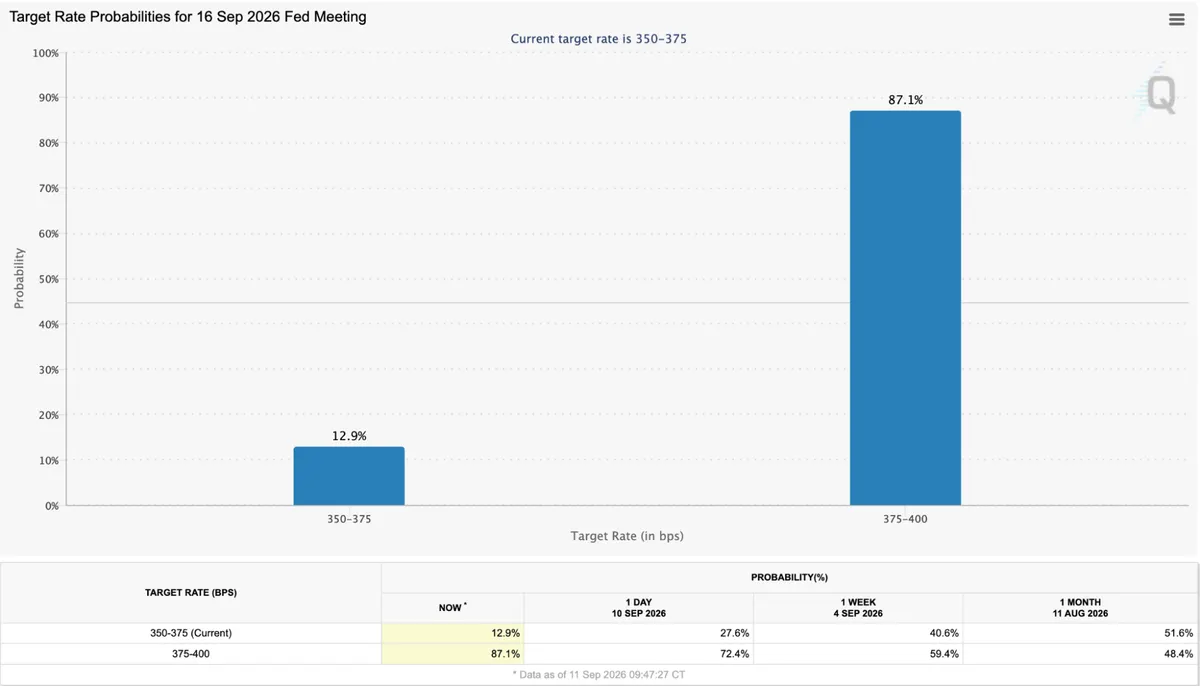
CME FedWatch showed the probability of a 25-basis-point increase rising to around 87.1% on Friday, up from 72.4% a day earlier and 59.4% a week ago.
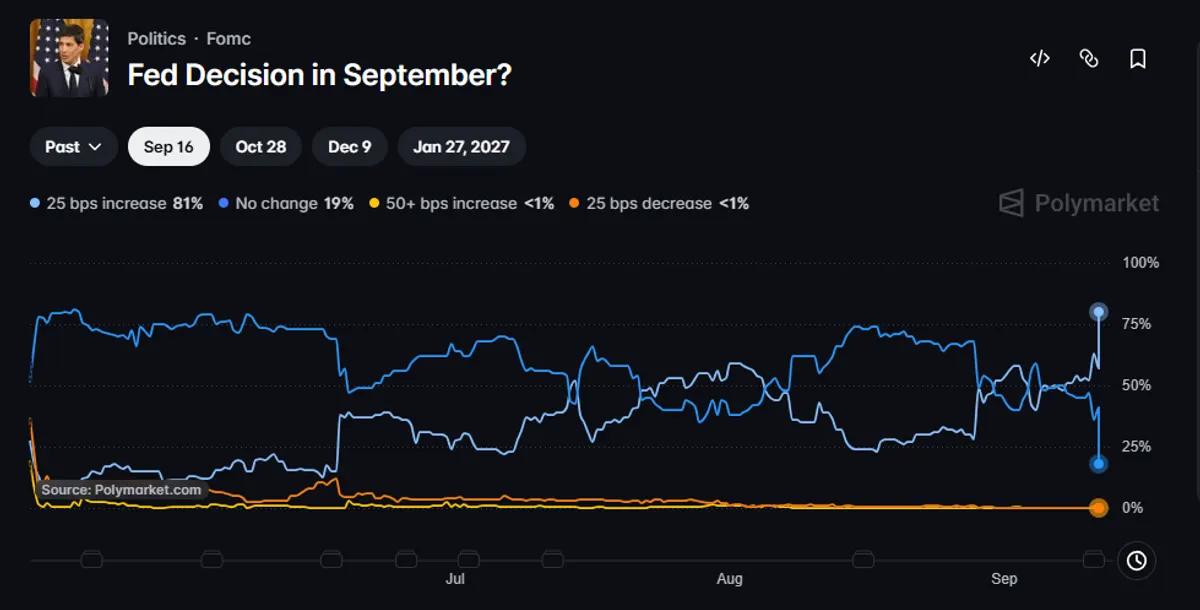
Polymarket traders put the probability around 80%, with more than $113 million in trading volume tied to the question.
The possibility of a rate increase matters for Bitcoin and crypto in general, because changes in U.S. interest-rate expectations can quickly alter the flow of capital into risk assets.
Higher rates can strengthen the dollar and make interest-bearing assets more attractive, while expectations for easier monetary policy have historically provided a more supportive backdrop for assets such as cryptocurrencies.
Oil shock puts Fed in a difficult spot as inflation heats up
The prospect of a Federal Reserve rate hike is gaining attention as rising energy prices add to inflationary pressure. Any increase would be the first since July 2023.
The federal funds rate has remained at 3.5% to 3.75% in 2026, although three Federal Open Market Committee members previously backed a hike at the July meeting.
Energy prices were a major driver of August inflation. The energy index rose 2.1%, while gasoline prices jumped 3.9%, accounting for more than one-third of the monthly increase in the consumer price index. Gasoline prices were up 27.4% from a year earlier, while fuel oil prices surged 52%.
The pressure has intensified in recent days as oil prices moved above $100 a barrel. Brent crude traded around $105, while U.S. crude approached $100. U.S. diesel prices also reached $6 a gallon for the first time.
The surge creates a difficult choice for the Fed, as higher interest rates could help cool demand and broader inflation but would do little to address an energy-driven supply shock that could also weigh on economic growth.
Core inflation, which excludes food and energy, will therefore remain important for policymakers as they assess whether rising energy costs are spreading to other parts of the economy.
The latest data could ultimately determine whether the Fed views the inflation increase as a temporary energy shock or a broader price threat requiring tighter monetary policy.
Stocks rise despite inflation concerns as Bitcoin nears $80,000, what comes next?
Markets remained resilient despite signs that inflation could keep pressure on policymakers to maintain higher interest rates.
The S&P 500 rose 0.87%, while the Dow Jones gained 0.97% and the Nasdaq 100 advanced 0.77%. Falling oil prices helped support equities, while the 10-year Treasury yield slipped 4.1 basis points to 4.922%.
Technology stocks also gained as Oracle rose more than 2% after reporting a 121% jump in cloud infrastructure sales to $7.4 billion, while Dell climbed more than 8% on expectations of strong AI infrastructure demand.
Bitcoin also extended its recovery, trading around $78,700 and approaching the closely watched $80,000 level. BTC remains 37.3% below its $126,080 all-time high but has gained 23.1% over the past 30 days.