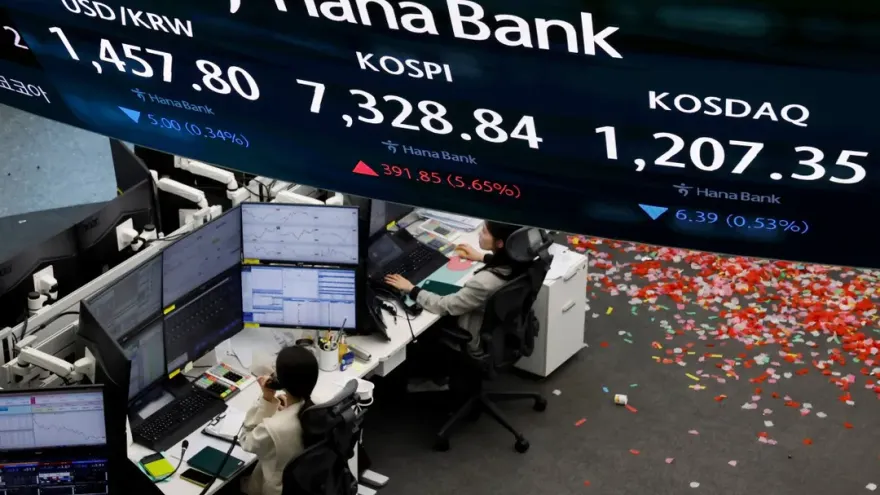
Key highlights:
- Goldman held its KOSPI 12,000 target, projecting ~360% earnings growth in 2026, with SK Hynix (+157%) and Samsung (+106%) leading gains.
- South Korea's semiconductor exports surged 169.6% YoY to $281B in 8 months, with August alone hitting a record $46.65B (+209%).
- SK Hynix investing $720B through 2034, with CXMT competition and U.S. data center pushback as key risks.
Goldman Sachs is maintaining its bullish 12,000 target for South Korea’s KOSPI, arguing that investors may be underestimating how long the artificial intelligence-driven memory semiconductor cycle can support corporate earnings.
The call comes after a sharp pullback in the Korean stock market from its June record, where it topped 9,264, with concerns about the sustainability of global AI spending adding to volatility.
Goldman Sachs Asia-Pacific equity strategist Timothy Moe, however, has kept the target he set three months ago, saying the outlook is primarily supported by the earnings that Korean companies are expected to deliver.
“We’re still holding to it—it's driven by what we think will be earnings delivery,” Moe said in an interview Friday. “The market is underpricing the duration of this earning cycle.”
KOSPI at 6,899: What could drive the index to Goldman Sachs’ 12,000 target?
At the time of writing, KOSPI was trading around 6,995, meaning the index would need to gain roughly 74% to reach 12,000.
Despite the decline to 5,531 in July, the benchmark remains up about 65% in 2026. Much of that performance has been tied to South Korea’s two semiconductor giants, SK Hynix and Samsung Electronics.
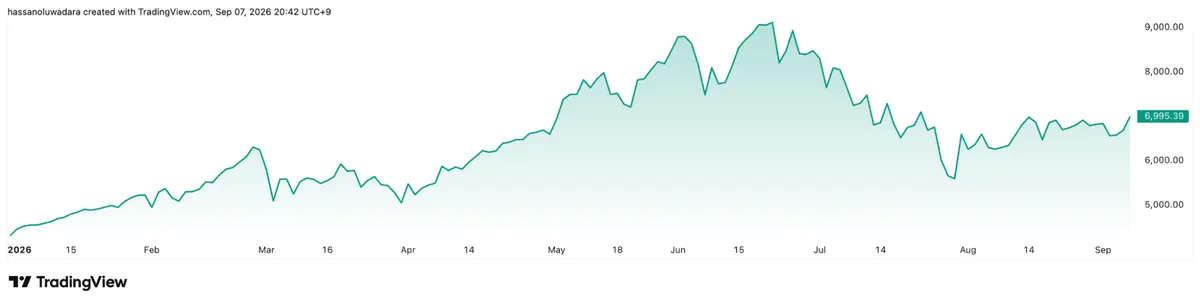
KOSPI yearly chart. Source: TradingView
SK Hynix has gained about 157% this year, while Samsung Electronics has more than doubled, rising about 106%.
Moe’s argument centers on the companies’ earnings outlook and the role of memory chips in the global AI infrastructure buildout.
Goldman Sachs estimates earnings growth of roughly 360% this year for KOSPI companies, followed by growth of about 35% in 2027.
The strategist said the eventual moderation in earnings growth is already understood by investors, while the market may still be underestimating the length of the current cycle.
The valuation gap is another part of the Goldman case, with Moe’s 12,000 KOSPI target based on 7.5 times forward earnings, compared with about 5.3 times for the index currently.
That multiple is roughly half the KOSPI’s seven-year average, according to the information provided.
South Korea's chip exports explode as AI data centers drive demand for HBM
Notably, the earnings outlook is increasingly tied to the spending plans of major U.S. technology companies, with AI infrastructure investment expected to remain a major driver of semiconductor demand.
Moe estimates that Big Tech could spend more than $1.2 trillion next year, well above earlier forecasts of about $800 billion.
Much of that spending is expected to flow into computing infrastructure, boosting demand for the memory chips needed to power AI servers.
The impact is already visible in South Korea’s trade data, as the country’s exports reached $709.4 billion in the first eight months of 2026, surpassing the full-year record of $709.3 billion set in 2025.
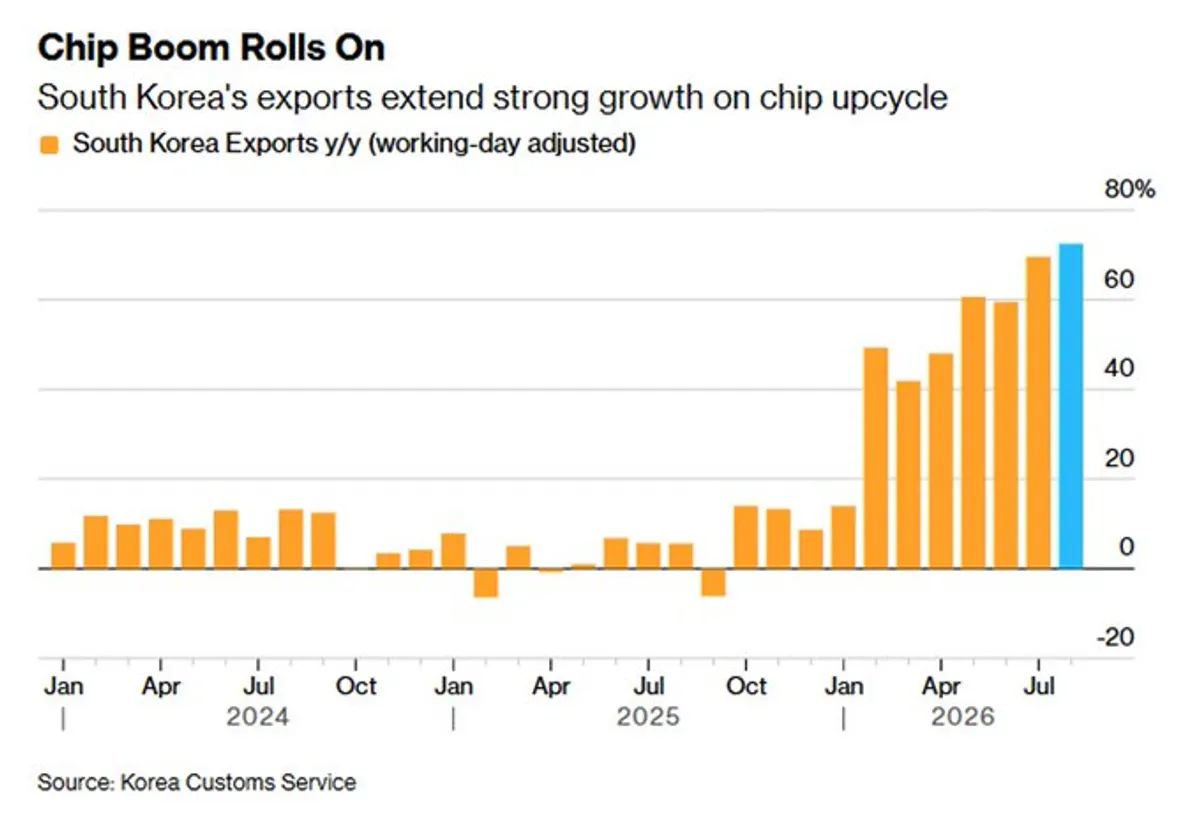
Semiconductor exports surged 169.6% year over year to $281 billion, accounting for roughly 41% of total exports.
The momentum accelerated in August, when semiconductor exports hit a record $46.65 billion, up 209% from a year earlier, according to the Ministry of Trade, Industry and Energy.
Additionally, chips accounted for 47.5% of South Korea’s total exports of $98.25 billion that month.
The surge has been fueled by demand for high-bandwidth memory, or HBM, alongside server DRAM and other memory products used in AI data centers. HBM is particularly critical because it enables AI accelerators to process large volumes of data at high speeds.
SK Hynix and Samsung remain key suppliers. Counterpoint Research estimates SK Hynix held a 58% share of the HBM market in the first quarter, while Samsung and Micron each held 21%, showing South Korea’s growing importance to the global AI hardware supply chain.
Memory prices could surge 17% as AI demand squeezes global supply
Goldman Sachs expects average DRAM selling prices at Samsung Electronics and SK Hynix to rise about 17% in the third quarter from the previous quarter, reflecting increasingly tight memory supply.
Also, spot prices for DDR4 and DDR5 RAM also remained above contract prices in August, signaling strong demand.
KB Securities warned that the memory market could face its tightest supply conditions yet as hyperscalers accelerate AI infrastructure spending.
The brokerage estimates global hyperscaler AI investment could reach $1.3 trillion next year, while Samsung and SK Hynix entered the third quarter with memory inventories below 10 days of supply.
The rollout of next-generation HBM4 memory could further pressure supply because it requires significantly more wafer capacity than conventional DRAM.
As chipmakers prioritize advanced memory for AI systems, less capacity could remain for other products.
South Korean manufacturers are responding with major investments as SK Hynix has outlined a $720 billion infrastructure expansion through 2034, while Samsung continues to expand its domestic semiconductor operations.
Still, Goldman’s outlook faces risks from rising competition from China’s ChangXin Memory Technologies and potential U.S. resistance to rapid data center expansion.
With Samsung and SK Hynix among the KOSPI’s largest companies, sustained AI demand and higher memory prices could be crucial to Goldman’s 12,000 KOSPI target through 2027.