Key highlights:
- Bitcoin slipped below $81K after August payrolls hit 162,000, nearly 3x the 55,000 forecast, pushing Sept. rate hike odds from ~49% to ~60%
- PPI (Sept. 10) and CPI (Sept. 11) are the key catalysts as a hotter print reinforces hikes; a softer one gives risk assets room to recover
- $1B in weekly ETF inflows cushions the drop, but BTC remains ~36.8% below its $126,080 ATH ahead of the Fed's Sept. 15-16 decision
Bitcoin slipped below $81,000 as traders reassessed the outlook for U.S. interest rates following a stronger-than-expected jobs report, shifting attention to this week’s inflation data and the Federal Reserve’s September policy meeting.
Bitcoin had climbed above $82,000 last week, reaching about $82,178.60 on Thursday and an intraday high of $82,262.21 in the following session.
However, the stronger jobs data triggered selling pressure, pushing BTC back below $80,000.
As at the time of writing, BTC was trading around $79,693.52 on Sept. 7, little changed over 24 hours after reaching $80,491.65 earlier in the session.
Trading volume rose about 11% to $21.69 billion, showing increased activity around the closely watched $80,000 level.
U.S. jobs blow past forecasts as traders raise Fed rate hike bets
The U.S. economy added 162,000 jobs in August, nearly three times the median forecast of 55,000 from major Wall Street banks, strengthening expectations that the Federal Reserve could keep interest rates higher for longer.
The unemployment rate held at 4.1%, while average hourly earnings rose 0.3% in August and 3.1% from a year earlier. Revisions to June and July data also added 55,000 jobs to the previously reported figures.
The stronger-than-expected report pushed traders to raise their expectations for another Federal Reserve rate hike at the Sept. 15-16 meeting.
CME FedWatch data showed the probability of a hike rising to about 60%, from 49% before the jobs report, while other market measures later put the odds near 57%.
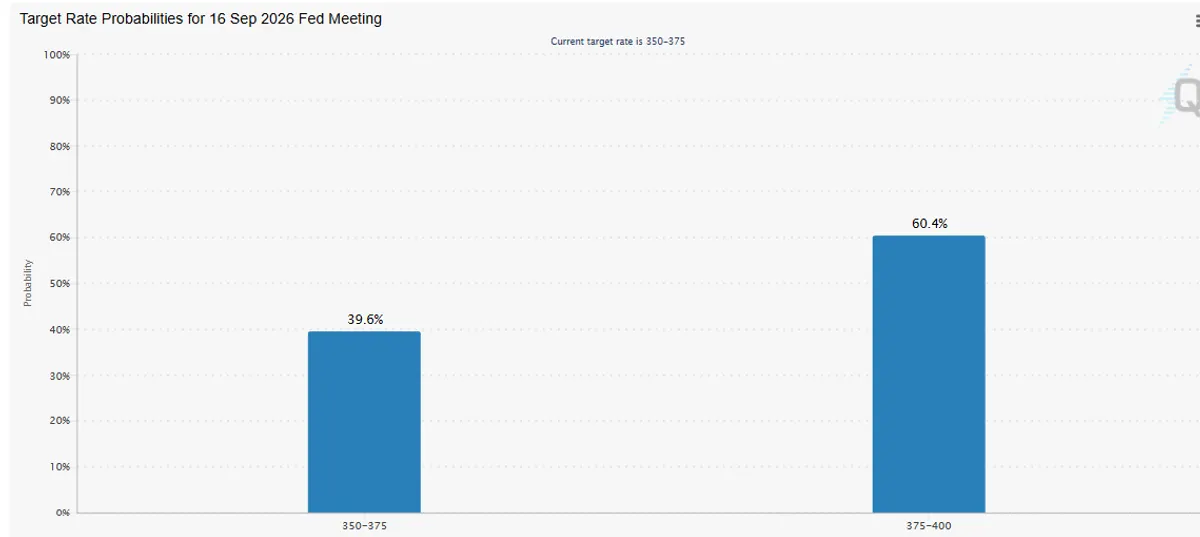
The market is estimating the odds of a Fed hike rate in September at 60.4%. Source: CME FedWatch Tool
This change is significant for Bitcoin because interest rate expectations influence how investors allocate capital between riskier assets and yield-bearing investments.
Higher rates can make bonds more attractive while increasing borrowing costs and tightening financial conditions, potentially weighing on cryptocurrencies.
Bitcoin’s response to the jobs data therefore reflects its implications for monetary policy rather than the employment figures alone. A resilient labor market could give the Fed greater room to maintain restrictive policy if inflation remains above its 2% target.
Markets will now turn to inflation data for further clues as the Producer Price Index is due Thursday, Sept. 10, followed by the Consumer Price Index on Friday, Sept. 11.
Notably, Reuters economists expect headline CPI to rise 0.4% month over month in August, with core CPI increasing 0.2%.
Oil is nearing $100 as Bitcoin faces a critical inflation test
The upcoming inflation data could become a major catalyst for Bitcoin as markets reassess the Federal Reserve’s path ahead of its September policy meeting.
A hotter-than-expected reading could strengthen expectations for tighter monetary policy, putting pressure on BTC as traders increase bets on a September rate hike.
Conversely, softer inflation, particularly evidence that price pressures are continuing to ease, could reduce those expectations and give risk assets room to recover.
The latest July data showed core CPI rising 2.5% year over year, down from 2.59% in June, while headline CPI stood at about 3.4%. Both measures remain above the Fed’s 2% inflation target, making the August figures important ahead of the Sept. 15-16 meeting.
The Fed is expected to have August employment, PPI, and CPI data available when it meets, along with updated economic and interest-rate projections.
The August Personal Consumption Expenditures report, however, is not due until Sept. 30, meaning it will come after the policy decision and could instead shape expectations for subsequent meetings.
Oil prices are adding to the inflation uncertainty as Brent crude was trading near $97 a barrel on Monday as tensions between the U.S. and Iran raised concerns over potential supply disruptions.
Higher energy costs could feed into inflation and complicate the Fed’s policy outlook if businesses pass higher expenses on to consumers.
Markets are already reacting to changing rate expectations, with Treasury yields rising after the latest jobs report.
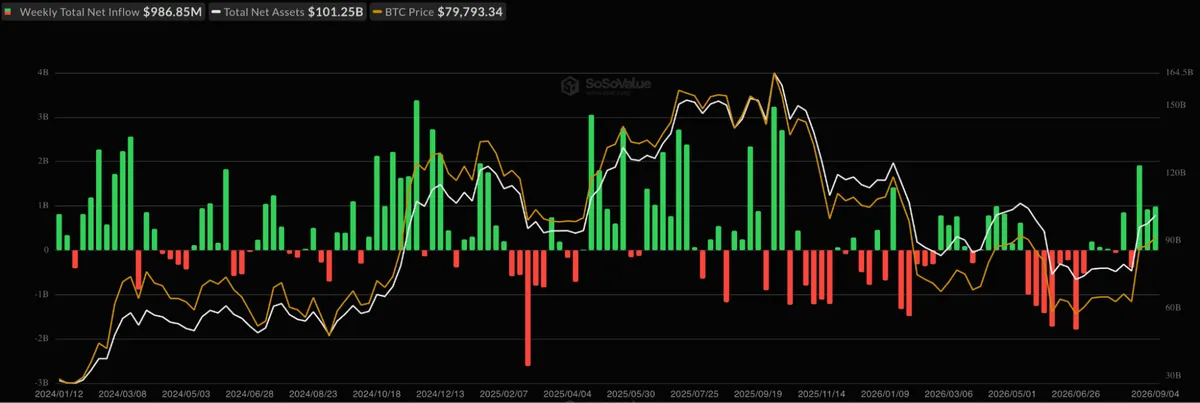
Weekly Bitcoin ETF flows. Source: Sosovalue
However, institutional demand remains a potential buffer for Bitcion, as U.S. spot Bitcoin ETFs recorded roughly $1 billion in net inflows last week, according to SoSoValue.
This inflow provides a source of demand as investors weigh inflation, interest rates, and broader macroeconomic risks.
Bitcoin is recovering fast, but can it finally break this key resistance?
Bitcoin enters the week with significant ground to recover, trading around $79,693, roughly 36.8% below its all-time high of $126,080.
Still, BTC has gained 2.8% over the past seven days, 3.8% over 14 days and 22.8% over 30 days, suggesting the recent pullback remains part of a broader monthly recovery.
Technical indicators also point to improving momentum as Bitcoin has reclaimed its 50-day EMA near $71,713, while resistance around $79,388 remains the immediate hurdle.
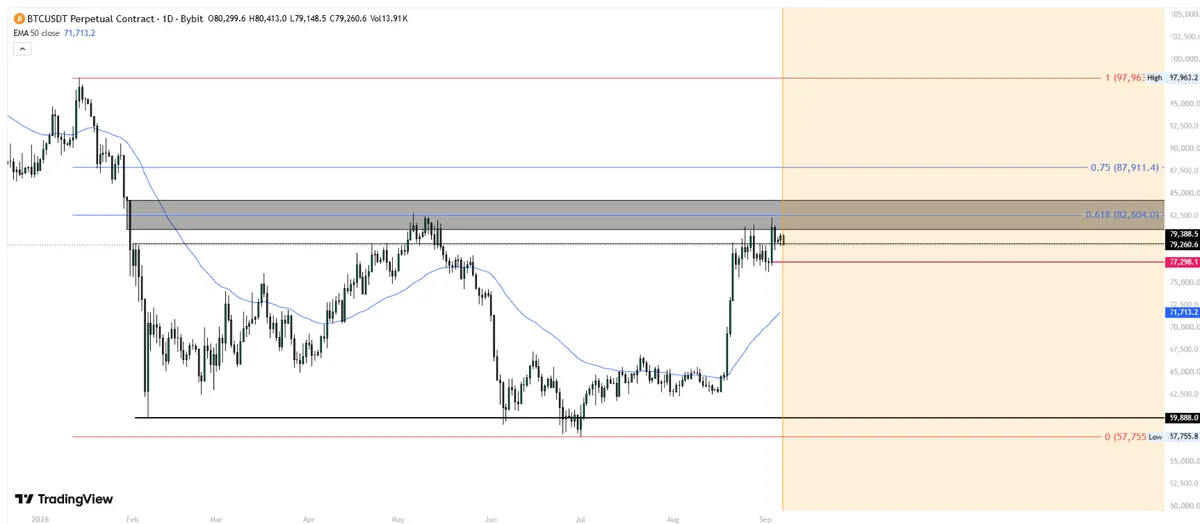
Source: TradingView
A daily close above that level could open the path toward the $82,604-$87,911 Fibonacci zone, while a break below $77,298 could expose the market to a deeper retest of the 50-day EMA.
The recovery follows a major deleveraging event in Bitcoin futures, with CryptoQuant analyst Darkfost described the episode as the sharpest deleveraging phase since 2023 and the largest liquidation event of the current market cycle.
Binance’s Bitcoin futures open interest also briefly fell below its 180-day average before recovering as open interest currently stands near $9.6 billion, above the $8.3 billion average.
For traders, attention now shifts to inflation and its potential impact on Federal Reserve policy.