Key highlights:
- Oura filed its S-1 targeting a $16B+ valuation and $3B raise, backed by 74% revenue growth to $1.21B, with membership revenue surging 121% to $240.5M
- The subscription flywheel is the key driver: 5M paid members (doubled YoY), ~85% retention, and 3.1M rings sold
- Key risks: Ring 4 battery defects ($84.4M warranty costs), a sleep-tracking accuracy lawsuit, and rising competition from Samsung, Apple, and Garmin
Oura is preparing to enter the U.S. public markets as investor interest in fast-growing technology companies rebounds.
The Finnish-founded health technology company publicly filed its Form S-1 registration statement with the U.S. Securities and Exchange Commission on Thursday, seeking to list on the Nasdaq Global Select Market under the ticker OURA.
The planned listing will put Oura’s growth and financial performance under greater public scrutiny, while raising questions about whether the smart-ring maker can sustain a valuation of more than $16 billion as it transitions from private to public markets.
Oura’s road to a $16 billion valuation runs through 5 million paid members
Although Oura has not disclosed the number of shares it plans to sell or set an IPO price range, reports surrounding the filing suggest the offering could raise up to $3 billion and value the smart-ring maker at more than $16 billion.
That would mark a significant increase from its roughly $11 billion valuation following an $875 million funding round last year.
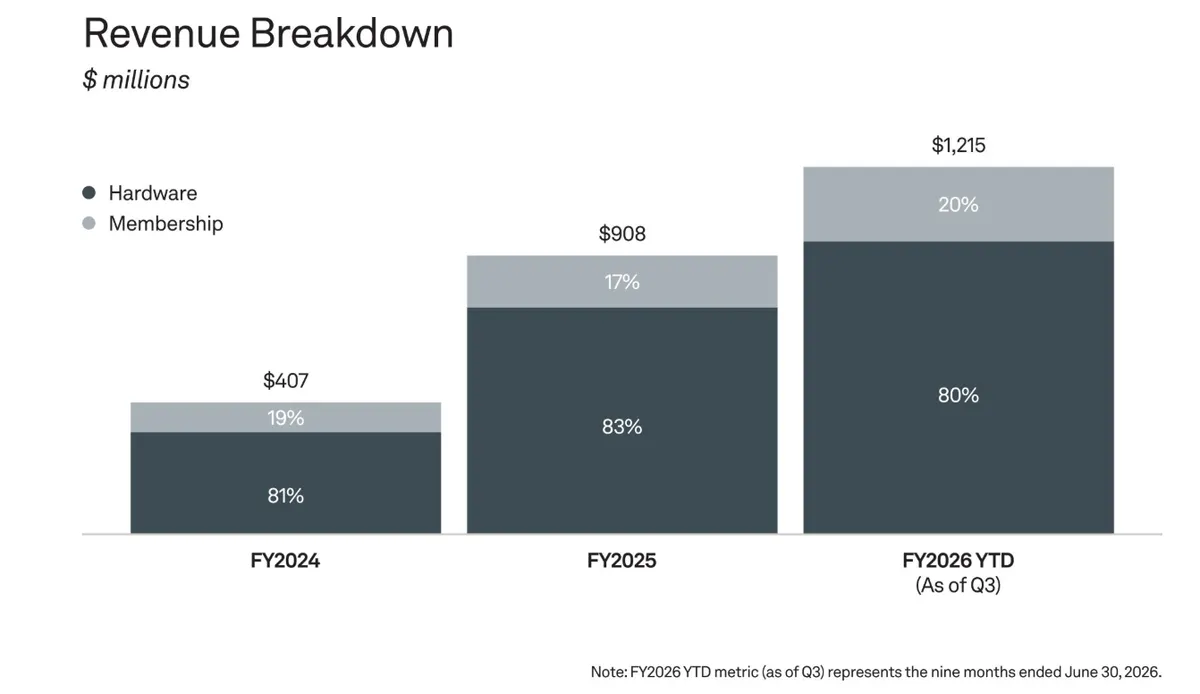
The company’s latest financial results help explain the investor interest. Oura generated $1.21 billion in revenue during the nine months ended June 30, 2026, up 74% from $697.6 million a year earlier.
Source: SEC
Notably, hardware accounted for most of that revenue at about $974 million, while membership revenue more than doubled to $240.5 million.
The subscription business has become an increasingly important part of Oura’s growth story. The company had 5 million paid members as of June 30, up from 2.5 million a year earlier.
Membership revenue increased 121% year over year and carried an 89% gross margin, providing Oura with a recurring revenue stream that resembles a software business more than traditional consumer hardware.
U.S. members pay $5.99 per month or $69.99 annually, with about 63% of new members choosing annual plans. Oura also reported roughly 85% 12-month paid-member retention.
Hardware sales remain the company’s primary growth driver. Oura sold 3.1 million rings in the first nine months of fiscal 2026, compared with 1.8 million during the same period a year earlier.
The company has also expanded distribution through retailers, including Amazon, Best Buy, Costco, and Target, which accounted for about 49% of hardware revenue.
Financially, Oura reported $60.8 million in net income, up from $1.6 million a year earlier, while adjusted EBITDA reached $106.7 million. Operating cash flow more than doubled to $328 million.
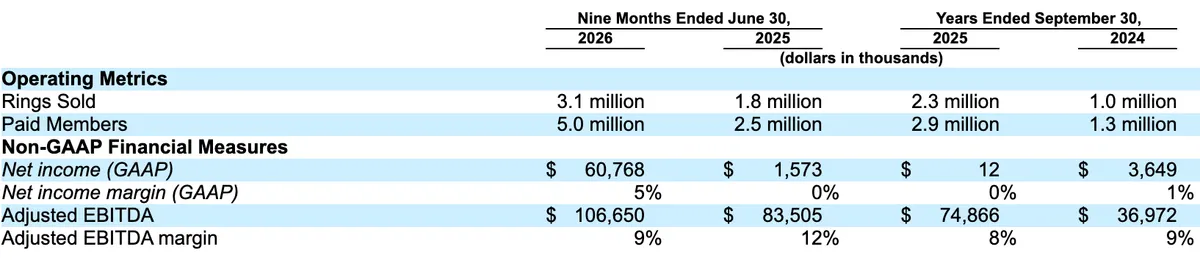
However, the filing also reported a $924.3 million net loss attributable to common stockholders, largely driven by a $985 million deemed dividend tied to redeemable convertible preferred stock.
Oura ended the period with $371.8 million in cash and $380.1 million in debt.
Can Oura’s rapid growth overcome battery problems and rising competition?
Oura’s rapid revenue growth will be a key test of whether investors are willing to accept its proposed $16 billion-plus valuation.
The company generated $406.8 million in fiscal 2024 revenue, rising to $907.9 million in fiscal 2025, before surpassing $1.2 billion in the first nine months of fiscal 2026.
The growth puts Oura on track to approach $2 billion in annual revenue and highlights the momentum behind its business.
But the company faces several challenges that could weigh on its valuation. Oura disclosed battery problems affecting some Ring 4 devices, pushing warranty expenses to $84.4 million in fiscal 2025.
It is also facing a proposed class-action lawsuit over allegations related to the accuracy of its sleep-stage measurements, claims the company has disputed.
Competition is adding further pressure. Oura helped establish the smart-ring category, but Samsung’s Galaxy Ring, Amazfit’s Helio Ring, and other wearable devices are giving consumers more alternatives.
Apple and Garmin also compete for customers seeking health, fitness, and biometric tracking through broader wearable ecosystems.
Why Oura’s valuation depends on more than smart rings
To support its premium valuation, Oura is positioning itself as more than a hardware maker.
The company describes its business as an “always-on health intelligence platform,” built around more than 50 health and wellness metrics and nearly 42 billion hours of physiological data.
It is also expanding into clinical research, women’s health, employers, health plans, and healthcare providers.
That strategy could strengthen Oura’s valuation if the company can turn its growing user base and data into recurring subscription revenue and sustainable profits.
However, a $16 billion-plus valuation already reflects high expectations for future growth.
Oura’s roughly 74% revenue growth provides a strong foundation, but it may not be enough by itself.
Investors will likely want to see continued growth, healthy subscription margins, tighter hardware costs, and a clear path toward durable profitability before fully embracing the premium valuation.