Key highlights:
- Michigan secured a preliminary injunction blocking Kalshi's sports contracts, joining Nevada, Washington, New York, Connecticut, and Arizona in challenging the platform under state gambling laws
- Conflicting Third and Ninth Circuit rulings have created a circuit split likely heading to the Supreme Court, with 44 states and the new “Prediction Markets Are Gambling Act” adding further pressure
- Despite the headwinds, Kalshi raised $1.12B in equity at a $22B valuation and led August trading with $37.17B in volume vs. Polymarket's $8.16B
Kalshi’s battle with U.S. state regulators has taken another turn after Michigan secured a preliminary injunction blocking the prediction market from offering sports-related event contracts to residents.
Michigan Attorney General Dana Nessel said the Ingham County Circuit Court issued the injunction against KalshiEx LLC, requiring the company to maintain geofencing that prevents people in Michigan from accessing its sports contracts.
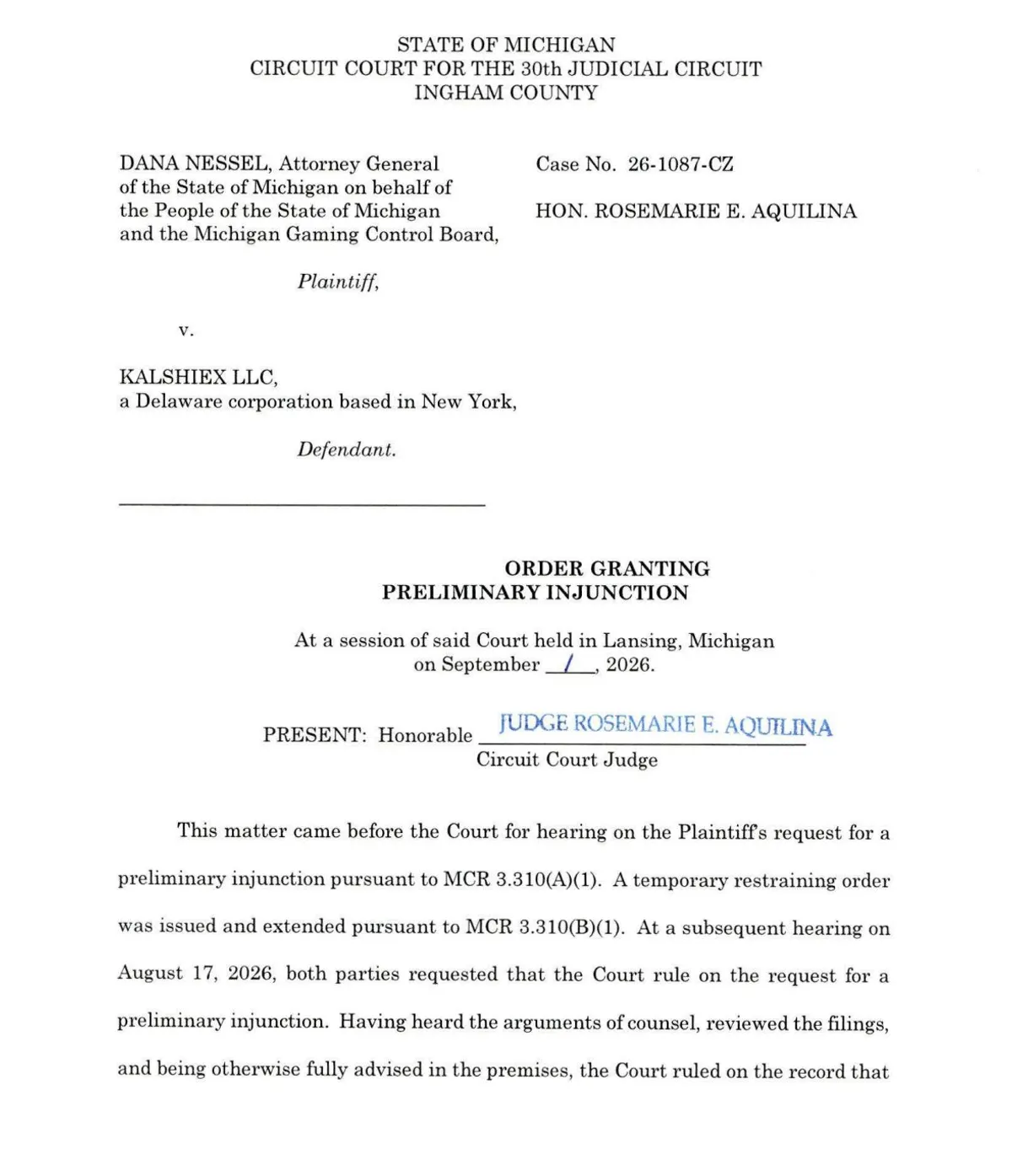
Any violation of the order could result in a fine of up to $500,000 per day. “Kalshi long attempted to pass itself off as a legitimate gaming operation in our state,” Nessel said, adding that her office would continue enforcing Michigan’s gambling laws.
The latest order follows a lawsuit Michigan Attorney General Dana Nessel filed in March under the state’s Lawful Sports Betting Act.
Michigan argues that Kalshi’s sports contracts amount to online sports betting and that the company is offering them without approval from the Michigan Gaming Control Board.
Kalshi’s sports betting battle escalates as states challenge federal authority
At the heart of the dispute is how Kalshi’s products should be classified. The prediction market allows users to buy and sell contracts based on real-world events, including sports outcomes.
Kalshi and federal regulators classify these products as financial derivatives, or event contracts, under the jurisdiction of the Commodity Futures Trading Commission (CFTC). State regulators, however, argue that sports contracts are wagers regardless of how they are labeled.
The dispute has already produced conflicting legal actions, as Michigan secured a temporary restraining order in June barring Kalshi from offering or advertising its sports betting products.
After Kalshi attempted to move the case to federal court, a federal judge rejected the request and returned the dispute to Michigan state court.
The CFTC later intervened, directing Kalshi not to comply with an earlier state order and arguing that federal law gives the agency authority over the exchange. Kalshi has maintained that it disagrees with Michigan’s position and will continue to challenge the state in court.
Notably, Nevada and Washington are among the states pursuing legal action against Kalshi and have secured significant court rulings, while similar legal challenges are ongoing in New York, Connecticut, and Arizona.
The dispute has intensified after conflicting federal appeals court rulings. In April, the Third U.S. Circuit Court of Appeals sided with Kalshi, ruling that federal commodities law likely preempted New Jersey’s attempt to regulate its sports contracts.
The Ninth Circuit later reached the opposite conclusion, allowing Nevada to enforce its gaming laws and finding that Kalshi’s contracts could constitute gambling based on their substance.
The conflicting rulings have created a circuit split, increasing the likelihood of Supreme Court review.
New Jersey has asked the court to intervene, arguing that Congress never clearly gave the CFTC authority over sports wagering and that prediction markets should comply with state gambling laws.
Kalshi's Supreme Court battle could change the future of prediction markets
The dispute could have major implications for the U.S. prediction market industry, with a Supreme Court ruling potentially determining whether states can regulate sports-related prediction contracts or whether federal oversight under the Commodity Exchange Act takes precedence.
The issue extends beyond Kalshi, as Polymarket and other prediction market operators have also faced growing scrutiny.
Forty-four states recently warned that prediction markets could create a new form of casino, arguing that these platforms may bypass gambling rules and taxes imposed on traditional sportsbooks.
The debate has also reached Congress. Senators John Curtis and Adam Schiff introduced the Prediction Markets Are Gambling Act, which would bar CFTC-registered platforms from offering contracts that closely resemble sports bets or casino-style games.
The bill argues that such contracts should remain under state authority.
Concerns over market integrity have added further pressure. The CFTC recently settled a case involving former White House staffer Gabriel Perez, who allegedly traded contracts using information about President Donald Trump’s speeches.
Perez agreed to return the alleged profits, pay a $65,000 penalty, and accept a three-year trading ban.
Kalshi also permanently banned former Rep. George Santos after investigating trades linked to Trump’s State of the Union address, imposing a $71,356 penalty.
The cases have intensified scrutiny of insider trading and regulatory oversight as prediction markets expand into politics, sports, and other real-world events.
Kalshi raises $1.12 billion as valuation race with Polymarket heats up
Despite the recent regulatory setbacks, Kalshi’s latest fundraising disclosure highlights the rapid growth of the U.S. prediction market industry.
A Form D filing with the SEC showed that Kalshi had sold about $1.12 billion in equity as of August 25, with its private offering potentially reaching nearly $1.5 billion.
The filing lists 71 investors and comes after the company’s $1 billion Series F round in May, which valued Kalshi at $22 billion.
The valuation puts Kalshi ahead of Polymarket, which was valued at $15 billion in April and is reportedly seeking fresh funding at more than $20 billion.
Investor interest has been fueled by surging trading activity as Kalshi and Polymarket recorded a combined $45.33 billion in August volume, down 14.5% from July’s record $50.59 billion following the FIFA World Cup.
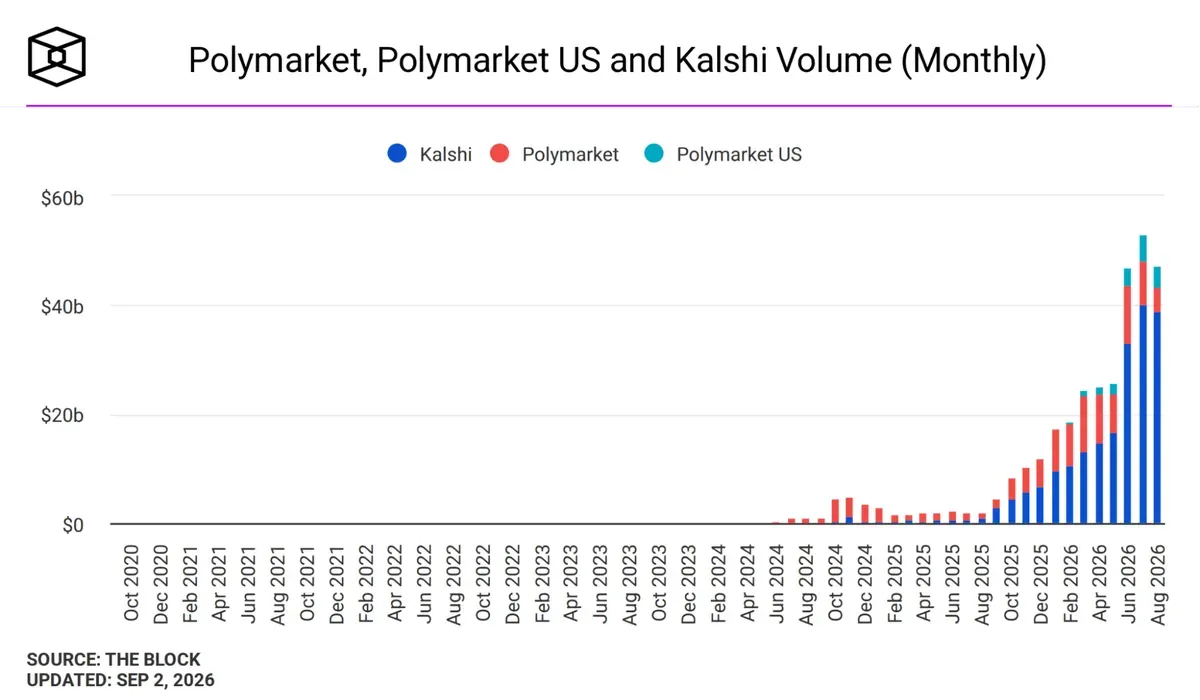
Source: The Block
Kalshi accounted for $37.17 billion, while Polymarket recorded $8.16 billion, showing Kalshi’s continued dominance despite the broader post-World Cup slowdown.