
Key highlights:
- Snowflake surged 23% after hours to a 52-week high of $377 after Q2 revenue hit $1.55B (+35% YoY) and EPS of $0.62 beat the $0.45 estimate
- CoCo AI agent surpassed 9,100 accounts, net new customers rose 32% YoY, remaining obligations grew 30% to $9B, and net revenue retention held at 126%
- FY27 product revenue guidance raised to $6.07B (+36% YoY), with a Q3 forecast of $1.588–$1.593B beating estimates, with GAAP profitability targeted for Q4 FY2028
SNOW stock jumped more than 23% in after-hours trading after Snowflake delivered a stronger-than-expected fiscal second quarter and raised its full-year outlook.
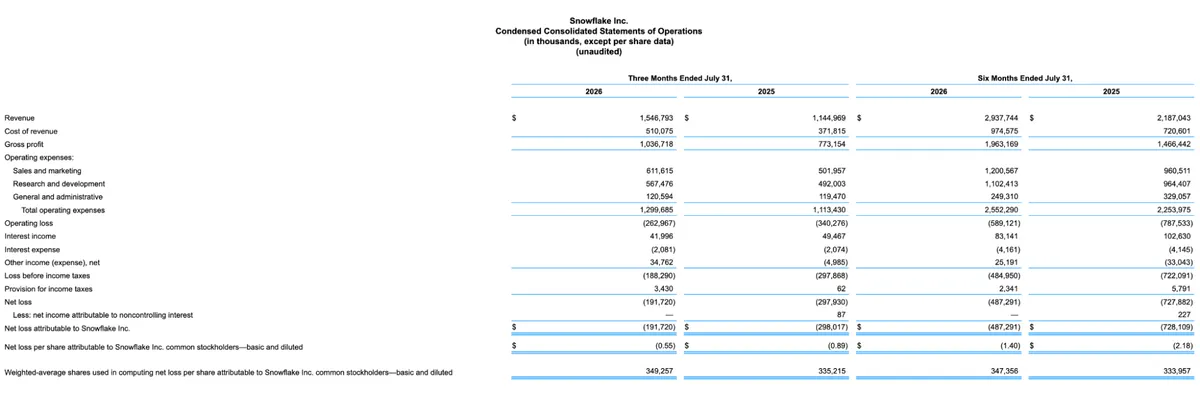
The stock climbed from a session low of $304.48 to $377, setting a new 52-week high, after Snowflake reported fiscal Q2 revenue of $1.55 billion, up 35% year over year. Product revenue, which represents the core of the business, rose 37% to $1.49 billion.
Adjusted earnings reached $0.62 per share, beating the $0.45 LSEG consensus. The GAAP net loss narrowed to $191.7 million from $297.9 million a year earlier.

Source: SEC
AI emerges as a major growth driver
Snowflake said artificial intelligence accounted for approximately half of the acceleration in its revenue growth, as customers increased spending on AI workloads and related products.
Its AI coding agent, CoCo, surpassed 9,100 customer accounts after adding more than 2,000 during the quarter. CoWork also expanded to 5,800 accounts, up nearly 11% sequentially.
CEO Sridhar Ramaswamy reportedly said AI adoption is also increasing consumption of Snowflake’s core data platform. The company has observed newer customer cohorts reaching higher levels of purchased consumption more quickly, suggesting that AI projects could drive additional usage beyond the initial adoption of AI products.
Snowflake expands customer base and backlog
Snowflake ended the quarter with 14,554 customers after adding 692 net new customers. Net additions increased 32% year over year.
The company added 14 Forbes Global 2000 customers during the quarter, bringing its total to 829. Snowflake said its AI Data Cloud now supports more than 41% of companies in the group.
Large customers are also expanding their spending. Snowflake had 65 customers generating more than $10 million in trailing 12-month product revenue, while 828 customers spent more than $1 million.
Remaining performance obligations rose 30% year over year to $9 billion, with about 54% expected to be recognized as revenue over the next 12 months.
Net revenue retention remained strong at 126%, supported by customer expansions involving data migrations and AI workloads.
Profitability improves, but GAAP losses remain
Despite the strong revenue growth, Snowflake is still not profitable under standard GAAP accounting rules. The company posted a net loss of $191.7 million for the quarter, although that was narrower than the $297.9 million loss recorded a year earlier.
Source: SEC
The improving loss profile is one reason investors are willing to look beyond Snowflake’s current GAAP losses. The company is growing rapidly while simultaneously expanding its adjusted operating margins, creating the possibility of stronger earnings as the business scales.
For fiscal 2027, Snowflake expects product revenue of $6.07 billion, representing 36% year-over-year growth. Third quarter product revenue is forecast at $1.588 billion to $1.593 billion, compared with the $1.50 billion expected by analysts.
The full-year non-GAAP product gross margin is expected at 74%, while the adjusted operating margin is projected at 14.5%. The third quarter adjusted operating margin is expected to reach 15.5%.
Snowflake maintained its full-year adjusted free cash flow margin target of 23% and reiterated its goal of reaching GAAP profitability in the fourth quarter of fiscal 2028.
For investors, the key question now is whether Snowflake can sustain the rally by continuing to accelerate AI-driven growth, improve profitability, and increase guidance.