Key highlights:
- Combined volume fell 14.5% to $45.33B in August, the first monthly decline in a year after July's World Cup-driven record of $50.59B
- Kalshi signed a U.S. Open deal, and Polymarket expanded Sportradar coverage to 300K+ matches, but the NFL preseason generated only $422.2M combined
- A Ninth Circuit ruling that Nevada can enforce gambling laws against Kalshi's sports contracts conflicts with a Third Circuit ruling favoring federal preemption
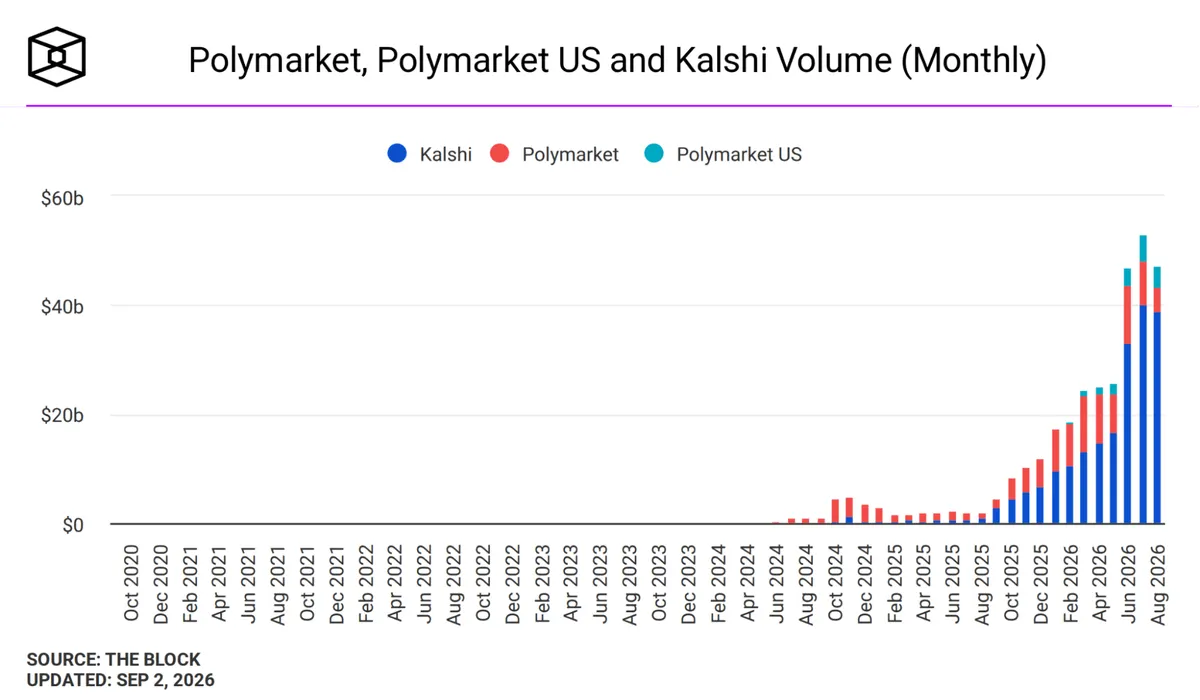
Prediction market trading has hit its first major slowdown in a year, with combined volume on Kalshi and Polymarket falling 14.5% to $45.33 billion in August after a record-breaking July fueled by the FIFA World Cup.
Kalshi recorded $37.17 billion in August volume, down 7.3% from $40.1 billion in July. Polymarket and its U.S. platform saw a sharper decline, with combined volume falling 36.7% to $8.16 billion from $12.89 billion.
Source: The Block
The pullback follows a record July, when combined volume reached $50.59 billion, driven largely by heightened trading around the FIFA World Cup, which ran from June 11 to July 19.
Despite the August decline, combined volume remained well above earlier levels. Kalshi and Polymarket recorded $45.33 billion in August, 76.7% higher than the $25.66 billion recorded in May.
Kalshi and Polymarket face a post-World Cup volume problem, What comes next?
The FIFA World Cup created a major boost for prediction market activity, and its end has left Kalshi and Polymarket searching for the next catalyst.
Both platforms have expanded into other sports, but the additional activity has yet to match the scale of the World Cup-driven surge.
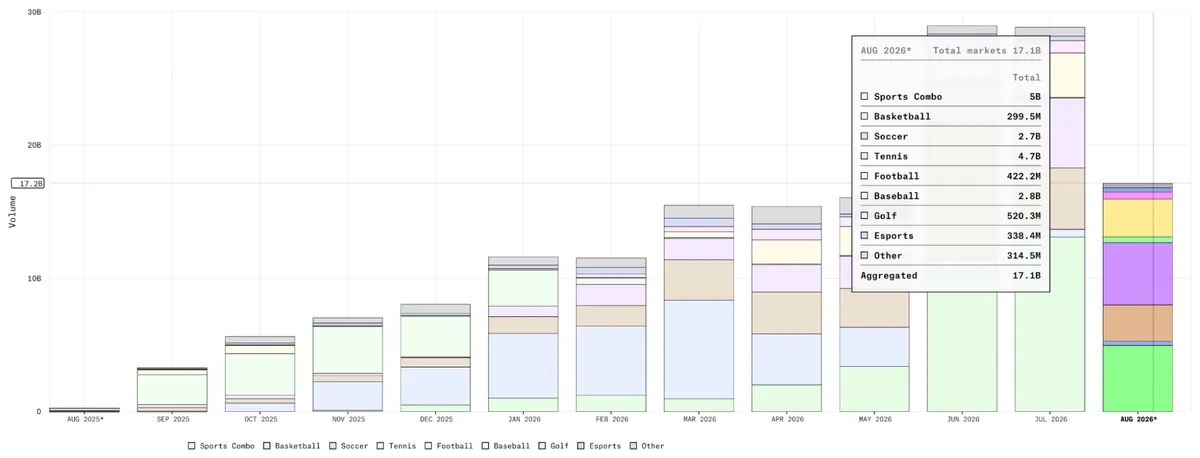
Notably, the NFL has emerged as one of the biggest opportunities to replace that volume. However, early trading has been considerably smaller.
NFL preseason markets generated $422.2 million across Kalshi, Polymarket Global, and Polymarket US in August, with Kalshi accounting for roughly 82% of the total.
Source: Paradigm
The relatively modest NFL volumes have not stopped either platform from expanding its sports offerings. Instead, both are building coverage across leagues and competitions in an effort to create a more consistent stream of trading activity.
Kalshi recently signed a multiyear agreement with the U.S. Tennis Association to become the exclusive prediction market partner of the U.S. Open, beginning with the 2026 singles main draw on Aug. 30.
The deal gives Kalshi exposure across the U.S. Open digital platforms and on-court signage, while also establishing an integrity framework for its tennis markets.
Polymarket is taking a similar approach through an expanded relationship with Sportradar. The agreement provides Polymarket with Sportradar’s sports data, streaming, and integrity services across more than 20 leagues and competitions, covering approximately 300,000 matches annually.
The expanded coverage includes the Bundesliga, EuroLeague Basketball, Chinese Basketball Association, National Basketball League, tennis Grand Slams, and UTR Pro events. It builds on existing coverage of MLB, NHL, UFC, and the ATP Tour.
The moves show that both platforms are trying to spread trading activity across a wider sports calendar rather than rely on a single blockbuster event. But so far, none of these competitions has generated volumes comparable to the World Cup.
Regulatory fight creates a bigger hurdle for prediction markets
While Kalshi and Polymarket are expanding into more sports to replace trading activity lost after the World Cup, they face a separate challenge that could directly affect how those markets can operate in the U.S.
At least 20 states are involved in litigation or regulatory disputes over sports-related prediction contracts.
State regulators argue that the contracts function as sports betting and therefore fall under state gambling laws, including licensing and enforcement requirements.
Kalshi disputes that classification. The company argues that its event contracts are federally regulated derivatives under the Commodity Exchange Act and that state gambling laws cannot override federal oversight.
The Commodity Futures Trading Commission (CFTC) has maintained that federally regulated event contracts fall within its jurisdiction, putting federal and state authorities on opposing sides of the dispute.
The legal stakes increased on Aug. 28, when the Ninth Circuit Court of Appeals ruled in KalshiEX, LLC v. Assad that Nevada could enforce its gambling laws against Kalshi’s sports contracts. The court rejected Kalshi’s argument that federal derivatives law preempts Nevada’s gambling regulations.
The ruling conflicts with an earlier Third Circuit decision involving New Jersey, which sided with Kalshi and held that federal commodities law preempted the state’s attempt to regulate its contracts.
That circuit split leaves a fundamental legal question unresolved: does federal commodities law give prediction market operators the right to offer sports contracts nationwide, or can individual states regulate those contracts as gambling?
If states retain broad authority to regulate these markets, operators could face a patchwork of restrictions, licensing requirements, and potential enforcement actions across the country.
If federal preemption ultimately prevails, states could have far less authority to block or regulate federally listed sports contracts. That would give prediction markets a clearer path to scale nationally, particularly as Kalshi and Polymarket seek to build sports trading into a more consistent source of volume.