
Key highlights:
- Bitcoin entered September at $77K after a strong 24.95% August gain, reviving "Rektember" fears, historically averaging -2.97% in September
- Fed rate hike odds jumped to 66.4% post-Warsh, 10-year yields at 4.78%, and rising oil prices from U.S.-Iran tensions added inflationary pressure
- Analysts are split on rejection toward $65K–$70K vs. a retest of $74K–$75K before a push to $82K–$87K in October
Bitcoin is entering September under pressure, putting the cryptocurrency’s reputation for weak performance during the month back in focus as investors weigh whether 2026 can finally break the so-called “Red September” pattern.
Bitcoin delivered a very strong performance in August, gaining 25% and briefly climbing above $81,000. The leading cryptocurrency remains up 19.7% over the past 14 days and 21.6% over the past 30 days, although it is still about 38.7% below its all-time high of $126,080.
The early September pullback has therefore revived a familiar question for traders: can Bitcoin hold onto the gains from August, or will historical seasonality once again weigh on the market?
The September curse is fading, but 2026 could put it to the test
September earned the nicknames “Rektember” and “Red Spetember” among traders, reflecting Bitcoin’s historically weak performance during the month.
Since 2013, Bitcoin has ended September lower in eight of 13 years, according to CoinGlass data. The month has posted an average return of about -2.97%, with a median return of -2.44%, making it historically Bitcoin’s weakest month.
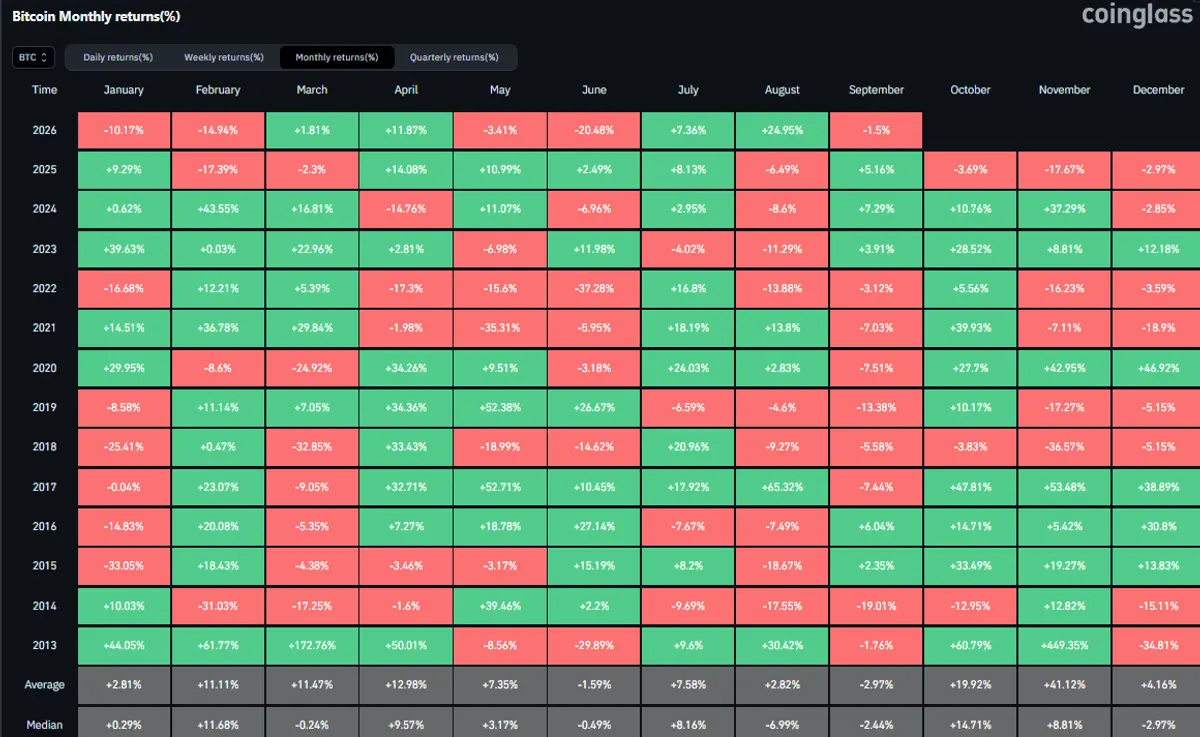
Bitcoin's monthly returns. Image source: CoinGlass
However, the pattern has shown signs of changing in recent years. Bitcoin gained 3.91% in September 2023 and 7.29% in September 2024, ending a six-year streak of September losses.
The cryptocurrency also closed September 2025 higher, marking three consecutive years of positive returns.
That recent performance gives September 2026 a different backdrop from the period when “Red September” became firmly established.
Still, Bitcoin enters the month facing several market pressures that could revive concerns over another difficult September.
Bitcoin enters September under pressure as Fed bets, and oil prices threaten $80,000
Bitcoin is entering September under pressure as shifting Federal Reserve expectations, rising oil prices, and broader risk-off sentiment weigh on financial markets.
The biggest near-term risk for Bitcoin is shifting expectations around U.S. monetary policy.
Following hawkish comments from Fed Chair Kevin Warsh at Jackson Hole, markets have traders to price in a roughly 66.4% chance of a 25-basis-point rate hike at the Federal Reserve’s September 15-16 meeting, up from 39.6% a week earlier.
Higher rates and rising Treasury yields could weigh on Bitcoin by making traditional income-generating assets more attractive. The U.S. 10-year Treasury yield has climbed to around 4.78%, while the 30-year yield recently reached 5.28%.
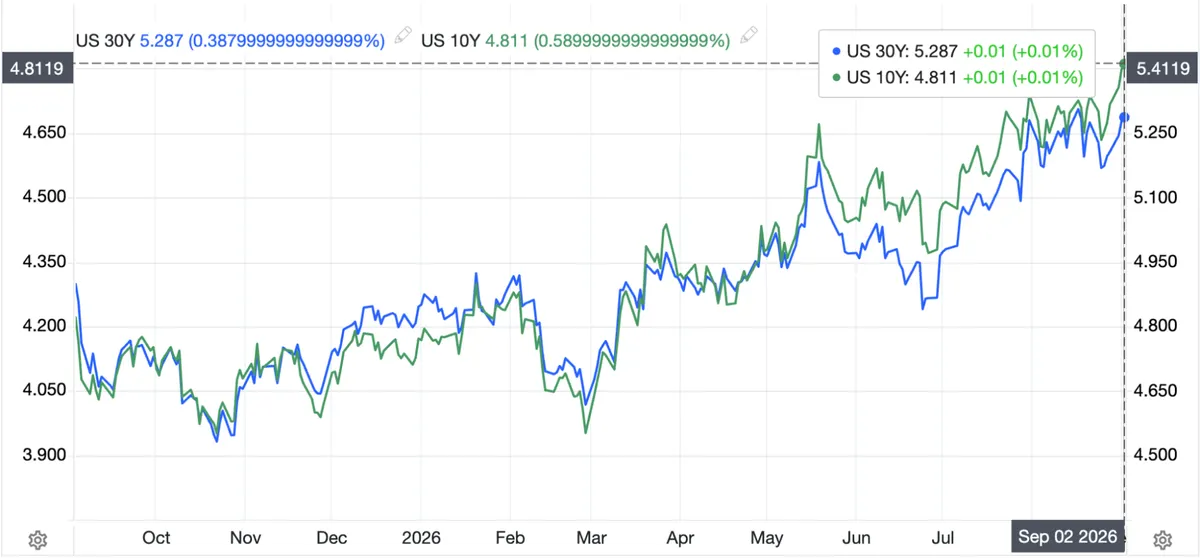
Source: Trading Economics
Geopolitical tensions are adding to those pressures as the pressure between the U.S. and Iran has now escalated along with concerns around the Strait of Hormuz, which has pushed oil prices higher.
Reuters reported that crude prices rose more than $4 a barrel on Tuesday to a five-week high. Higher oil prices could add to inflationary pressure and further strengthen the case for tighter monetary policy.
The shift has already weighed on risk assets, with the Dow Jones Industrial Average falling 0.79% on Tuesday, the S&P 500 dropping 0.71% and the Nasdaq Composite declining 1.03%.
Bitcoin has shown greater resilience, however, holding near the $77,000-$78,000 range despite weakness in stocks and a sharp rise in oil prices.
Additionally, investors are currently watching upcoming U.S. employment and inflation data for clues about the Federal Reserve’s next move ahead of its September 15-16 meeting.
Any shift in rate expectations could ripple through Treasury yields and broader risk assets, ultimately determining whether Bitcoin can reclaim $80,000 or faces renewed selling pressure.
Will BTC extend the winning streak or bring back ‘Rektember’?
Notably, institutional demand could be crucial to determining whether Bitcoin’s recent resilience continues into September.
Spot Bitcoin ETFs recorded about $3.52 billion in net inflows in August, their strongest monthly performance of 2026.
august 2026 just finished as the biggest bitcoin ETF net inflow month (+$3.54b) since july 2025
cumulative net flows in 2026 rise to -$1.7b pic.twitter.com/iVHSccAErw— Alex Thorn (@intangiblecoins) September 1, 2026
The funds attracted roughly $3.04 billion over nine consecutive trading sessions through August 27 before seeing a $201.9 million outflow on August 28. Inflows returned on August 31, with another $216.7 million entering the products.
The strong demand helped Bitcoin climb from below $63,000 to a high of $81,428 in August.
Still, the cryptocurrency has struggled to establish a sustained move above $80,000, with resistance around $81,200-$81,500 and buyers defending the $77,000-$77,700 area.
Historically, strong August rallies have often been followed by September weakness. Bitcoin fell 1.58% in September 2013 after gaining 27.4% in August, while a 63.8% August rally in 2017 was followed by a 7.72% decline in September.
Notably, analyst Peter DiCarlo said he sees roughly a 60% chance of rejection at current levels, arguing that Bitcoin must break and hold above the $82,000 internal swing high to confirm a bullish structural shift.
Bitcoin September Outlook bitcoin:native
Bitcoin’s breakout over the past few months has been textbook according to our strategy.
That said, I have now removed my short-term trades and exposure because, based on my framework, I believe there is roughly a 60% chance of… pic.twitter.com/qHZDwTjKJ3— Peter DiCarlo (@pdicarlotrader) August 31, 2026
A rejection, he said, could send BTC toward $65,000-$70,000 before a potential recovery toward new highs.