
Key highlights:
- Polymarket is raising ~$1B at a ~$21B valuation (up 40% from April), led by Trump Jr.'s 1789 Capital with $300M, bringing its total Polymarket commitment to $500M
- Kalshi leads U.S. trading ($10.79B monthly volume vs. Polymarket's $3.08B), and both face a legal threat after the Ninth Circuit ruled states can enforce gambling laws
- Trump Jr.'s advisory roles at both platforms and CFTC Chair Selig's vocal support for prediction markets have drawn Democratic scrutiny over potential political influence
Polymarket is seeking to raise about $1 billion in fresh funding at a valuation of roughly $21 billion, with Donald Trump Jr.-linked venture capital firm, 1789 Capital, leading the round with a $300 million investment.
The proposed investment would significantly increase 1789 Capital’s financial exposure to the prediction market platform after it has already invested about $200 million in Polymarket, meaning its total commitment could reach roughly $500 million if the latest transaction closes.
Polymarket valuation jumps 40% with the major new investment
The Wall Street Journal first reported the financing on Aug. 31, while 1789 Capital spokesperson Alexa Henning confirmed the planned investment and valuation.
The round has yet to close, meaning the final amount, investors, and ownership structure could still change.
The financing would rank among the largest funding rounds in the prediction-market industry and could value Polymarket at roughly $21 billion, up about 40% from its previous $15 billion valuation secured in April.
Trump Jr.-Backed 1789 Capital to Add About $300M to Polymarket at $21B Valuation
The Wall Street Journal reported that 1789 Capital, where Donald Trump Jr. is a partner, plans to invest about $300 million more in prediction market platform Polymarket. The investment is part of a… pic.twitter.com/sAvdcxfS2D— Wu Blockchain (@WuBlockchain) August 31, 2026
Notably, Intercontinental Exchange, the parent company of the New York Stock Exchange, remains its largest disclosed investor. ICE previously disclosed holdings in Polymarket worth about $1.6 billion, representing roughly 22% of the company’s outstanding shares.
Donald Trump Jr.’s involvement gives the latest financing another layer of attention. He is a partner at 1789 Capital and has also served as an adviser to both Polymarket and Kalshi, two companies competing in the same rapidly expanding market.
His relationship with the industry and his venture firm has attracted political scrutiny as Democrats on the House Judiciary Committee investigate 1789 Capital’s growth and investments in companies that have benefited from government policy or contracts.
Trump Jr. has said he invests as a private citizen and has no policy role in the administration, while 1789 Capital has rejected suggestions that its investment activity is driven by political influence.
His father, President Donald Trump, has also publicly supported prediction markets, while Trump-appointed CFTC Chairman Michael Selig has expressed support for the sector and defended the federal regulator’s role in overseeing event contracts.
Polymarket’s $20 billion valuation bid faces a surprising Kalshi challenge
The proposed raise comes as prediction markets gain mainstream attention, with platforms such as Polymarket and Kalshi allowing users to trade contracts tied to outcomes, including elections, sports events, and economic developments.
Polymarket’s proposed valuation would put it close to Kalshi, which raised $1 billion at a $22 billion valuation in May in a round led by Coatue, with backing from Sequoia Capital, Andreessen Horowitz, IVP, Paradigm, Morgan Stanley, and ARK Invest.
A Securities and Exchange Commission filing published Aug. 25 showed Kalshi had recorded about $1.12 billion in equity sales, with roughly $380 million still available under the offering.
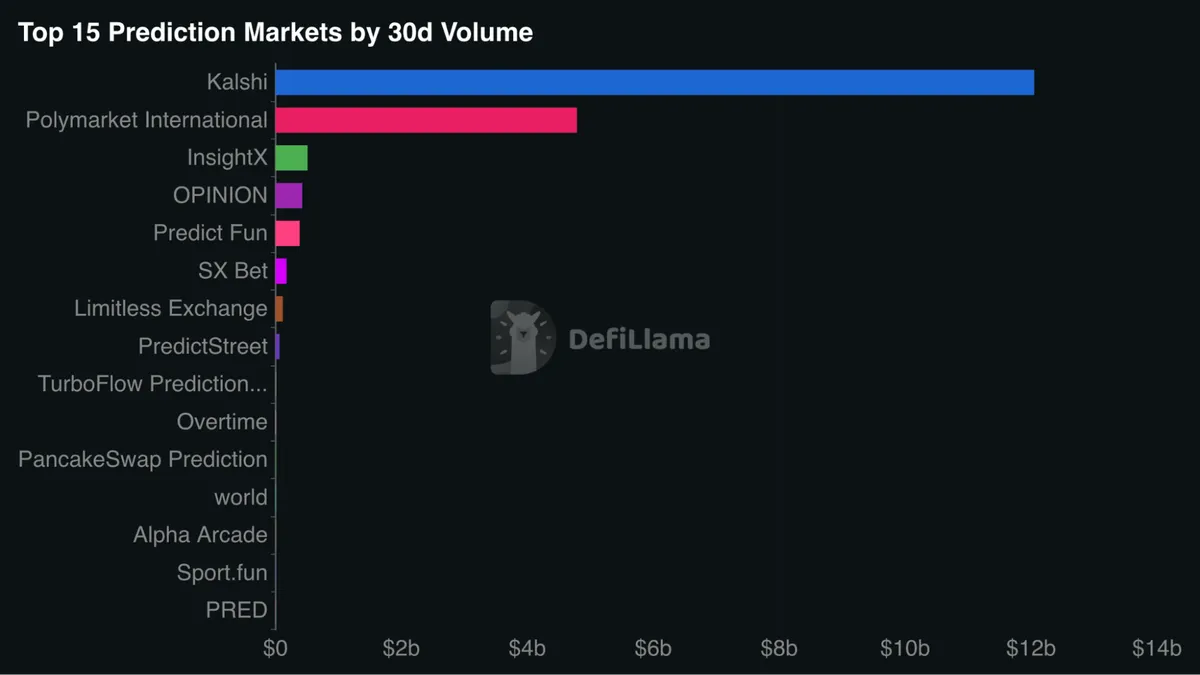
DeFiLlama data showed Kalshi with about $10.79 billion in monthly trading volume, compared with roughly $3.08 billion for Polymarket.
Prediction markets face a new legal threat as states push to regulate event contracts
As prediction-market trading has grown, regulators have increasingly debated whether event contracts should be treated as financial derivatives or gambling products.
The issue has become particularly important for Polymarket as it expands in the U.S. The company operates a regulated U.S. exchange through QCX LLC, which the Commodity Futures Trading Commission (CFTC) has designated as a designated contract market.
Its international platform was previously barred from serving U.S. users following a 2022 CFTC settlement, but Polymarket has since established a separate federally regulated U.S. operation.
The expansion comes as prediction markets face growing regulatory pressure. At least 20 states are involved in litigation over sports-related prediction contracts, with regulators arguing that they constitute gambling and fall under state gaming laws.
The CFTC, however, maintains that federally regulated event contracts fall within its jurisdiction.
The dispute intensified on Aug. 28, when the Ninth Circuit Court of Appeals ruled in KalshiEX, LLC v. Assad that Nevada can enforce its gambling laws against Kalshi’s sports contracts. The court rejected Kalshi’s argument that federal derivatives law preempts state regulation.
The ruling also created a circuit split with the Third Circuit, which previously sided with Kalshi and found that federal commodities law preempts New Jersey’s oversight.
The conflicting decisions could ultimately send the issue to the U.S. Supreme Court, which may have to determine whether prediction markets are governed primarily by federal derivatives law or state gambling regulations.