
Key highlights:
- HNT surged ~284% weekly after Celina, Texas, adopted Helium for mobile traffic offload, sending 24-hour volume up 3,580% to $202M by Aug. 30
- Helium's model burns HNT for Data Credits, with 42,000+ U.S. locations, 2.5M daily users, and AT&T and Telefónica partnerships supporting the utility case
- $1 is technically achievable, but RSI at 90–97 signals extreme overbought conditions with resistance at $0.7767 and support at $0.6999
The Helium crypto price has surged 283.5% in a week, reaching a high of $0.965 before cooling to $0.7268 at the time of writing, after Celina, Texas, converted its citywide WiFi network into carrier coverage on the Helium network.
Helium is a decentralized wireless network founded in 2013 to support Internet of Things devices and incentivizes users to deploy "hotspots," effectively small wireless access points, by rewarding them with tokens for providing coverage to nearby devices.
The DePIN project has positioned the network as a cost-efficient alternative to traditional wireless infrastructure and claims more than 93,000 hotspots across North America.
Why did a city in Texas partner with the Helium Network?
Celina, Texas, has partnered with Helium to address a connectivity challenge created by its rapid population growth, after adding more than 12,700 residents in a single year, representing 24.6% growth.
Rather than relying solely on traditional cellular infrastructure, the city is allowing mobile traffic to be carried over WiFi networks already operating across public buildings and participating businesses.
Traditional cellular expansion can take years because new towers require planning, permits, and significant capital. Coverage can also weaken indoors as cellular signals pass through walls and other building materials.
Helium's solution is to use WiFi infrastructure that already exists across Celina at locations including the Celina Public Library, Ralph O'Dell Senior Center, and participating downtown businesses.
Notably, participating facilities provide the WiFi infrastructure, while Helium makes that connectivity available for supported mobile traffic. When residents or visitors enter a covered area, compatible phones can connect automatically without an app, sign-in, or manual network changes.
However, the system does not replace traditional cell towers. Instead, it adds another layer of connectivity that can handle mobile traffic where WiFi infrastructure is already available.
Helium said the Celina network is already carrying about 100 GB of data daily, with more locations expected to come online this fall.
How Helium is expanding beyond crypto and building a real-world wireless network
The deployment also shows Helium's push to turn its decentralized wireless network into real-world telecommunications infrastructure. Partnerships with major telecom companies have become an important part of that strategy.
In 2025, Helium partnered with AT&T to allow the telecom company's subscribers to access Helium's community-built WiFi network. Helium has also announced relationships involving Telefónica's Movistar and other mobile network operators and mobile virtual network operators.
The Celina deployment joins cities including Redondo Beach, New Orleans, and Sausalito that have used Helium to help address connectivity gaps.
Although Helium said its network now spans more than 42,000 locations across the U.S. and serves more than 2.5 million people daily, the fundamental case for HNT depends on whether these deployments translate into sustained network usage.
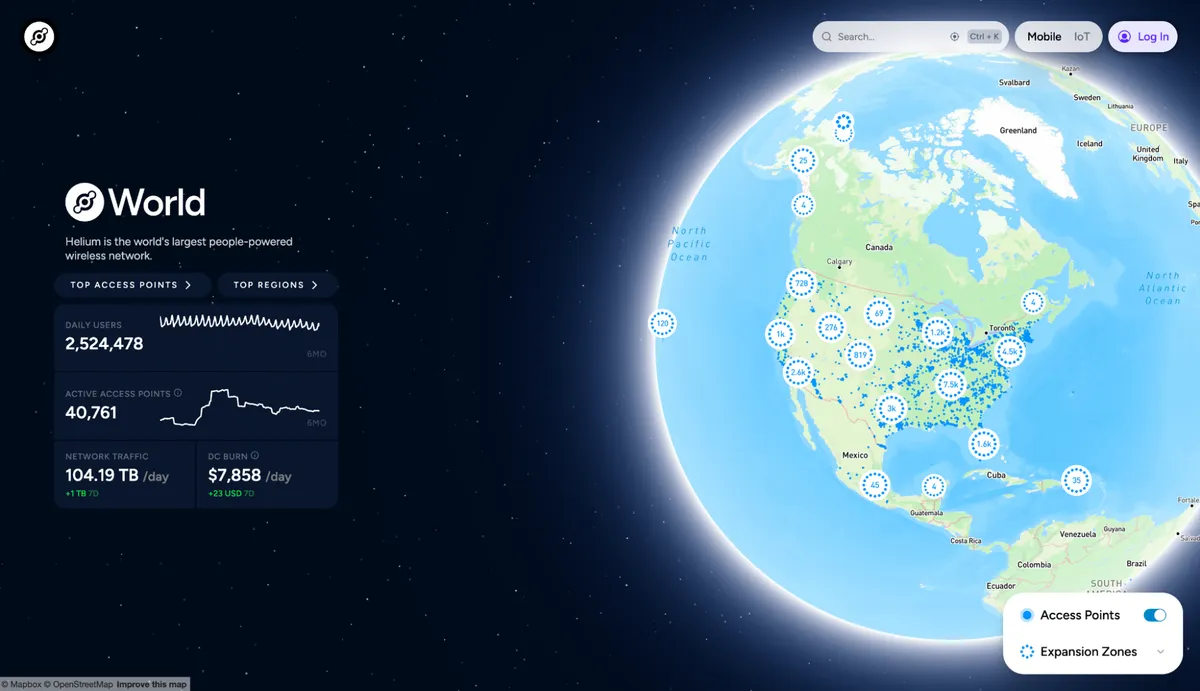
Source: Helium
Helium’s model ties data consumption to HNT because network users must burn HNT to purchase Data Credits, which are used to pay for wireless services. As more mobile traffic moves across Helium, greater data usage can therefore increase the amount of HNT burned.
This creates a potential link between real-world adoption and tokenomics. Higher usage from partners such as AT&T, combined with expansion into more municipalities, could increase network activity and HNT burn over time.
For HNT, the question is therefore whether Helium can shift from a decentralized wireless experiment into a widely used connectivity layer. If adoption scales and network activity rises alongside it, the resulting increase in HNT utility and burn could provide a stronger long-term foundation for the token beyond crypto demand.
Can HNT reach $1?
HNT has a strongly bullish daily setup, but the rally is severely overbought. The biggest near-term risk is a sharp pullback after the extended move.
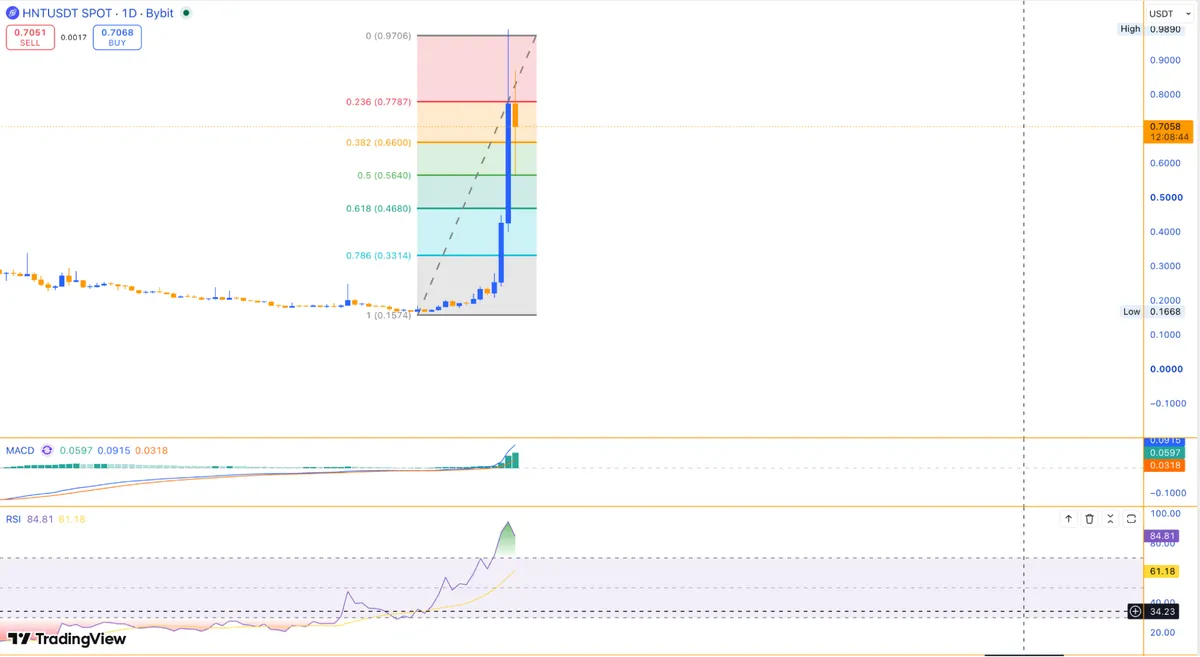
HNT’s RSI-14 stands at 94.2, while RSI-7 is 97.3 and RSI-21 is 90.1. All three readings are firmly in overbought territory, showing exceptionally strong buying momentum but also increasing the risk of volatility and a mean-reversion move.
However, an overbought RSI does not automatically signal a reversal. Also, trend structure remains bullish. HNT is trading at $0.7068, above its key moving averages, with 7-day SMA at $0.3232, 30-day SMA at $0.214, and 200-day SMA at $0.7031.
However, the first major hurdle is the $0.7767 Fibonacci level. A sustained break above this resistance would strengthen the case for further upside and bring the psychological $1 level into focus.
On the downside, $0.6999 is the key immediate support, aligning closely with the 200-day SMA and EMA. If that level fails, the $0.6602 Fibonacci level becomes the next important downside reference.
For now, $1 remains technically achievable, but the path is unlikely to be straight given the extreme overbought conditions.