Key highlights:
- DeFi Development Corp acquired ~19,000 SOL at $98.14, bringing its treasury to ~2.33M SOL.
- DFDV Q2 digital asset treasury revenue up 170% to $3.26M despite a $27.3M net loss.
- Key levels: $104.41 is near-term support, and $109–$110 is immediate resistance, while a daily close above $110 opens a path toward $114.88 and $127.83.
Solana treasury company DeFi Development Corp announced that it will resume its Solana treasury purchases, acquiring approximately 19,000 SOL at an average price of $98.14.
The purchase increased DFDV’s treasury to approximately 2.33 million SOL, reinforcing the company’s strategy of using Solana as its primary treasury asset.
Defi Development Corp. noted that newly acquired tokens are expected to be held long-term and deployed through DFDV’s staking and on-chain treasury infrastructure to generate additional yield.
DFDV adds more SOL as corporate demand for Solana grows
In the announcement, DFDV said the latest purchase was partially funded through proceeds from its divestment of ZeroStack, allowing the company to resume accumulation without relying entirely on additional capital.
The company has increasingly positioned itself as a publicly traded vehicle for leveraged exposure to SOL.
The buying comes as corporate demand for SOL continues to grow, with companies and other entities collectively holding approximately 19.35 million SOL, worth about $2.01 billion, across 23 entities in eight countries.
Those holdings represent roughly 3.06% of Solana’s total supply.
CEO Joseph Onorati said DFDV’s recent trading activity showed growing investor interest in that strategy, noting that the company’s shares had delivered more than twice SOL’s return in August and outperformed SOL by 1.8 times quarter-to-date.
The company’s strategy extends beyond simply holding SOL. DeFi Development Corp. operates validator infrastructure and stakes its treasury while also deploying capital across selected Solana DeFi protocols.
In its second-quarter results, the company said revenue increased 66.9% year over year to $3.3 million, with digital asset treasury revenue rising 170% to $3.26 million.
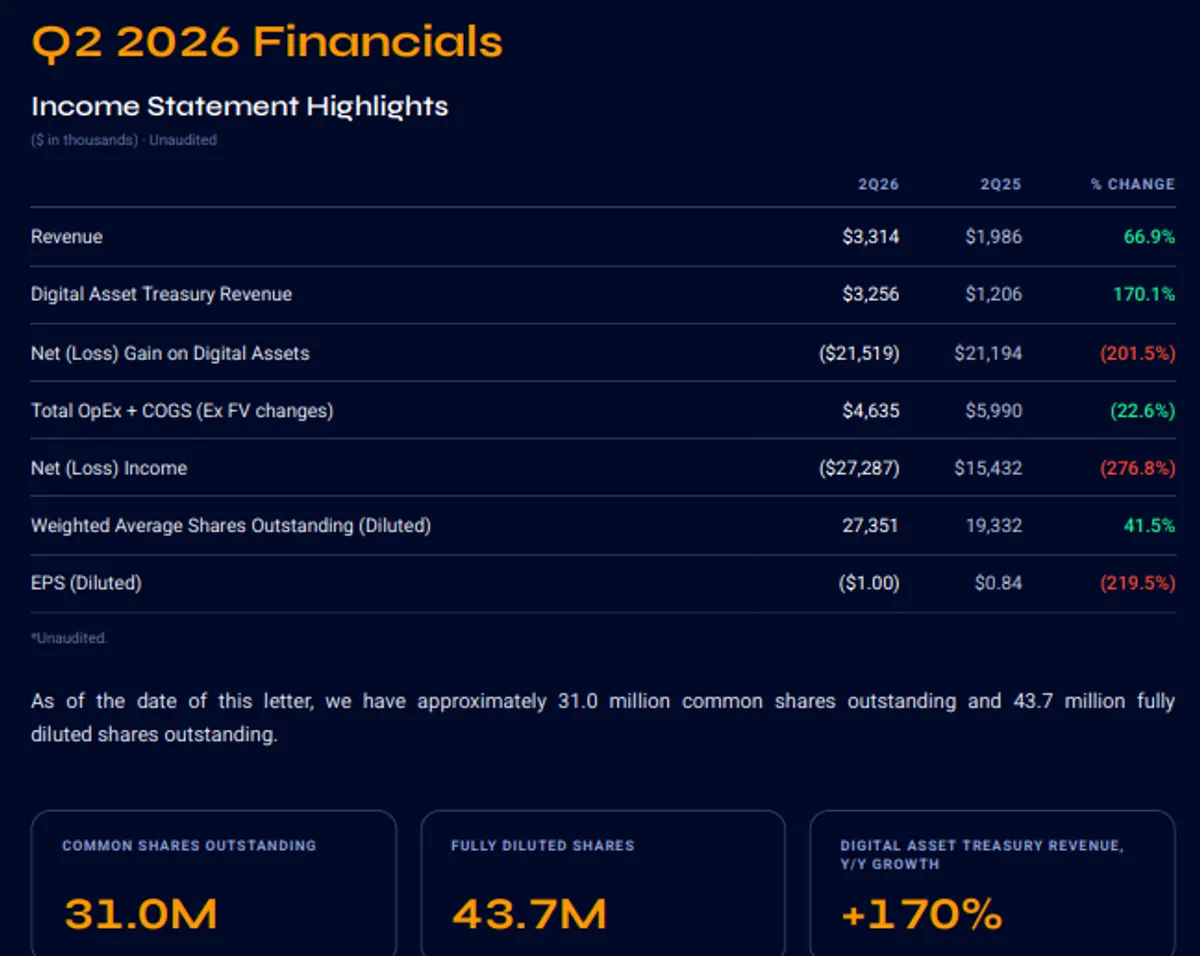
Defi Development Q2 2026 financial report Source: DFDV
However, the company recorded a $27.3 million net loss, compared with $15.4 million in net income a year earlier, largely because of losses on digital assets.
Notably, DFDV is cutting costs and streamlining its operations, with plans to reduce third-quarter expenses by eliminating one-time legal and accounting costs, consolidating third-party services, and automating internal workflows.
The company also repurchased $3.5 million of its 2030 convertible notes for $2.3 million, bringing total buybacks to $7.9 million and lowering future interest expenses.
At the same time, DFDV is concentrating its DeFi strategy on Kamino, JupLend, and Sanctum while winding down its Treasury Accelerator program.
The company also recently launched State of Solana, a platform tracking SOL performance, network activity, staking yields, validator data, and ecosystem trends, as it seeks to highlight the network’s growth beyond its token price.
Solana Price Analysis: SOL holds above $106 as bulls defend key breakout levels
Solana’s SOL traded around $106.25 on August 28 after briefly touching $110, as strong ETF inflows and rising network activity helped sustain its recent breakout despite hotter-than-expected U.S. inflation data.
The rally began around August 19, when SOL broke above a prolonged $75-$80 range, later reclaiming $88, $94, and $100. The latest retreat from $110 appears to be profit-taking, with SOL still holding above its rising four-hour trendline.
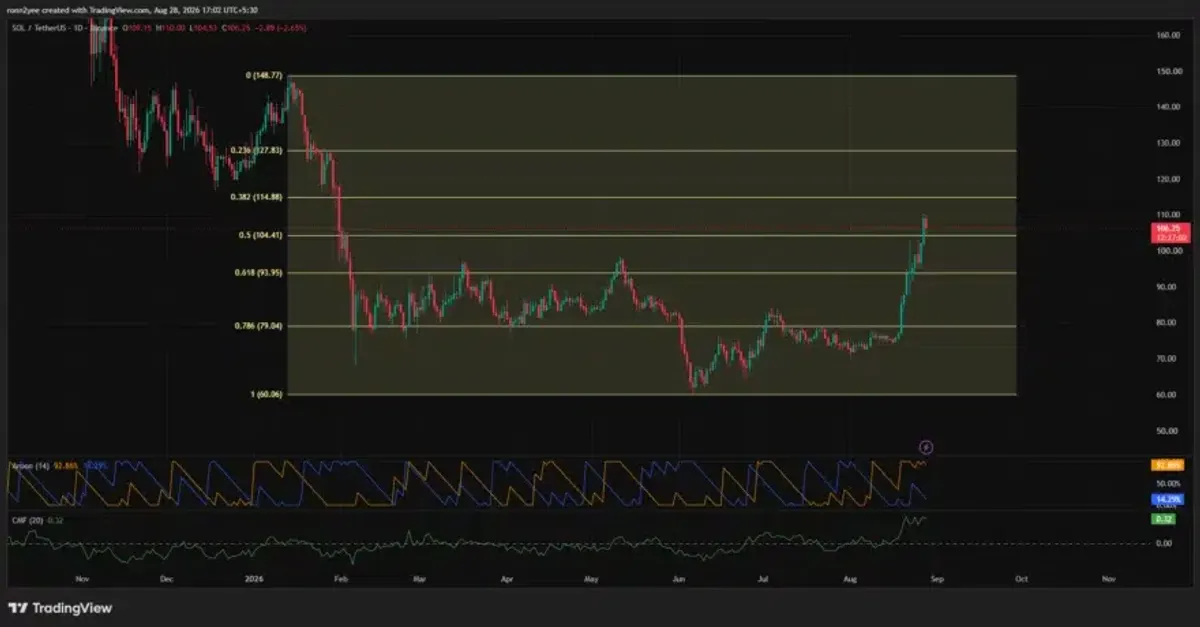
On the daily chart, $104.41 is the key near-term support, while $109-$110 remains the immediate resistance. A daily close above $110 could open a move toward $114.88 and $127.83. A break below $104.41 could expose $100.95 and $93.95.
Solana’s network activity has also accelerated, with more than 1.01 billion transactions processed in one week in August. Meanwhile, SOL accounted for about 95% of global on-chain equity trading volume during one week in June.