Key highlights:
- IREN fell ~8% after hours as Q4 revenue of $137.2M missed the $157.1M estimate, and a $684M net loss overshadowed AI Cloud revenue doubling 110% to $70.5M
- The AI pivot is delivering as 2026 capacity sold out, $4B in contracted ARR, with new contracts at $20M+/megawatt and customers prepaying 45–55% of GPU costs
- IREN mirrors a mining-to-AI shift trend of swapping Bitcoin revenue for predictable multi-year contracts across a 5GW global pipeline
Bitcoin miner and AI infrastructure company IREN fell by 8% during after-hours trading after its fiscal 2026 results showed a costly transition away from Bitcoin mining.
IREN shares closed 2.4% higher at $40.53 on Aug. 27 but dropped sharply after the earnings release.
As of the time of writing, the stock was trading at $37.73, down 6.91%, as investors weighed a quarterly revenue miss against the company’s expanding AI infrastructure operations.
IREN’s AI growth accelerates as Bitcoin mining revenue slumps
IREN’s latest results show the financial strain of its shift from Bitcoin mining to AI cloud infrastructure, with rapidly growing AI revenue offsetting a sharp decline in its legacy mining business.
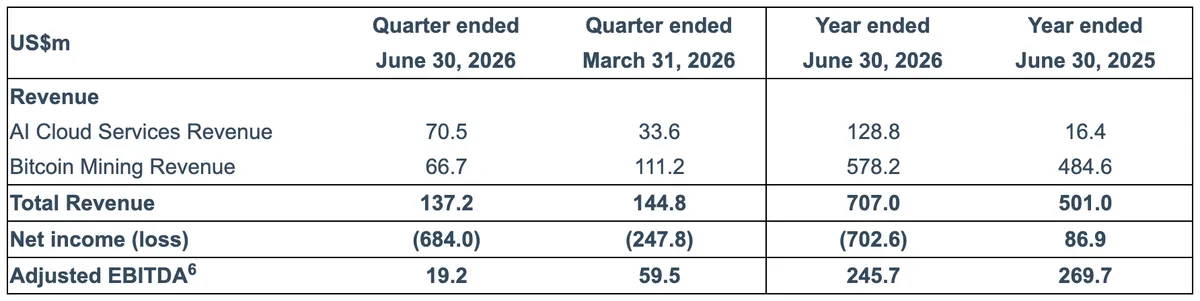
In the report, the company said it generated $137.2 million in fourth-quarter revenue, down from $144.8 million in the previous quarter and below Wall Street’s $157.14 million estimate.
The shortfall largely reflected IREN’s decision to scale back Bitcoin mining as it reallocates power and data center capacity to AI workloads.
AI Cloud Services revenue nearly doubled, rising 110% to $70.5 million from $33.6 million. It accounted for more than half of quarterly revenue for the first time, overtaking Bitcoin mining revenue, which fell 40% to $66.7 million from $111.2 million.
The transition came with significant costs, as it reported a $684 million net loss, compared with $247.8 million in the previous quarter, largely due to $450.4 million in non-cash impairment charges tied to decommissioned Bitcoin mining equipment.
Notably, its adjusted EBITDA fell 67.7% to $19.2 million.
IREN expands AI business with $4 billion in contracted revenue
Despite the weaker financial results, IREN’s AI business is expanding rapidly.
Following Microsoft’s acceptance of its Horizon 1 data center system, operating annualized recurring revenue (ARR) reached approximately $1 billion under a five-year agreement.
IREN today reported its FY26 results and provided a business update.
Key highlights:
- New multi-year AI Cloud contract with a leading frontier AI lab
- $4bn contracted ARR for 2026 capacity; $1bn operating ARR today
- $2.8bn GPU financing funds 90% of associated GPU capex
-… pic.twitter.com/skayhgGWHj— IREN (@IREN_Ltd) August 27, 2026
The company said its 2026 capacity is effectively sold out, with about $4 billion in contracted ARR.
Microsoft is also expected to receive three additional 50-megawatt liquid-cooled deployments at IREN’s Childress, Texas, site. IREN has also expanded deals with AI companies, including Cohere, Perplexity, Figure AI, and Fal AI, diversifying its customer base.
Recent three-year contracts generate more than $20 million per megawatt of IT capacity, while new capacity is being discussed at around $25 million. Customer prepayments are also covering 45% to 55% of GPU capital costs.
IREN has secured $3.6 billion in GPU financing tied to its Microsoft contract at a 6% rate, plus another $2.8 billion for other deployments.
Its global data center pipeline now exceeds 5 gigawatts, with about 0.3 GW of IT capacity planned for 2026 and 0.8 GW in 2027.
The results leave investors weighing two opposing trends: a shrinking Bitcoin mining operation that is pressuring current earnings and an AI cloud business growing rapidly through large customer contracts and expanding infrastructure.
Why are crypto mining companies shifting to AI?
IREN’s transition from Bitcoin mining to AI infrastructure reflects a broader shift across the crypto-mining industry, as operators seek to repurpose power-secured data centers for the rapidly expanding demand for AI computing.
The global AI cloud market is projected to reach $133.42 billion in 2026, fueled by rising enterprise spending on GPUs, servers, and specialized cloud platforms.
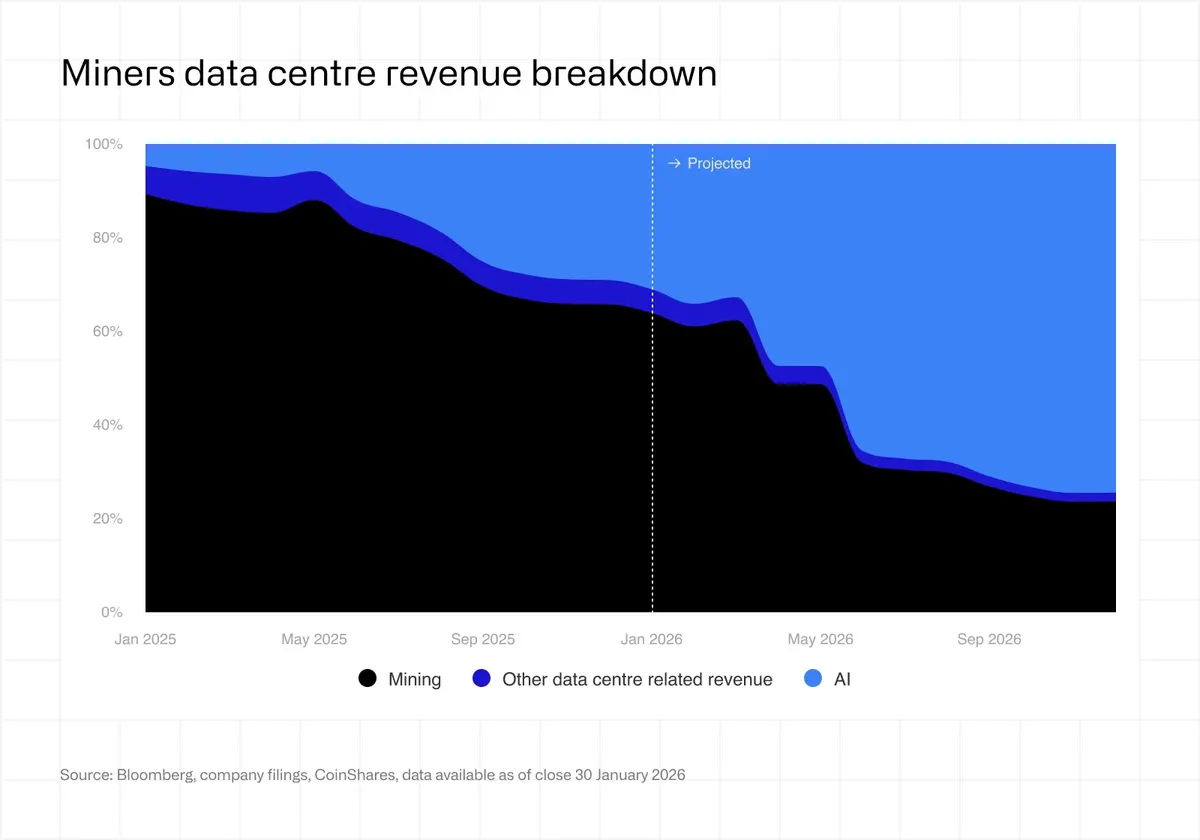
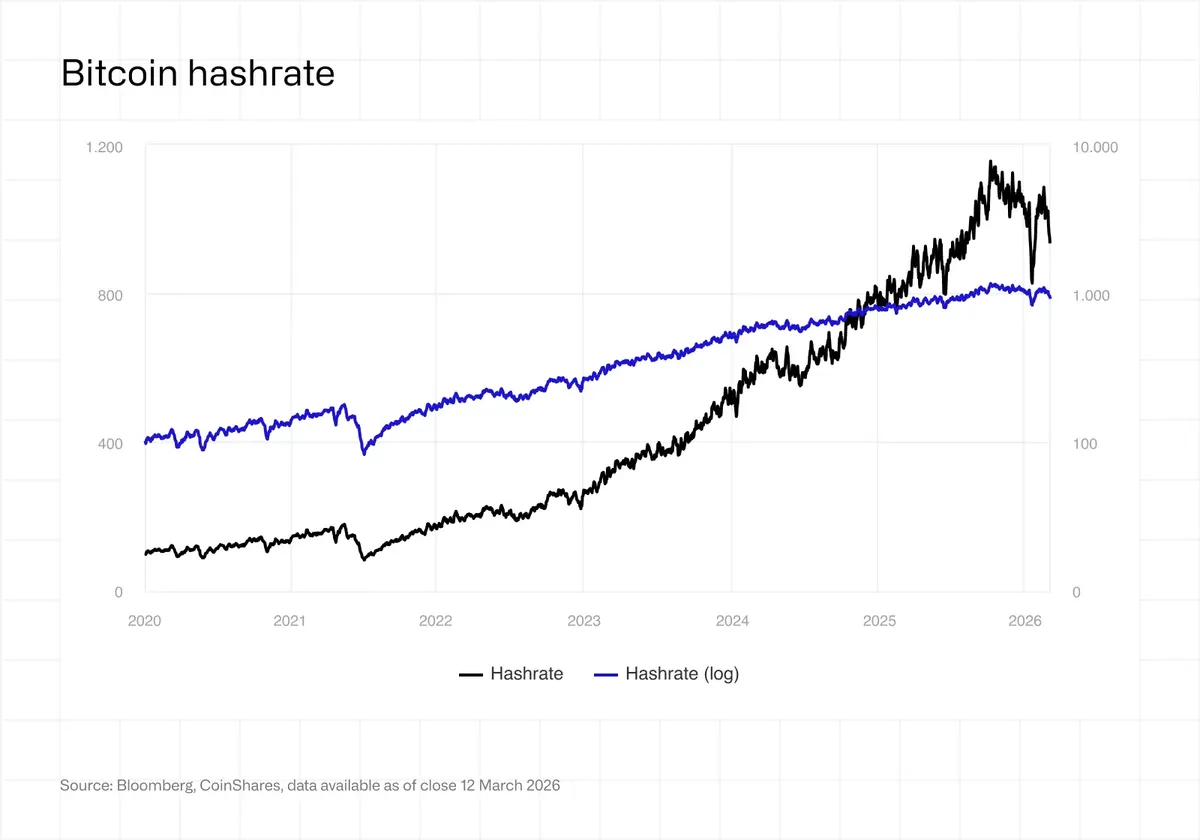
According to CoinShares’ Q1 2026 mining report, more than $70 billion in cumulative AI and high-performance computing contracts have been announced across the public mining sector.
Source: CoinShares
Core Scientific’s expanded deal with CoreWeave is worth $10.2 billion over 12 years, while TeraWulf has $12.8 billion in contracted HPC revenue. Hut 8 has also signed a $7 billion, 15-year AI infrastructure lease at its River Bend campus.
The shift is reshaping miners’ revenue mix, with listed miners potentially deriving up to 70% of revenue from AI by the end of 2026, up from roughly 30%.
The economics are also driving the transition. Bitcoin mining infrastructure costs about $700,000 to $1 million per megawatt, compared with $8 million to $15 million for AI infrastructure. Despite higher upfront costs, AI can offer more stable long-term returns.
Meanwhile, hash price fell to a post-halving low of roughly $28 to $30 per petahash per day in early March, forcing mid-generation miners to secure electricity below $0.05 per kilowatt-hour to remain profitable.
AI infrastructure contracts, by comparison, can offer margins above 85% with multiyear revenue visibility.