Key highlights:
- Two governance proposals could reduce projected SOL emissions by $1.5 billion
- One proposal would double the annual disinflation rate from 15% to 30%
- A second measure would raise daily SOL burns to as much as 9,000 SOL
Solana validators are voting on two proposals that would slow down how fast new SOL enters circulation. The measures could cut projected token emissions by around $1.4 billion to $1.5 billion over the next six years.
Here’s what to know about the two proposals
The network currently creates new SOL every day to reward the validators that secure it. Staking yield for these is near 5.2%, with about 3.78% of that coming from protocol inflation. The rest of that comes from transaction fees and value gained during block production.
The first proposal, named SGP-0002, could speed up how the inflation rate shrinks over time. 21Shares explained how this would play out in a research note.
"It doubles Solana's annual disinflation rate from -15% to -30%, compressing the timeline to Solana's 1.5% terminal inflation rate from approximately 5.7 years to 2.8 years, reaching that level by H1 2029 rather than H1 2032," the firm wrote.
Nominal staking yield could potentially fall to around 4.34% in the first year, then 3% in year two and 2.25% in year three.
The second proposal, named SGP-0003, targets transaction fees. It would split the current 5,000-lamport signature fee into two parts. First, a base fee that goes to the validator producing the block. Second, a resource fee linked to computing power used, which would be destroyed.
This change could push the daily SOL burns from 600-800 SOL up to around 7,500 and 9,000 SOL, according to 21Shares estimates.
Voting results are splitting the two measures
The two proposals are part of the network's first-ever onchain governance system. Each proposal needs at least one-third of the total network stake to participate and two-thirds of participating stake to vote in favor before it passes.
So far, the results are split. The disinflation proposal has taken the lead. It currently has 64.27% support and around 48% participation. The network could reach its minimum 1.5% inflation rate around 2029 instead of 2032 if it is approved. This would cut about 18.9 million SOL out of issuance over the next six years.
The fee-burn proposal is coming up short. It currently has 68.27% support, which is below the two-thirds threshold needed. 16.90% are opposed, and a notably high 21% are abstaining.
Abstentions still count for total participation without counting as support, suggesting that the abstention share could deter its progress. Another proposal, SGP-0001, which sets the basic rules for how these votes work, is passing comfortably with over 87% support.
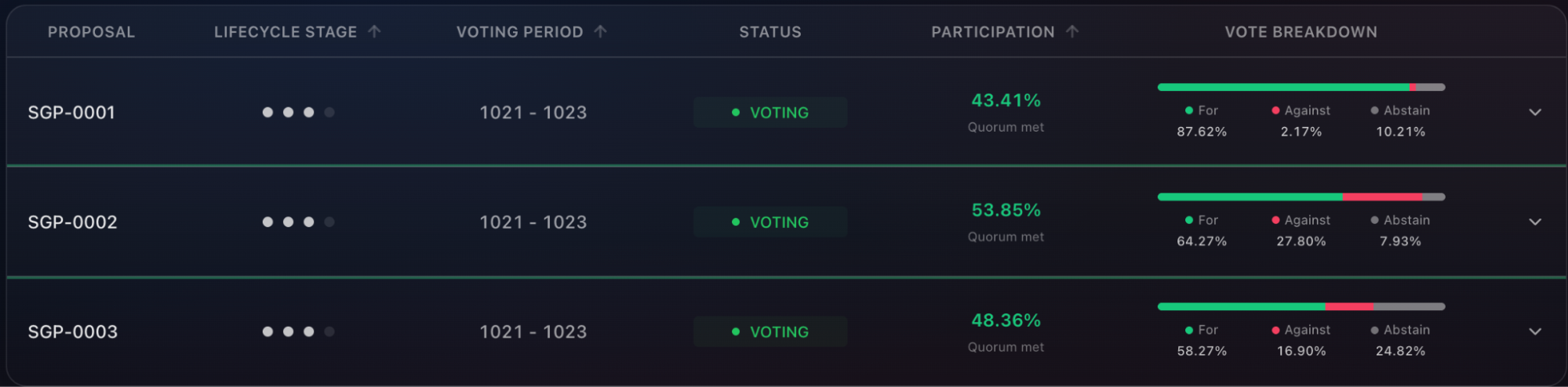
Source: Solana Validator Governance
Public companies are also split on the supply changes
The proposals have drawn opinions from SOL treasury companies. Solana Company (HSDT) said on August 21 that it supports the constitution proposal but opposed the supply measures. The company said in its press release that institutions need predictable, stable economic rules to plan multi-year strategies around.
DeFi Development Corp (DFDV), on the other hand, took an opposite view. The firm shared on August 4 that it fully supports the measures. The firm opined that slower issuance could reduce selling pressure on staking rewards, while higher burns let network activity feed back into SOL's scarcity over time.
Notably, the proposals had already gotten strong support from major validators. Helius and Jupiter were the top supporters, staking about 16 million SOL and 12.47 million SOL, respectively.