Key highlights:
- Bitcoin touched above $81,000 after the largest short liquidation event since 2019, backed by $2.23B in ETF inflows.
- The $81,000–$86,000 zone is key resistance, with a gamma flip at $82,300 and a 365-day VWAP at $82,600
- Fed Chair Warsh's first Jackson Hole speech today is the macro wildcard as hawkish signals would lift yields while an accommodative would strengthen the Bitcoin bull run
Bitcoin’s recovery is entering a more difficult phase as it pushes back above $81,000, with traders now watching the $83,000 area closely ahead of Federal Reserve Chair Kevin Warsh’s first Jackson Hole speech later today.
Bitcoin (BTC) reached as high as $81,148 before dropping to $79,437.
The rally has gained momentum from stronger institutional flows and a sharp reduction in leveraged short positions, but on-chain data suggests Bitcoin is approaching a concentrated supply zone that could determine whether the recovery extends further.
Bitcoin jumps 26% in two weeks as short squeeze sparks fresh buying wave
Bitcoin has gained 4.3% over the past week and 26.5% over two weeks, although it remains 23.3% below its all-time high of $126,080.
Trading volume has also climbed, with $35.83 billion changing hands in 24 hours, up 23.4% from the previous day.
The latest advance follows a sharp rally that began in mid-August, fueled in part by a major short squeeze.
According to Glassnode, Aug. 19 recorded its largest single-day short-liquidation event since 2019, with 85% of liquidations coming from short positions.
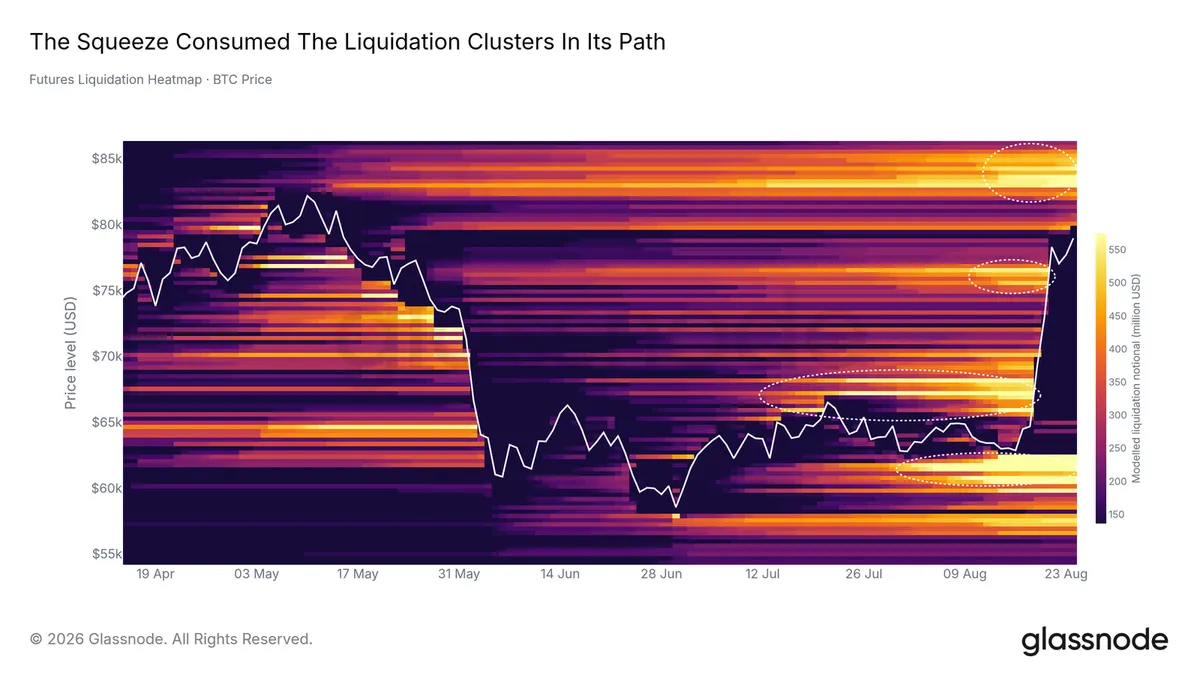
A visualization of the Bitcoin liquidation squeeze. Source: Glassnode
The squeeze helped Bitcoin break through several liquidation clusters, consuming about 86% of the available liquidation fuel, while futures open interest fell 11% in coin terms.
Relatively neutral funding rates suggested the rally was driven largely by forced short covering rather than aggressive leveraged long positions.
Spot demand also strengthened, with U.S. spot Bitcoin ETFs recording $2.23 billion in inflows during the squeeze window, while CryptoQuant reported $1.92 billion in inflows between Aug. 17 and Aug. 21.
The seven-day average reached 3,820 BTC on Aug. 21, its strongest level since early January.
Could Kevin Warsh’s Jackson Hole speech trigger Bitcoin’s next big move?
The market is now turning its attention to Federal Reserve Chair Kevin Warsh’s address at 10 a.m. ET on Friday at the central bank’s annual Jackson Hole symposium in Wyoming.
The speech will be his first major appearance at the event since taking over as Fed chair in May, drawing investor focus to potential signals on interest rates, inflation, and the Fed’s balance sheet.
Warsh has so far avoided strong forward guidance, instead emphasizing economic data and financial-market conditions. That cautious approach has left investors searching for clues about what could trigger a policy shift.
The speech comes as the 30-year Treasury yield recently topped 5.3%, its highest level since 2007, before easing to about 5.18% on Thursday.
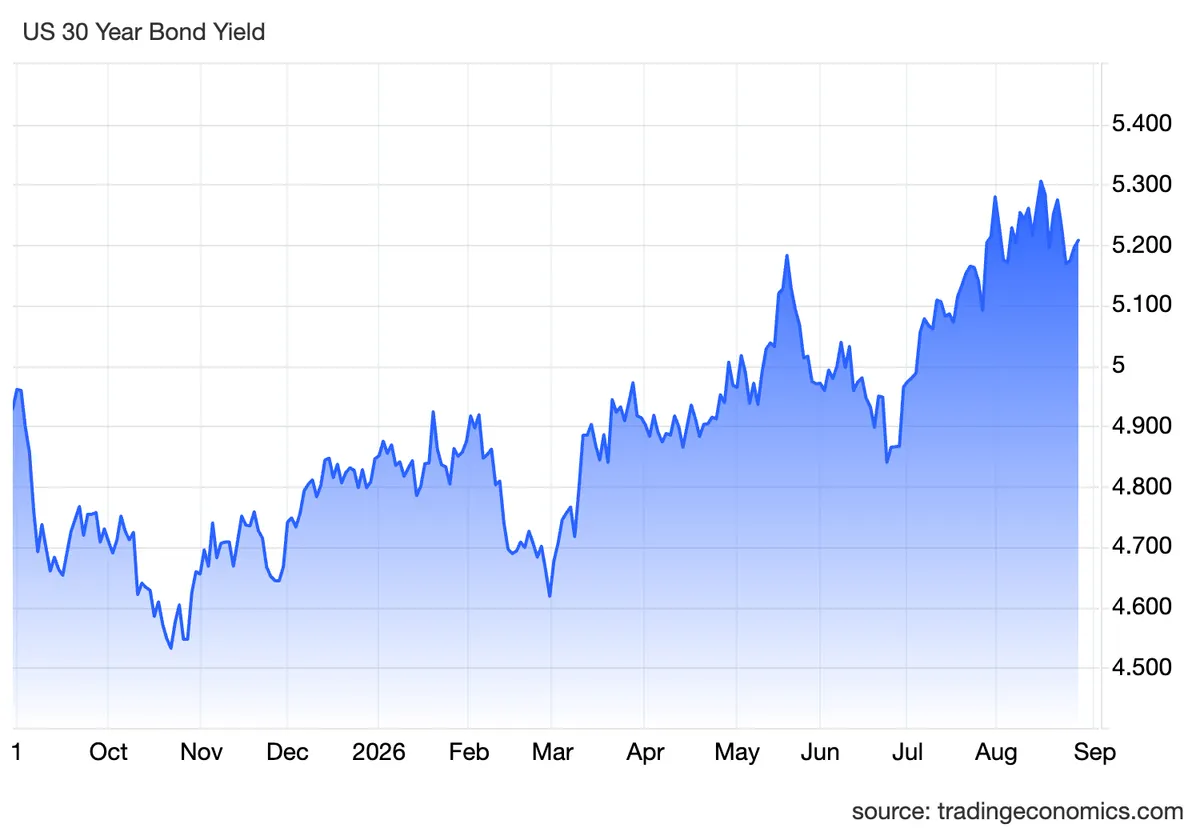
Source: Trading Economics
Other Fed officials have been more direct about the possibility of higher rates. Kansas City Fed President Jeffrey Schmid questioned whether the current 3.50%-3.75% policy rate is restrictive enough to bring inflation down.
Boston Fed President Susan Collins took a more cautious view, describing recent inflation data as “mixed” and saying the need for a rate increase remains an open question.
These conflicting views make Warsh’s speech a potential market catalyst. A hawkish message could lift the dollar and Treasury yields, putting pressure on Bitcoin and other risk assets. A more accommodative tone could strengthen expectations for easier financial conditions and support BTC.
Treasury policy could add another layer to the liquidity picture. Treasury Secretary Scott Bessent plans to increase weekly buybacks of previously issued debt from $2 billion to at least $4 billion starting September 9.
BTC has already climbed from roughly $64,000 to $80,000 alongside a rally in gold. Whether that momentum continues could depend partly on how markets interpret Warsh’s comments on Friday.
Bitcoin recovery faces key $81,000-$86,000 resistance as holders near breakeven
Bitcoin’s recovery is approaching a key resistance zone, with $81,000 to $86,000 emerging as the next major test.
An analyst at Glassnode identifies the area as a significant supply wall, with much of the $83,000-$86,000 supply held by long-term investors nearing their cost basis.
1.05M $BTC of long-term holder supply sits between $83K and $86K, the first heavy cost-basis shelf above spot at $79K.
Effectively all of it has held through the entire drawdown, making that band the test of whether patient supply sells at breakeven.
👉 https://t.co/1Pg8mGjiX7 pic.twitter.com/hd9MTZgp9G— glassnode (@glassnode) August 27, 2026
A move into the zone could therefore determine whether these holders sell as their positions return toward breakeven. Other market indicators point to similar resistance.
A self-custody cost-basis shelf begins near $80,800, while options markets show a gamma flip around $82,300. Short-liquidation levels also extend toward $86,000.
Bitcoin’s broader technical structure adds further focus to the $80,000-$83,000 range, with its 365-day volume-weighted average price near $82,600.
Glassnode said a sustained break above $83,300, particularly alongside strong ETF inflows, could signal that the supply wall is being absorbed.
A drop toward the $70,000 short-term-holder cost basis would weaken the recovery, while a fall to $62,900 could erase the rally.