Key highlights:
- StarkWare has confirmed the first quantum-resistant Bitcoin transaction using its QSB system
- The team noted that QSB is not a silver bullet for Bitcoin’s quantum computing problem, branding it a “parachute.”
- Millions of BTC remain exposed to future quantum attacks, including potentially dormant Satoshi-linked holdings
Bitcoin has recorded what StarkWare describes as its first quantum-resistant transaction on the mainnet without changing the network’s consensus rules. While the milestone offers a potential short-term defense against future quantum attacks, up to 7 million BTC are vulnerable to powerful quantum computers.
Bitcoin completes first quantum-resistant transaction
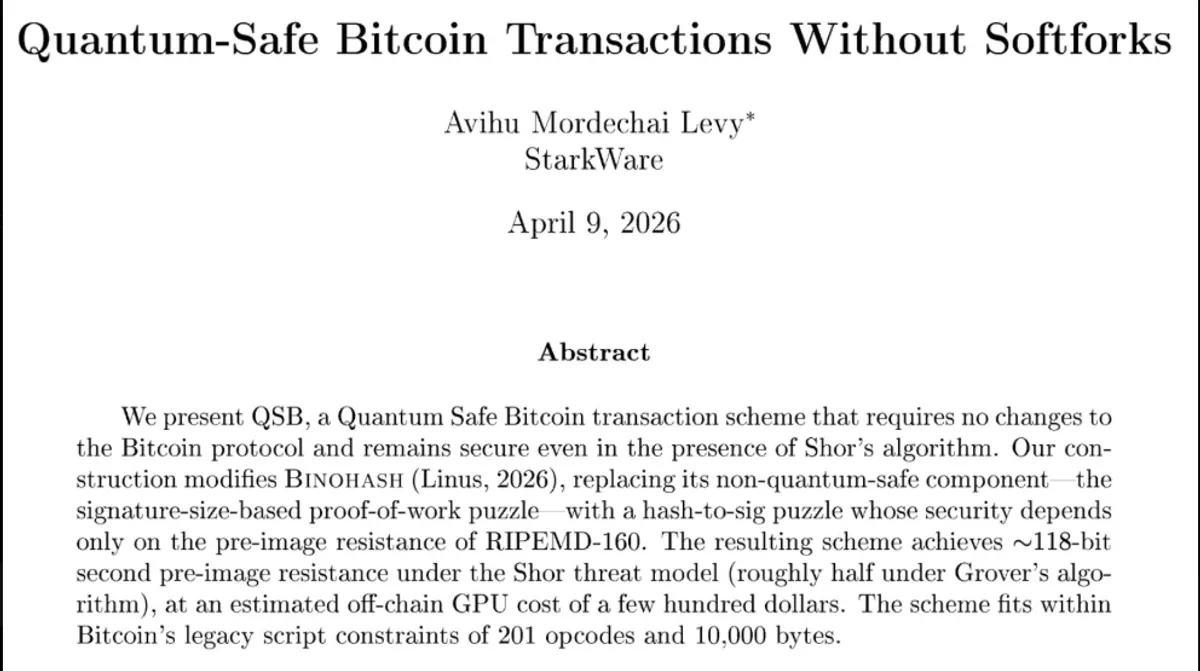
StarkWare researcher Avihu Levy disclosed that Mara’s Slipstream mined the first-of-its-kind transaction, noting its confirmation on the Bitcoin mainnet. Dubbed Quantum-Safe Bitcoin (QSB), the approach was designed to protect Bitcoin without a soft fork or other protocol-level change.
Rather than relying on Bitcoin’s conventional elliptic-curve signature system, QSB uses hash-based protections intended to prevent a future quantum computer from using Shor’s algorithm to access private keys from exposed public keys.
Source: Avihu Levy via X
In an X post, Levy noted that the system comes with significant trade-offs. Right off the bat, QSB transactions are nonstandard and cannot simply move through Bitcoin’s ordinary mempool relay process.
A close look indicates that they require specialized handling and substantial off-chain computation before broadcast. StarkWare urged the Bitcoin community to view the milestone as a “parachute” or “a doomsday bunker” for the impending quantum nuclear war.
“QSB is not a cure for Bitcoin’s quantum problem,” said StarkWare, noting that the project is opt-in only for coins moved into deliberately prepared QSB outputs, which are protected. Furthermore, Levy added that QSB still requires testing, review, and operational hardening, while pointing to sky-high miner fees.
Millions of BTC remain exposed
While present-day quantum computers cannot break Bitcoin’s cryptography, researchers are exploring solutions to protect the network. The most obvious route is migration of coins to address types that use post-quantum cryptography.
Once such addresses become available, users can move their holdings from conventional addresses into quantum-resistant ones. However, there is the challenge that not all coins will move, with Satoshi’s 1.1 million BTC at risk if quantum computers eventually become capable of recovering private keys from vulnerable public keys.
A Coinbase Quantum Advisory Council report estimates that nearly 7 million BTC fall into categories that are vulnerable to quantum attacks. Around 1.7 million BTC are held in old Pay-to-Public-Key addresses, where public keys are already visible on the blockchain.
Back in July, Galaxy Digital committed $5 million for researchers and projects working on the Bitcoin quantum problem. Furthermore, Coinbase and Strategy have teamed up with major industry players to launch the Bitcoin Security Consortium, aiming to fast-track the network’s post-quantum migration.