Key highlights:
- Nvidia beat Q2 estimates with $96.2B in revenue (+50% YoY), led by 117% YoY data center growth to $89B, sending shares up 5.7%
- Q3 guidance of ~$108B topped expectations, with CEO Jensen Huang declaring AI has hit an "inflection point" where compute is now directly revenue-generating
- Nvidia's cloud backlog exceeds $2 trillion, AWS is deploying 2M more GPUs in 2027–28, and neo-cloud GPU capacity is set to nearly triple to 8 GW by year-end
Nvidia delivered another strong quarterly performance Wednesday, beating Wall Street expectations and easing concerns over slowing demand for artificial intelligence infrastructure.
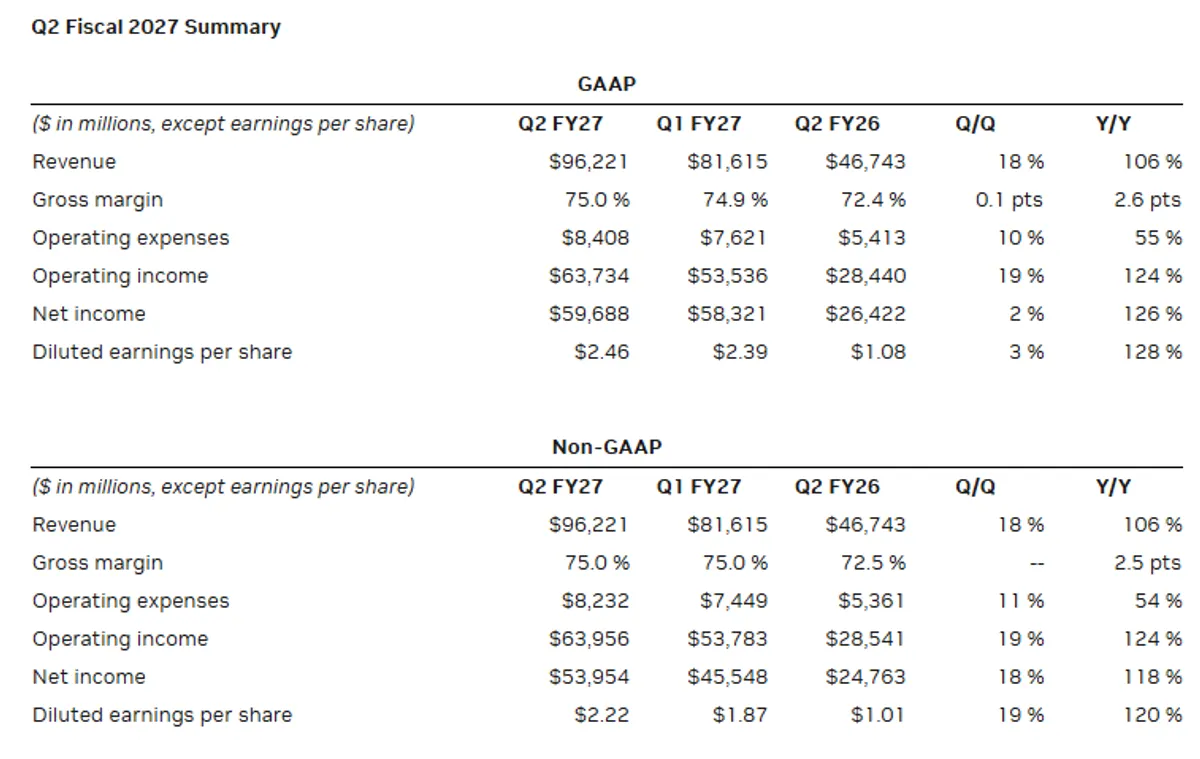
The chipmaker reported $96.2 billion in revenue, up more than 50% year over year and above analysts’ estimate of about $92.4 billion, with adjusted earnings reaching $2.22 per share, compared with expectations of roughly $2.09.
Source: Nvidia
Data center revenue remained the company’s main growth driver, surging 117% year over year to $89 billion and accounting for about 92% of total revenue, topping estimates of roughly $85.1 billion.
Nvidia's share closed Wednesday’s regular session at $209.66, down 1.59%, before reversing sharply after the earnings release and climbing about 5.7% to $221.60 in after-hours trading.
The strong results also broke a recent pattern in which Nvidia beat Wall Street estimates, but its shares fell after earnings. The stock declined following its February, May, November 2025, and August 2025 reports despite those quarters exceeding expectations.
The rally followed a seven-session losing streak that had raised concerns about elevated AI valuations, rising financing costs, and whether the massive spending on data centers could continue at its current pace.
Nvidia guides $108 billion revenue for next quarter as “AI reached inflection point”
The latest results from Nvidia point to continued strength in demand for AI infrastructure, with the chipmaker forecasting another record quarter and stronger growth ahead.
Nvidia expects fiscal third-quarter revenue of about $108 billion, plus or minus 2%, above analysts’ estimate of roughly $104.2 billion.
The forecast would give Nvidia its first quarterly revenue above $100 billion. The company also projects about 70% revenue growth in fiscal 2028, well ahead of Wall Street expectations of around 44% to 45%.
Nvidia CEO Jensen Huang said the artificial intelligence industry has reached an “inflection point” as AI moves from experimentation toward widespread commercial use.
“AI has reached its inflection point. It’s doing useful work. Its tokens are productive and profitable. Now, compute is revenue,” Huang said.
His comments point to growing demand for AI inference, as businesses increasingly use trained models to handle tasks such as answering questions, writing code, and powering applications.
The shift could drive greater demand for AI chips and data center infrastructure as companies deploy AI at scale.
Nvidia looks beyond chips as AI compute demand surges
Nvidia is expanding its capacity to meet that demand through its next-generation Vera Rubin platform, which has begun shipping and is expected to contribute about one-fifth of data center revenue in the current quarter.
The company also expanded its partnership with Amazon Web Services, which plans to deploy an additional 2 million Nvidia GPUs across its infrastructure in 2027 and 2028.
The company said its cloud-industry backlog now exceeds $2 trillion, while AI laboratories could account for roughly a quarter of its business next year.
Nvidia also expects so-called neo-cloud providers, including CoreWeave and Nebius, to end the year with more than 8 gigawatts of Nvidia GPU capacity, up from about 3 gigawatts at the end of last year.
Post-earnings rally lifts AI and semiconductor stocks
Nvidia’s post-earnings rally spread across the AI and semiconductor sector, with Micron gaining about 3.5%, Sandisk 3.7%, Marvell 2.9%, and Intel 1% in after-hours trading. AI infrastructure providers Nebius and CoreWeave climbed about 6.6% and 5.3%, respectively.
The broader market also pointed to a stronger open, with Dow futures up 0.4%, S&P 500 futures gaining 0.5% and Nasdaq 100 futures rising 0.9%.
Semiconductor ETFs also rallied, with both the VanEck Semiconductor ETF (SMH) and iShares Semiconductor ETF (SOXX) advancing about 2.5%, while the Vanguard Information Technology ETF (VGT) gained roughly 2%.