Key highlights:
- An ECB board member has confirmed that the digital euro will provide the highest privacy protection for users
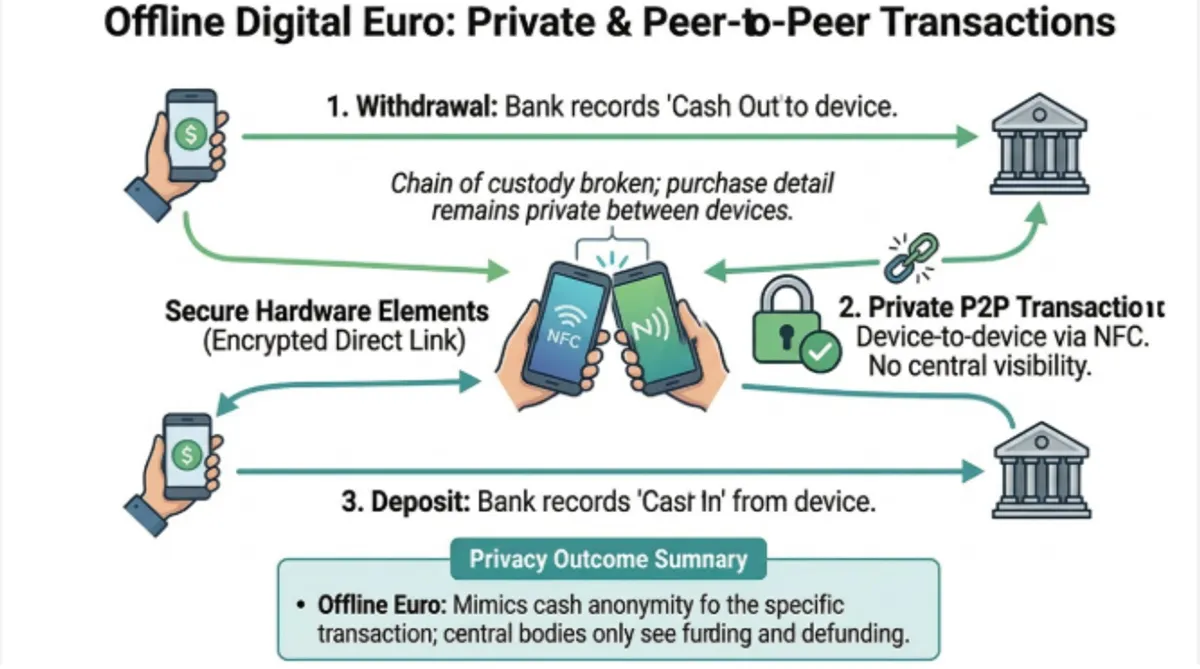
- No third party will access the identities of transacting parties under the offline payment functionality
- A mainstream launch is scheduled for 2029 with major pilots lined up along the way
The European Central Bank (ECB) says the incoming digital euro will offer users a “maximum level of privacy” while downplaying claims that it will be a mass surveillance tool. ECB board member Piero Cipollone confirmed that the Eurosystem will not be able to identify the parties involved in digital euro transactions.
ECB says digital euro will offer maximum level of privacy
Piero Cipollone disclosed the latest update in an interview with Italian news outlet Il Sussidiario, noting that the ECB is putting privacy guardrails for the incoming digital euro. According to Cipollone, the digital euro will provide users with as much privacy as the current technology allows.“
The digital euro guarantees the maximum level of privacy that current technology can offer,” said Cipollone.Right off the bat, the ECB board member noted that third parties will not be able to see the identities of parties using the digital euro’s offline payment functionality. For online payments, Cipollone revealed that only the banks can identify parties in compliance with existing anti-money laundering regulations.
Source: ECB
Cipollone added that the Eurosystem, the monetary authority for the EU, cannot identify parties making or receiving payments in both offline and online digital euro payments. However, it is unclear if the Eurosystem can access transaction amounts under the digital euro privacy rules.
“In practice, whether used online or offline, the Eurosystem would not be able to directly link specific individuals to digital euro transactions,” added Cipollone. The ECB board member also downplayed speculation that the digital euro will lead to a total ban on cash transactions in the region. Cipollone pointed to a public consultation on new euro banknotes as proof that the ECB is not close to banning cash transactions.
The ECB is still stress-testing the digital euro ahead of a scheduled mainstream launch in 2029. In the meantime, a 12-month pilot program is lined up for the second half of 2027 with 36 payment providers named as participants.
Here’s what we know about the digital euro
Apart from its privacy-focused design, the ECB has confirmed that the digital euro will complement cash usage while supporting financial inclusion. The ECB has clarified that the digital euro is not a cryptocurrency but a CBDC issued by the Eurosystem.
Data from the ECB reveals there will be a wallet holding limit to prevent users from moving bank deposits into the CBDC en masse to prevent a financial crisis. The ECB has tested hypothetical limits of up to €3,000 per person and concluded that such limits would not threaten financial stability.Furthermore, the digital euro will not earn interest, while behaving like cash. The ECB intends to create a European payment rail that works across the entire euro area while weakening the bloc’s dependency on Mastercard and Visa.
While the EU is inching toward a mainstream launch in 2029, the US has rejected the concept of a CBDC. China is leading the pace with its yield-paying digital yuan, with several African countries introducing digital versions of their national currencies.