The growth of crypto has been fueled by dozens of innovations in the world of decentralized finance, but for years one of its most enduring assets has strongly resisted being roped into concepts such as yield farming and staking.
For more than a decade, Ripple’s XRP has been firmly entrenched in the top 10 cryptocurrencies in terms of its market capitalization, thanks in part to the fanaticism of its extremely loyal community. But it has been missing out on the rewards to be had in DeFi. While holders of other top tokens like ETH, SOL and AVAX have been able to farm yield, stake their tokens to verify transactions and deploy capital into liquidity pools, anyone with a stack of XRP has had to sit things out. Simply put, there has never been an easy way for them to generate a passive income, until now.
In the last couple of years, Ripple’s ecosystem has undergone a dramatic transformation, and a number of projects have emerged at the forefront of the push to become the de facto yield layer for XRP holders, chasing billions of dollars in capital that has been left sitting idle for years.
No Native Yields
XRP has traditionally been non-existent in the DeFi world, and it was originally designed to be that way. Ripple, the company that created the XRP Ledger, has been laser-focused on a single goal – to become the global standard for processing cross-border payments. To pursue this goal, Ripple built the XRP Ledger specifically with lightning speed and ultra-low costs in mind, so as to make it appealing to the world’s largest financial institutions. For that reason, it shunned models such as Ethereum’s proof-of-stake, meaning there’s no way for token holders to earn rewards for participating in the running of the network.
In addition, Ripple also shunned the idea of Turing-complete smart contract support, deciding that this would only add complexity and negatively impact transaction speeds on the network. These smart contracts are the foundational building blocks of everything in DeFi, from lending protocols to automated market makers and permissionless yield vaults, and without them, it means native XRP DeFi simply cannot exist.
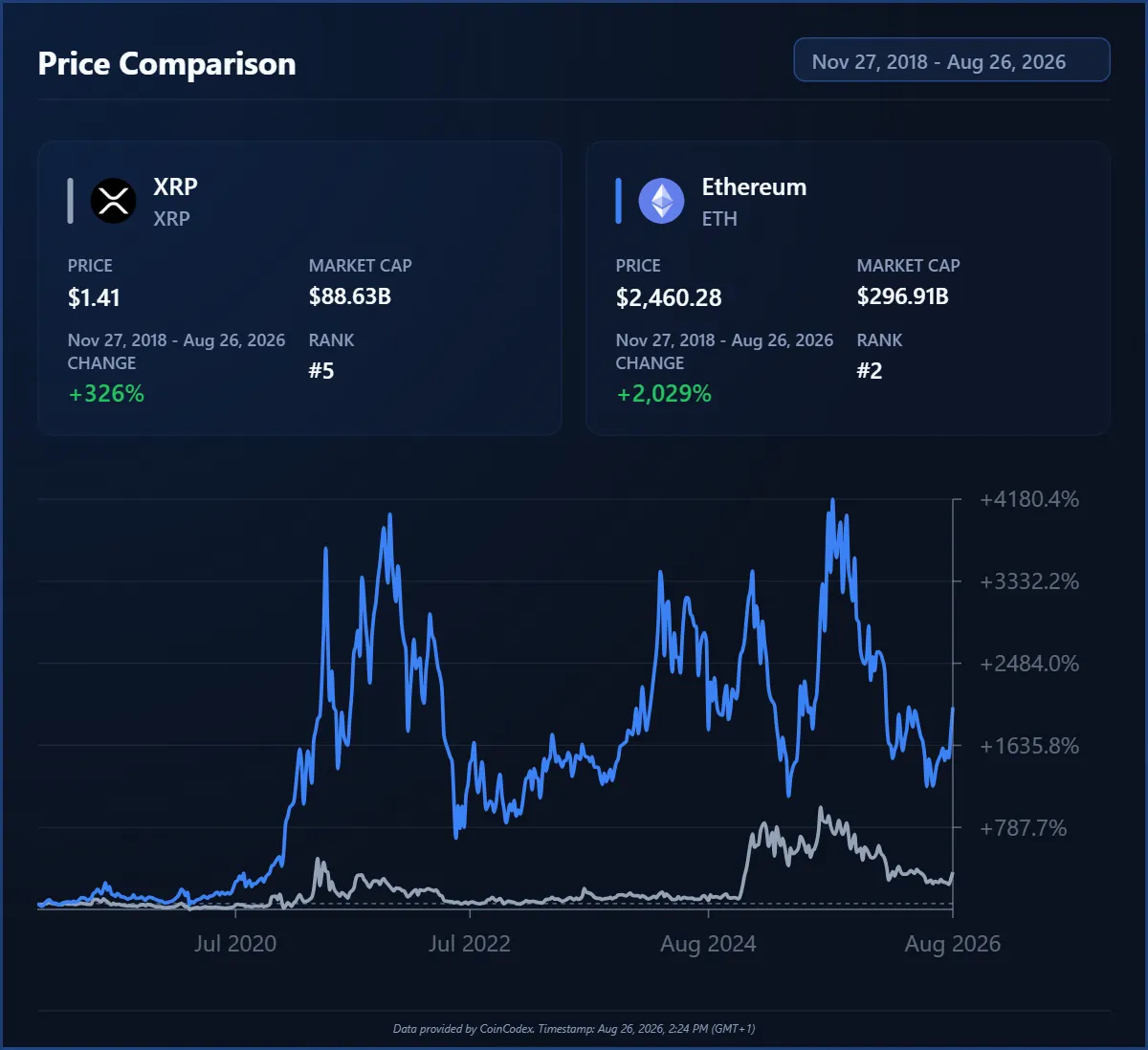
Until recently, that has never mattered to Ripple. The company is dedicated to serving financial institutions rather than retail users, providing pure transaction utility and little else. But this has been a source of frustration for XRP’s legions of believers, who remain convinced that the token will one day blast off to the moon in the same way that Bitcoin did. They’ve been left to watch the value of ETH and other tokens skyrocket over the last decade, while the price of XRP has barely moved during that time. Unlike assets that became deeply integrated into DeFi ecosystems, XRP has historically offered fewer opportunities for holders to put their assets to productive use.
Some people have tried to bring DeFi functionality to XRP in a kind of roundabout way, such as by wrapping the asset so it could be bridged onto EVM-based blockchains that possess the necessary smart contract capabilities. But earning yield on XRP this way involves too much friction, with users forced to rely on third-party custodians to bridge their assets and take on unacceptable counterparty risk.
How Did XRP DeFi Flare Up?
Fortunately, that’s no longer the case. Thanks to advances in areas such as account abstraction and blockchain interoperability, the XRP Ledger is no longer isolated from the world of EVM chains. XRP has gained enormous utility in the last couple of years, with projects such as Flare Network, Midas and, most recently LendProtocol rolling out innovations that dramatically expand what users can do with the asset. No longer is XRP limited to paying for remittance fees. Nowadays, it’s just as productive as any other DeFi asset.
It all started with Flare Network, which is an EVM-based Layer-1 blockchain that has aggressively positioned itself as the most accessible and seamless bridge between the XRP and the broader DeFi economy. Flare made its move last year with the debut of FXRP, a new overcollateralized asset that enables XRP to interact with any EVM-based blockchain.
The main difference between FXRP and other wrapped versions of XRP is that it relies on Flare’s innovative FAssets ecosystem, which simplifies the process of bridging non-smart contract tokens onto EVM networks. Historically, the process of “wrapping” non-EVM tokens has involved depositing assets with centralized custodians in order to receive wrapped versions that can be used in DeFi protocols. FXRP doesn’t require any third-parties to be involved, however. Instead, it relies on Flare’s decentralized data proofs to verify XRP transactions in a trustless way, so that users can easily swap XRP for FXRP and vice versa. Thanks to this mechanism, Flare-based smart contracts have the ability to react almost instantly to XRP transactions on the native XRP Ledger. If someone transfers XRP to Flare to mint FXRP, the new asset must be overcollateralized using a bag of stablecoins and FLR tokens.
Because of Flare’s Smart Accounts functionality, which abstracts away the complexity of this bridging process, XRP can be exchanged for FXRP in a simple, one-click transaction. This means XRP holders now have streamlined access to basically everything that EVM-based DeFi has to offer, including yield-bearing vaults, lending and borrowing protocols, dynamic liquidity pools and various other yield-generating tools. Importantly, FXRP remains an extremely liquid asset, with users able to redeem their tokens for their original XRP at any moment, without having to endure the waiting period that’s so common with other bridged tokens.
XRP’s Evolving DeFi Yields
Flare’s success has inspired a number of other projects to step up and bring more utility to XRP holders. One of the most ambitious is mXRP, which is a liquid staking token launched by the tokenization platform Midas on the XRP Ledger EVM sidechain earlier this year. Midas partnered with the interoperability protocol Axelar to make this happen.
With mXRP, users benefit from an extremely sophisticated yield-generating mechanism that goes beyond simple lending and interest payments. Instead, mXRP leverages highly automated trading strategies focused on interest rate arbitrage and market making, which aim to maximize rewards for users through a series of calculated risks, aiming for a yield of 8% APR. Users simply deposit XRP with Midas to receive mXRP, which can then be lent or used as collateral elsewhere, while simultaneously generating those base rewards. What’s especially compelling about mXRP’s model is that it's highly composable. As a liquid token, it means users never lose access to the original XRP they deposited.
More recently, LendProtocol has taken a strong interest in providing generous returns for XRP token holders. It has developed an entirely new method for XRP to unlock yield that caters to the demand for more stable and predictable returns. LendProtocol acts like a fixed-rate lending platform that’s native to the XRP Ledger, and it stands out for its extremely competitive 12% APR, which compounds further to achieve an effective yield of closer to 13%. Like other lending protocols, it requires users to overcollateralize in order to borrow XRP, depositing assets such as BTC, ETH or USDC. All XRP holders have to do is deposit their tokens into LendProtocol’s liquidity pools and they’ll receive daily payouts without the friction seen on traditional DeFi platforms. In this way, it’s an extremely appealing option for risk-averse XRP holders.
XRP Holders are the Real Winners
Liquidity flows make it clear that Flare’s FXRP is the most mature of XRP’s burgeoning yield layers. However, its competitors are not holding back. mXRP has quickly carved out a niche for itself among more sophisticated users who favor composable, high-risk high-reward DeFi investments, while LendProtocol is gaining ground in the market for fixed returns.
It’s still very early days in the race to become XRP’s most important yield layer, but the initial success of these three projects reveals an almost insatiable appetite among one of the crypto industry’s most intensely loyal communities. XRP’s market cap is enormous – it’s made up of tens of billions of dollars in idle capital that’s just waiting to be put to good use. Hence, the race to become XRP’s ultimate yield layer remains wide open. The biggest winners are not the protocols at all, but the XRP holders who finally have a way to reap the rewards of their ferocious loyalty to one of the most established blockchains of all.