
Key highlights:
- Kalshi raised $1.12B via private equity (targeting $1.5B total), on top of a $1B Series F in May 2026 at a $22B valuation
- A new $750M round is reportedly in talks, valuing Kalshi at $40B ahead of a possible 2027 IPO
- Annualized trading volume hit $178B (up from ~$5B a year prior), with institutional volume up 800%
Kalshi’s latest fundraising disclosure is putting the prediction market industry into the spotlight, with the U.S.-regulated prediction market reporting roughly $1.12 billion in equity sales and a valuation of $22 billion.
A Form D filing made public by the U.S. Securities and Exchange Commission (SEC) on August 25 showed that Kalshi’s private offering began on April 3 and could raise nearly $1.5 billion in total.
About $380 million remains available, with 71 investors listed in the filing, which was signed by CEO Tarek Mansour. It comes at the time prediction markets attract growing interest from institutional investors.
Kalshi’s funding push puts pressure on Polymarket
The disclosure comes after Kalshi raised $1 billion in a Series F round in May, lifting its valuation to $22 billion. Coatue led the round, with Sequoia Capital, Andreessen Horowitz, IVP, Paradigm, Morgan Stanley, and ARK Invest also participating.
The filing does not clarify whether the $1.12 billion includes proceeds from the Series F.
Just weeks after reaching the $22 billion valuation, reports emerged that Kalshi was seeking additional funding at a valuation of up to $40 billion, including a potential $750 million round.
That places Kalshi ahead of Polymarket, its closest high-profile rival. Polymarket completed a funding round in April at a $15 billion valuation, including a $600 million investment from Intercontinental Exchange, the parent company of the New York Stock Exchange. Polymarket is now reportedly discussing another raise of about $1 billion at a valuation above $20 billion.
Polymarket Reportedly Seeks $1 Billion at Valuation Above $20 Billion
Bloomberg reported, citing people familiar with the matter, that prediction market platform Polymarket is in preliminary talks with potential investors to raise about $1 billion at a valuation exceeding $20… pic.twitter.com/rQXvwRNaD2— Wu Blockchain (@WuBlockchain) August 4, 2026
That leaves Kalshi ahead on the latest disclosed valuation, while both companies are pursuing substantially higher valuations as prediction markets expand.
The numbers behind the business help explain the investor interest, with Kalshi’s annualized trading volume reaching about $178 billion by April, up from roughly $5 billion a year earlier, while institutional trading volume increased 800% over six months.
The company has also reported annualized revenue above $2 billion and claims more than 90% of U.S. prediction-market activity.
Its July performance further showed the scale of the business, as Kalshi recorded about $37.7 billion in monthly trading volume, compared with a combined $12.9 billion across Polymarket’s global and U.S. platforms.
Prediction markets gain momentum as institutional interest grows
Prediction markets continued to expand in July, with Kalshi and Polymarket recording a combined $50.6 billion in trading volume, up from $47 billion in June.
World Cup-related contracts drove a significant share of the activity, although trading cooled after the tournament ended. Kalshi accounted for $37.7 billion, while Polymarket’s global platform and U.S. operations generated a combined $12.9 billion.
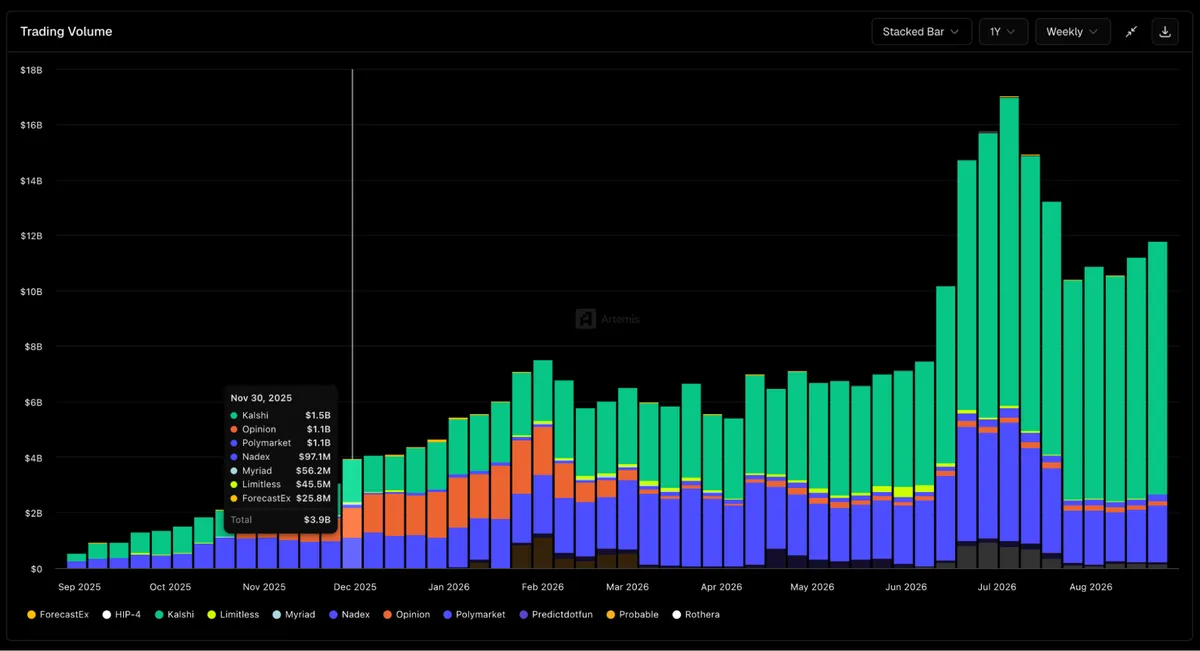
Prediction market trading volume Source: Artemis
Kalshi is also pushing deeper into institutional finance. In August, Cantor Fitzgerald announced plans to give institutional clients brokerage access to Kalshi, with Susquehanna International Group serving as a market maker. The arrangement is designed to support larger block trades and broaden institutional participation.
The institutional shift could help prediction markets become more than retail-driven event trading, but liquidity remains an important hurdle.
Large trades can move prices sharply in thinner markets, making deeper order books essential for professional investors.
Also, legal issues have also been a barrier, as Kalshi continues to face disputes in several states, including Washington, Nevada, Connecticut, New York, Massachusetts, and others, over whether event contracts should be regulated as financial products or gambling.