Key highlights:
- Bitcoin held near $80,000, up about 25% weekly, as oil fell 3.6% to under $86 on renewed U.S.-Iran diplomatic talks
- Iran condemned the latest U.S. sanctions and warned of retaliation, while China and Russia rejected the pressure campaign
- U.S. stocks advanced as Treasury yields eased, with the S&P 500 up 0.3% and Nasdaq 0.7%, ahead of Nvidia’s closely watched earnings report
Bitcoin held near $80,000 on Tuesday as easing oil prices and a rally in U.S. stocks improved sentiment across risk assets.
The move came as renewed diplomatic efforts between the United States and Iran raised hopes of easing tensions and reducing the risk of further disruptions to global energy supplies.
The market had faced renewed pressure in recent days after Washington announced a broader sanctions campaign against Tehran, fueling concerns over higher oil prices, inflation, and further weakness across risk assets.
On August 24, the Treasury launched what it called “Operation Economic Outcast,” expanding potential secondary sanctions to Iran-linked activity across digital assets, technology, gold, aviation, and shipping.
Nearly 60 crypto individuals, entities, and vessels were also sanctioned for processing over $100 million in cryptocurrency payments connected to Iran's oil trade and sanctions evasion.
Iran, China, and Russia push back on U.S. sanctions
Iran condemned expanded U.S. sanctions on Tuesday, calling them an act of “gross lawlessness” and warning that Washington should expect a response.
Iranian Economy Minister Ali Madanizadeh described the measures as an “economic terrorist attack” and said Tehran was prepared to retaliate. He warned that Iran’s response would not necessarily be defensive, saying countries should “expect an attack” from Iran.
Iranian Economy Minister Madanizadeh on US sanctions:
We have been waiting for these days for a long time, and we knew what plans they had.
The government has a two-year plan and was completely ready for these events to happen.
The unipolar world is over, and they will… pic.twitter.com/9KSphBQ6WK— Clash Report (@clashreport) August 24, 2026
China and Russia have rejected the U.S. pressure campaign. China said its cooperation with Iran complies with international law and opposed what it called illegal unilateral sanctions.
Meanwhile, diplomatic efforts to de-escalate the conflict have resumed. Iran and Oman discussed a proposed temporary navigation corridor through the Strait of Hormuz, while Pakistan reported progress in talks aimed at reopening the strategic waterway.
BTC climbs above $81,000 amid increasing tension
Bitcoin's rally began on Monday after it briefly climbed above $81,000, its highest level since mid-May, before it now retires to around $79,000.
BTC remains up roughly 25% over the past week, extending a sharp recovery from the low-$60,000 range, although it was still down about 2% over the previous 24 hours at the latest reading.
Its surge was accelerated after the U.S. Treasury announced plans to significantly increase purchases of longer-dated government bonds, raising expectations for improved liquidity.
The broader market also recovered after Monday’s decline, when technology stocks came under pressure as investors assessed the latest U.S. sanctions on Iran and positioned themselves ahead of Nvidia’s earnings report.
Oil prices fall 3.6% as Treasury yields drop and stocks gain
Oil markets, on the other hand, fell with Brent crude falling 3.6% to under $86 a barrel, marking its second consecutive daily decline after gaining in 13 of the previous 14 sessions.
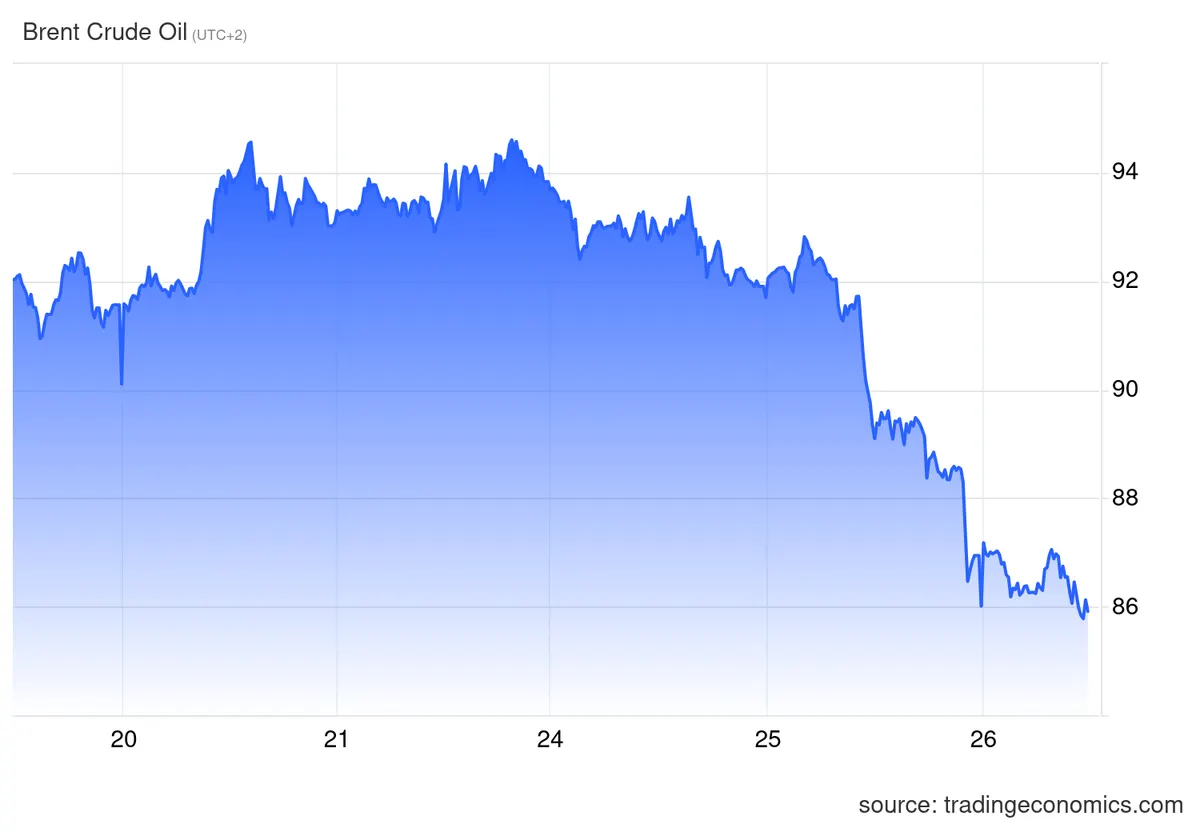
The decline helped ease fears that the latest U.S.-Iran tensions would trigger a sustained oil-supply shock.
U.S. equities also recovered, with the S&P 500 rising 0.3% to 7,677.28, bringing the index closer to its recent record. The Dow Jones Industrial Average gained 0.3% to 53,577.40, while the Nasdaq Composite advanced 0.7% to 26,151.30.
Meanwhile, the decline in oil prices helped push Treasury yields as they fell to 4.63% from 4.70% on Monday, improving financial conditions for risk assets.
Lower yields can reduce the relative attractiveness of government bonds and provide support for equities and cryptocurrencies such as Bitcoin.
Why Oil prices matter so much for Bitcoin and Stocks
Oil is particularly important for Bitcoin and stocks because a sustained rise in crude prices can feed directly into inflation.
Higher energy costs can push consumer prices higher, keep interest rates elevated, and increase Treasury yields, conditions that generally make risk assets less attractive.
The latest decline in oil prices therefore eased some of the pressure that had been building across financial markets.