Key highlights:
- Nvidia fell 2.91% to $208.48 on Monday, marking its seventh straight decline and wiping about $414 billion from its market value
- The decline comes ahead of Nvidia’s fiscal Q2 2027 earnings on August 26, with revenue guidance of about $91 billion, up 95% year over year
- Rising memory costs and the 30-year Treasury yields rising above 5% and $40 trillion in U.S. debt are raising financing costs for AI data centers
Nvidia shares (NVDA) extended their losing streak on Monday, falling 2.91% to close at $208.48 and marking a seventh consecutive daily decline, the longest such run for the stock since September 2022.
Since the August 13 close at $225.30, Nvidia has lost about 7.5%, wiping roughly $414 billion from its market value over seven sessions.
Notably, the AI infrastructure and the semiconductor market were also under pressure as the Philadelphia Semiconductor Index dropped 2.7%, Micron fell 5.83%, Super Micro Computer fell 5.56%, Taiwan Semiconductor Manufacturing lost 3.7%, Broadcom fell more than 2%, and AMD finished lower as well.
The decline comes just days before one of the most closely watched earnings reports of the year.
Nvidia is scheduled to release its fiscal second-quarter 2027 results after the U.S. market closes on Wednesday, August 26, with investors looking for fresh evidence that the enormous spending on artificial intelligence infrastructure is still translating into strong demand for its chips.
NVDA stock tests key support as Nvidia faces a crucial week
Nvidia guided for fiscal second-quarter revenue of $91 billion, plus or minus 2%, while Wall Street estimates are around $92 billion, with adjusted earnings expected at roughly $2.08 to $2.09 per share.
At the midpoint of Nvidia’s guidance, revenue would be about 95% higher than a year earlier.
Nvidia has repeatedly beaten earnings and revenue expectations, yet its shares have fallen after each of its last four reports.
In February 2026, Nvidia reported $68.1 billion in quarterly revenue, but shares dropped 4.13%, from $192.85 to $184.89. In May, revenue surged 85% year-over-year to $81.6 billion, yet the stock slipped 0.50%, from $220.61 to $219.51.
The pattern continued in November 2025, when shares fell 0.40% after a strong earnings report. In August 2025, Nvidia dropped 0.88%, from $181.77 to $180.17, despite beating analyst estimates.
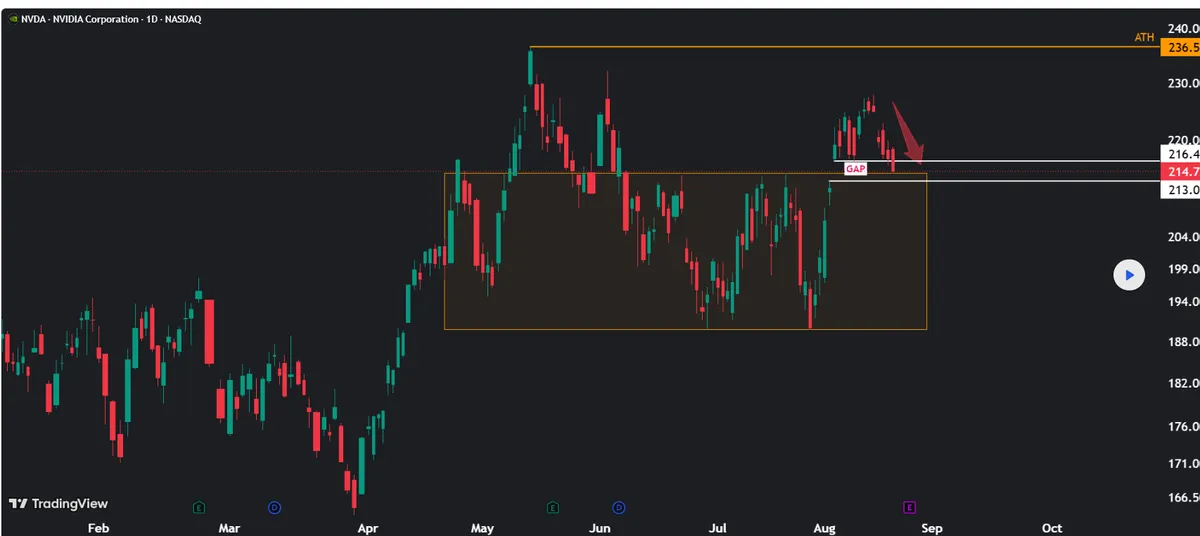
Technically, Nvidia's pullback has brought the stock closer to several important levels. Shares closed at $208.48 on Monday, while immediate support has been identified around the $206 to $207 area.
A stronger support zone sits around $190 to $197, with the 200-day moving average around the mid-$190s in some market measurements.
On the upside, NVDA faces resistance around $224 and then its May record closing high of $236.54.
Despite a seven-day decline, NVDA remains up about 11.7% year-to-date, roughly matching the S&P 500’s 11.8% gain.
AI stocks face pressure from higher yields and chip costs in 2026
The AI trade is facing growing pressure as investors weigh strong demand for artificial intelligence against higher financing costs and rising hardware prices.
The pressure extends beyond Nvidia to companies including Microsoft, Alphabet, Amazon, Meta, Oracle, and OpenAI, all of which are committing billions of dollars to data centers and AI infrastructure.
Nvidia remains a key focus, with Bloomberg reporting that major customers have been notified of server price increases of more than 15%, driven largely by rising memory costs. Higher hardware prices could increase the cost of the broader AI buildout and pressure companies to generate stronger returns from their investments.
At the same time, rising Treasury yields are making it more expensive to finance these projects. The 30-year Treasury yield recently climbed above 5%, while U.S. debt has surpassed $40 trillion, increasing concerns about borrowing costs and inflation.
The pressure is particularly important for AI companies funding massive data center expansions with debt, as they face higher costs as yields rise, increasing pressure to deliver stronger revenue and cash flow.
For AI stocks, the key question is whether future earnings can justify the rising cost of AI infrastructure.