
Key highlights:
- Tether’s sizable investment in Bitcoin mining has hit a stumbling block in Uruguay
- Authorities cut power supply to Tether’s mining sites over a contract disagreement
- Tether is still investing in Bitcoin mining in Latin America amid surging USDT adoption across the region
Barely three years after investing $120 million in Bitcoin mining infrastructure in Uruguay, Tether has reportedly closed the curtain on the ambitious project. As the stablecoin issuer counts its losses, USDT adoption in Latin America is on the rise, fuelling cross-border transactions in developing countries.
Tether abandons $120 million Bitcoin mining project
According to Reuters, stablecoin issuer Tether has abandoned its $120 million Bitcoin mining project in Uruguay following a disagreement over electricity allocation with local authorities. Per the report, Uruguay’s state-owned public electricity utility provider UTE cut power supply to Tether’s mining sites after parties failed to reach a middle ground for an energy supply contract.
Back in May 2023, Tether announced the launch of Bitcoin mining operations in Uruguay, citing abundant renewable energy and a robust grid. The stablecoin issuer invested $120 million on two mining facilities in Uruguay and by February 2024, operations in the facilities had commenced, generating income for Tether.
While operations ran without a hitch, the first crack in the wall appeared when Tether sought an increase in the amount of electricity to its mining facilities. Tether hinged its argument on a clause in its contract with UTI which it believed entitled it to a minimum level of power that could be increased.
However, UTE argued that the amount in the contract represented the maximum allocation which cannot be exceeded. After a left-leaning government took office in early 2025, chances for a renegotiation fell through with UTI and Tether failing to reach a compromise
Tether’s legal entity in Uruguay, Microfin, stopped paying its electrical bills and UTI cut electricity supply to both Bitcoin mining sites. Tether told authorities that it will cease operations and lay off its staff, effectively bringing down the curtain on its ambitious mining project.
USDT adoption is surging amid dwindling mining fortunes
Pundits theorize that rising energy costs and falling Bitcoin mining profitability were underlying issues that plagued Tether’s foray. Several traditional Bitcoin miners have pivoted to AI over profitability issues, with a data centre power crunch providing a $150 billion opportunity for industry players.
While the Uruguay projects failed, Tether is still keen to invest in Bitcoin mining. The company has acquired a 70% stake in Adecoargro with plans to use renewable electricity from its operations for Bitcoin mining across South America.
Meanwhile, Tether CEO Paolo Ardoino is looking at the silver lining in the dark cloud. He pointed to rising USDT adoption in Venezuela, Argentina, and Bolivia, with use cases spanning inflation hedging, import and export settlement, P2P trading, and local commercial transactions.
“Several developing countries’ economies are heavily relying on USDT for both internal and foreign commerce,” wrote Ardoino on X.
Tether’s USDT holds a market capitalization of $183 billion, more than double the size of its closest competitor, Circle’s USDC. Recently, Tether announced the completion of a major KPMG audit, putting to rest speculation over the details of its balance sheets.
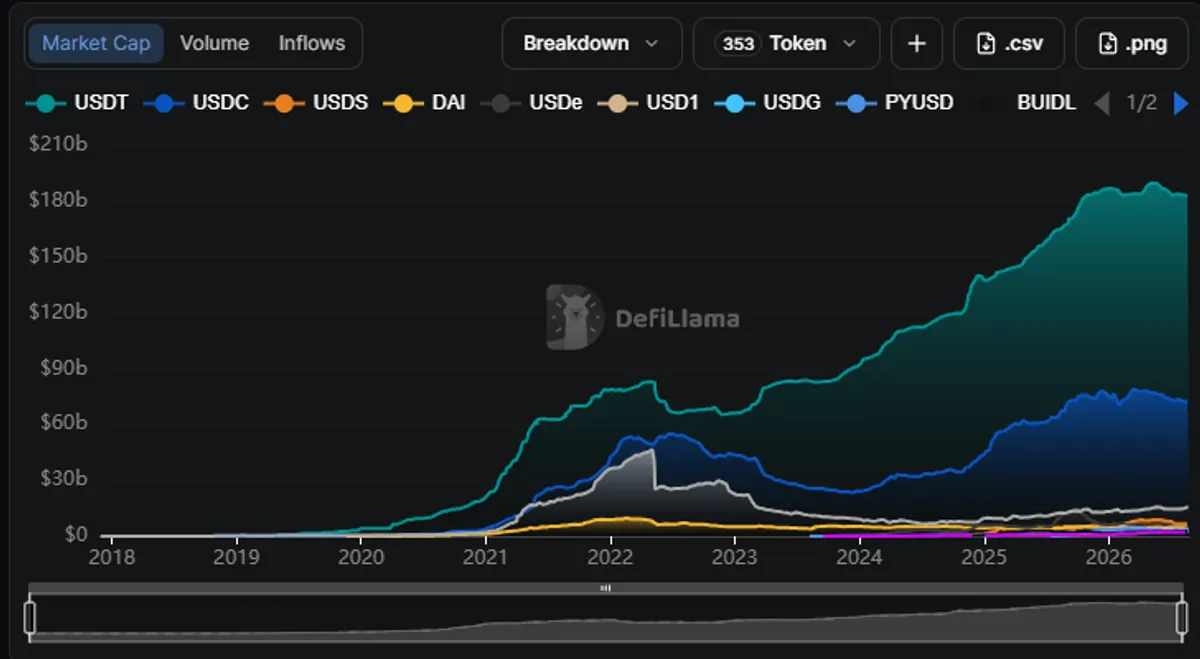
Source: DeFiLlama