
Key highlights:
- Tether has announced a full company audit by KPMG, bagging a near-perfect score from the accounting giant
- KPMG counted individual gold bars held by Tether as part of the audit
- However, the company did not release the audit to the public, while critics slam it for not complying with the GENIUS Act
Stablecoin issuer Tether has completed the “largest inaugural financial audit in history,” tapping KPMG U.S. to review its financials. While KPMG hails the audit as “historic,” critics say it falls short of the standards laid out by the GENIUS Act.
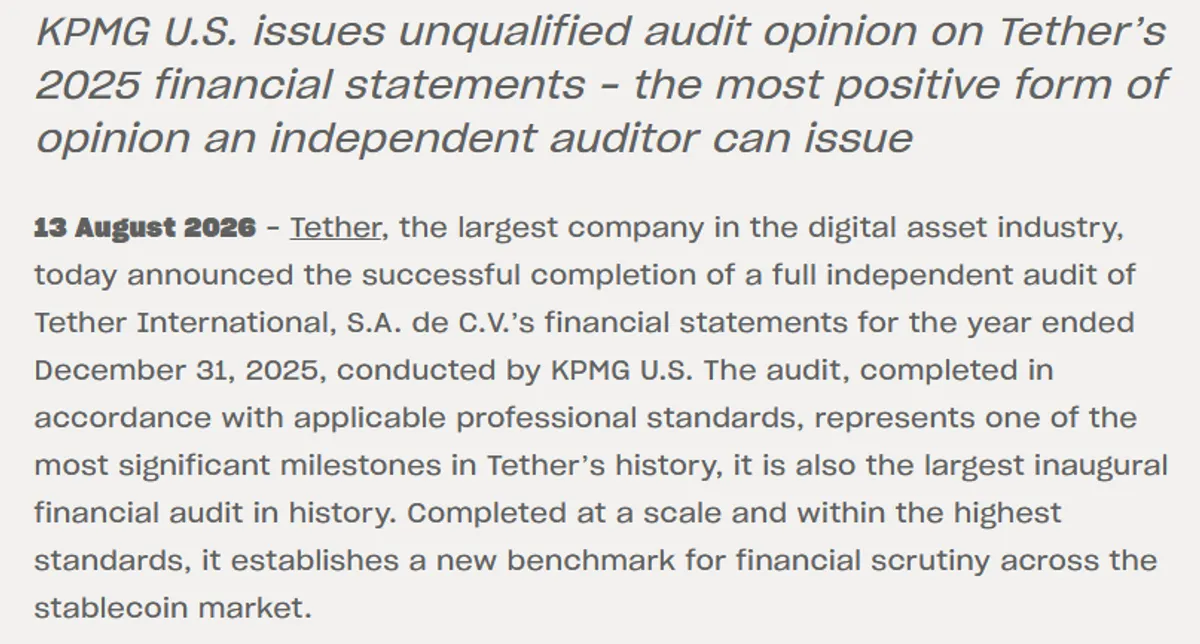
KPMG issues unqualified audit opinion on Tether
According to an official announcement, KPMG issued an unqualified audit opinion on Tether’s 2025 financial statements after scrutiny of the stablecoin issuer’s financial records. Tether described the audit as a “first-of-its-kind” in the stablecoin industry, with company CEO Paolo Ardoino noting that KPMG left no stone unturned.
Source: Tether
As part of the audit, KPMG physically counted and inspected each gold bar held by Tether, rather than relying on reports from counterparties. Furthermore, KPMG auditors pored over relevant statements, including income, change in equity, and cash flows, issuing a clean opinion for the stablecoin issuer.
An unqualified audit opinion, also known as a clean opinion, is a positive report issued by an independent auditor. It indicates that a company’s financial data matches its actual business activity and the auditor found no major flaws or rule-breaking choices in the numbers.
“KPMG did not simply review a set of headline figures,” said Ardoino. “KPMG conducted a full and thorough audit in accordance with AICPA standards.”
Before the KPMG audit, Tether did not release full financial audits, drawing heavy criticism from several sector players. However, the stablecoin issuer published periodic quarterly reserve attestations primarily carried out by BDO Italia.
The latest quarterly reserve attestation revealed that Tether generated $1.15 billion in net operating profit in Q2 2025. Meanwhile, its critical excess reserve cushion shrank by 50% to $4.11 billion, with its gold holdings reaching a record 146.2 metric tons in Q2 2026.
Critics poke holes in Tether’s KPMG audit
Right off the bat, critics have taken swipes at the KPMG audit. The loudest voices argue that Tether failed to release the KPMG audit for public scrutiny alongside the announcement.
Furthermore, critics say the latest audit is not in compliance with the GENIUS Act. KPMG’s audit was conducted under American Institute of Certified Public Accountants (AICPA) standards rather than Public Company Accounting Oversight Board (PCAOB) standards, required by the GENIUS Act.
To achieve compliance with US regulations, Tether launched USAT to jostle for market share with Circle's USDC. Across the Atlantic, USDT has been forced off all licensed EU crypto exchanges after Tether failed to meet the requirement of holding 60% of its reserves as cash deposits in EU commercial banks.
Meanwhile, Tether’s global user base has accelerated past half a billion individuals. USDT holds the clear market lead as stablecoins lead the charge for increased crypto spending in recent weeks.