Key highlights:
- Strategy and Metaplanet could be removed from major stock indexes in November
- The new MSCI test is based on five financial ratios instead of just crypto holdings
- Companies must fail at least four of five ratio tests to be classified as non-operating
- A decision is expected by October 16
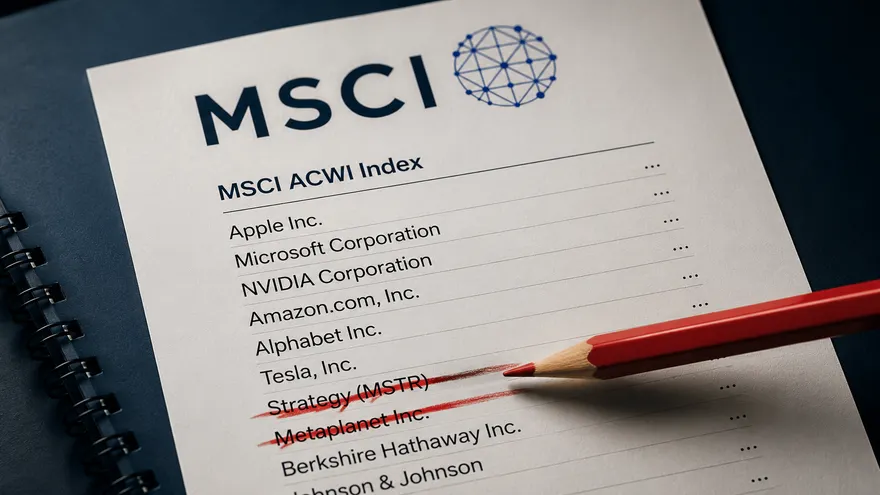
MSCI is considering a new methodology that could remove Strategy, Metaplanet and other treasury companies from its Global Investable Market Indexes as early as the November 2026 review.
The index provider's consultation proposes screening out what it calls "non-operating companies.” They are using a set of financial tests rather than singling out firms based on just the amount of crypto it holds.
MSCI Proposal Could Remove Strategy and Metaplanet From Global Indexes
MSCI is consulting on proposed changes to the eligibility of non-operating companies for its Global Investable Market Indexes (GIMI). A simulation using May 2026 data shows that Strategy (MSTR), Yellow Cake… pic.twitter.com/qqPjYOidIf— Wu Blockchain (@WuBlockchain) August 14, 2026
How MSCI's screening test works
A simulation run using May 2026 data found that Strategy, Metaplanet and uranium investor Yellow Cake would all have been deleted under the proposed rules.
Strategy's free float adjusted market cap was $23.93 billion in that simulation. Yellow Cake's stood att $1.81 billion, and Metaplanet's at $654 million.
Three other companies, SharpLink, Center Laboratories, and Lydia Holding, are set to be on a public watchlist. This comes as the simulation found only one qualifying period of failure for each instead of the two consecutive failures needed for removal.
The proposal uses a two-stage process. A company passes if its operating assets make up more than 50% of total assets. If it falls short of that mark, it moves to a second test that is based on five parameters. This includes operating asset intensity, expense intensity, operating cash flow, non-operating fair value changes, and how much the company depends on outside financing to grow its asset base.
A company is seen as non-operating if it meets at least four of those five flags. Existing index constituents get a bit of breathing room since they need to fail two consecutive annual reviews before being removed. New candidates would be ineligible after failing the most recent review.
This new method is very different from MSCI's earlier move to address the issue. In January, the index provider abandoned a proposal that would have removed companies holding 50% or more assets in Bitcoin or other coins. The process was stopped after investors questioned if the process could definitively differentiate an operating business from an investment vehicle.
Strategy especially pushed back on that plan, calling the method arbitrary. The firm also added at the time that it unfairly picked on crypto treasuries, ignoring companies holding other assets.
What this could mean for Strategy, Metaplanet
The stakes of a potential removal are quite significant. Deletion from an MSCI index matters because funds that were built to track that benchmark would need to adjust their holdings once the index composition changes.
MSCI has not published its own estimate of how much selling this proposal could flag. JPMorgan said in January that Strategy could see $2.8 billion in sales if removed from the indexes.
Strategy's balance sheet is still based on Bitcoin. Its SEC filing showed that it holds 840,447 BTC worth $53.18 billion. The company made a move this week, selling 1,690 BTC for $108.6 million. This was done to help repurchase its STRC stock. The company’s CEO recently said they could restart buying BTC later this year.
Metaplanet, meanwhile, currently holds 43,000 BTC on its corporate tracker and has been part of the MSCI Japan Index since February 2025.
The new proposal would be open for feedback from September 30, and a decision could be reached by October 16. Changes would then be deliberated on for the November 2026 review.