Key highlights:
- Solana nearly hit its consensus limit after a routing failure took 28.83% of stake SOL offline
- The blockchain kept producing blocks as 597 of 699 staked validators remained online and continued voting during the disruption
- The incident exposed infrastructure concentration risks, with a single connectivity provider and a major validator operator accounting for a significant share of affected stake
The Solana blockchain came within striking distance of a network-wide freeze after a routing failure at infrastructure provider Teraswitch knocked 29% of staked SOL offline. While the network continued producing blocks and processing transactions throughout the incident, the disruption brought Solana close to the threshold where transaction finality would have stopped.
Routing failure takes Solana validator offline
The incident began with a bad internet route originating from Teraswitch’s Miami facility before spreading to data centers in Asia and Europe. Validators in London, Amsterdam, Frankfurt, Singapore, and Tokyo lost connectivity, while infrastructure in North America remained online.
Marinade Finance disclosed that 28.83% of Solana’s staked tokens became delinquent, leaving the network 19.9 million SOL away from the threshold at which finality would have stopped. Solana requires over two-thirds of its active stake to participate for transactions to reach finality, meaning more than one-third going offline can prevent the network from finalizing transactions.
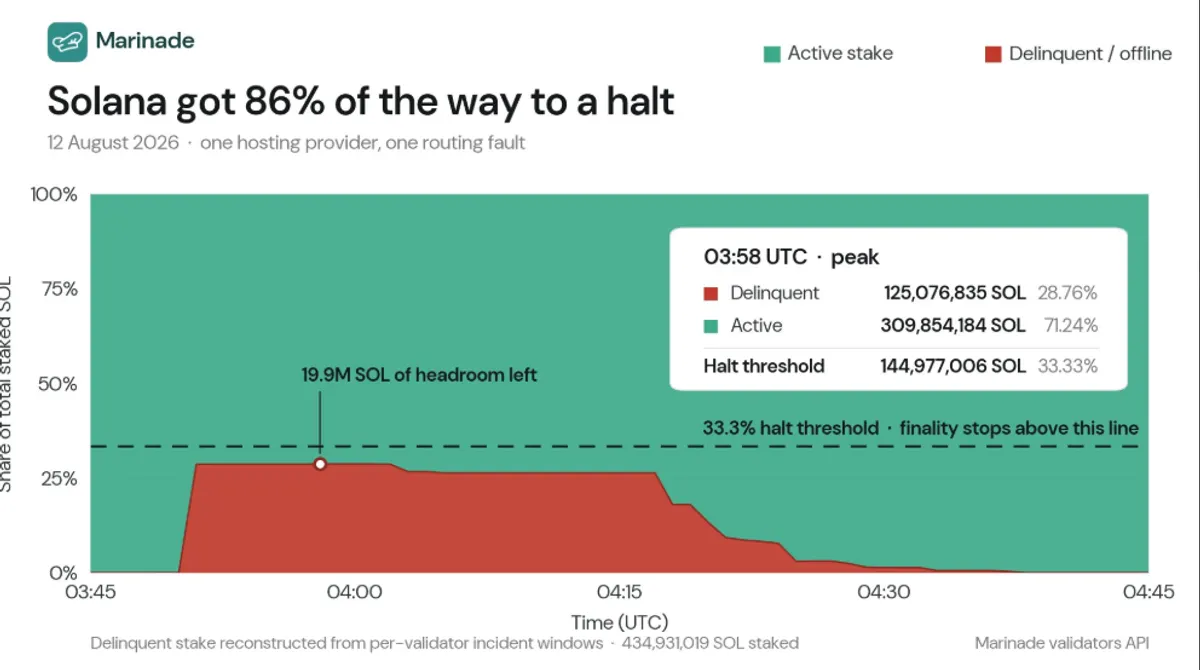
Source: Marinade Finance
“Solana got 86% of the way to a halt this morning, and it barely registered anywhere,” said Marinade Finance. “28.83% of staked SOLM went delinquent. Finality stops at 33.34%.”
Teraswitch resolved the routing problem within 10 minutes, with traffic restored by 4:16 a.m. UTC. A total of 90 validators were affected, with Marinade Finance pegging the rewards lost by the cohort at 333 SOL.
Despite the loss of almost a third of its stake, Solana did not halt. The Solana Foundation said 497 of 699 staked validators continued voting and that blocks continued to be produced throughout the disruption.
The incident exposed a concentration risk within Solana’s infrastructure. One operator identified as AS2032 accounted for more than a quarter of all staked SOL and lost connectivity during the routing failure.
Solana’s design proves sturdy as SOL price holds steady
Solana Foundation technology executive Jacob Creech disclosed that the network’s resilient design allowed it to weather the validator disruptions. Creech pointed to Solana’s “decentralization and infrastructure diversity” as key to guiding the network through stress periods.
“Because Solana validators are distributed across independent infrastructure providers, the failure of a single provider did not interrupt the network,” said Creech.
The episode is notable because Solana has previously suffered a streak of network outages in the past. However, the incidents have become few and far between in recent months, teeing up the network for greater institutional adoption.
The incident did little to dent the price of SOL over the last day. At press time, SOL is exchanging hands at $76, dipping by only 0.51% in the last 24 hours, highlighting its resilience. Meanwhile, daily trading volume held steady at $1.37 billion at current levels, pointing to an incoming breakout for the asset.