
Key highlights:
- BIP-110’s minority chain stalled after mining just two blocks, highlighting its lack of network-wide support
- Only around 2.53% of Bitcoin’s hashpower supported BIP-110, far below the 55% signaling threshold
- The failed bid underscores the difficulty of forcing changes to Bitcoin's consensus without broad support from miners and the broader ecosystem
Bitcoin’s controversial BIP-110 upgrade has failed to gain meaningful support from miners, leaving its breakaway chain stalled after producing just two blocks. The episode marks a major setback for supporters seeking to force new restrictions on non-financial data through a user-activated soft fork.
BIP-110 fails to attract miners as minority chain falls apart
BIP-110, a softfork proposal for the Bitcoin network to restrict non-financial data storage, entered its mandatory signaling phase over the weekend despite having support from only a small fraction of miners. The proposal set a 55% signaling threshold, meaning supporters needed more hashpower to establish the new rules across a meaningful portion of the network.
The split began at block 961,632 after BIP-110-enforcing nodes began rejecting blocks that did not signal for the proposal. Meanwhile, the overwhelming majority of miners continued producing blocks under the existing Bitcoin rules.
With less than 3% of Bitcoin’s mining power supporting the change, the minority chain quickly fell behind the main network. The BIP-110 chain inherited Bitcoin’s mining difficulty while operating a tiny fraction of the network’s hashpower, causing blocks on the minority chain to arrive far more slowly than on the main chain.
The alternative chain managed to produce only two blocks before grinding to a halt. At press time, the BIP-110 branch is over 80 blocks behind the main chain, effectively rendering the fork irrelevant.
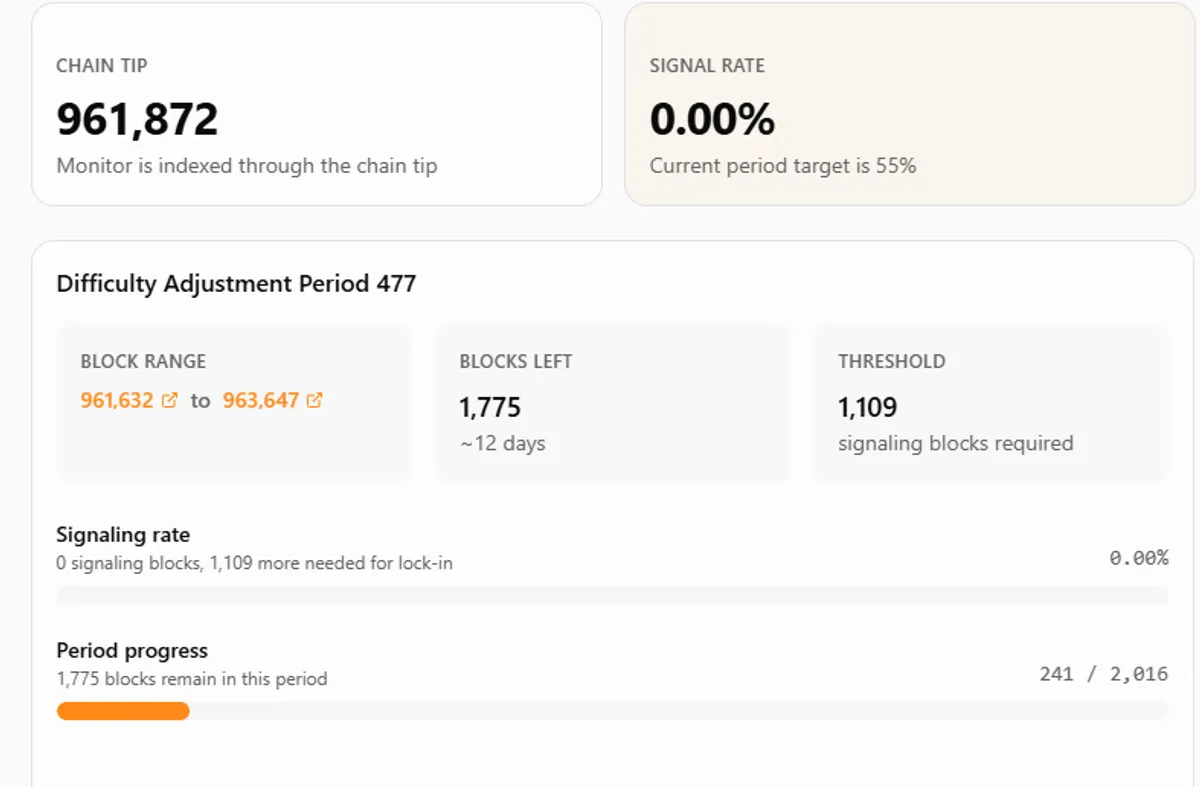
Source: BIP110.org
“BIP-110 was free to fork, and the network was free not to follow,” said Michael Saylor. “The result was decisive: about 99.85% of Bitcoin’s hashpower stayed with Bitcoin.”
BIP-110 supporters keep the fight alive despite initial failure
Roughnecks, one of the miners backing BIP-110, disclosed plans to push for a protocol change, braving the challenge of low ecosystem support. Roughnecks shut down its mining operations on the BIP-110 chain over the weekend, then released a statement on Monday morning saying it will resume mining.
“We do not see this as a defeat for the BIP-110 movement but an escalation to the next step,” said Roughnecks in a statement.
Roughnecks noted that it will continue mining until a sensible Proof-of-Work (PoW) change can be implemented for the network. Already, Dathon Ohm, one of the backers of BIP-110, disclosed that the community is working on a proposal to “fire the miners,” but the exact details are still under wraps.
The failure does not mark the end of the debate that produced BIP-110. Supporters have argued that the proposal addresses concerns over the growing use of Bitcoin blockspace for inscriptions and other nonfinancial data. Meanwhile, opponents have questioned whether changing consensus rules through a minority-led activation process is appropriate.