Key highlights:
- Russia has rolled out robust regulation for cryptocurrencies after months of intense legislative activity
- The new law provides for the issuance and trading of digital currencies while regulating the operation of cryptocurrency exchanges
- Meanwhile, the US is proceeding at a snail’s pace for its own robust crypto legislation
Russian President Vladimir Putin has signed a law to provide clear rules for the use of cryptocurrencies in Russia. While Russia has rolled out comprehensive regulation for digital assets, odds for the US Senate to pass the CLARITY Act have fallen to an all-time low.
Russia establishes clear rules for digital assets
According to state news agency TASS, the new law makes broad provisions for the issuance and circulation of cryptocurrencies in Russia. Furthermore, the law provides clear rules of the road for cryptocurrency mining and the activities of crypto exchanges and other digital asset service providers.
Right off the bat, the law mandates that only entities in a “special registry” will be allowed to operate cryptocurrency exchanges. Russian authorities, keen on triggering local ecosystem growth, pegged the minimum equity requirement for cryptocurrency exchange operators at 15 million rubles ($187,339).
All firms operating digital asset exchanges in Russia have until July 1, 2027, to seek registration in the “special registry.” The law defines large-scale, regular crypto trading as a regulated activity.
Individuals or companies that complete at least two cryptocurrency transactions in a month with a combined value exceeding 3.5 million rubles ($43,700) would be classified as engaging in systematic digital currency exchange activity and required to join a financial market self-regulatory organization.
Despite the robust nature of the rules, using cryptocurrencies for payments remains a prohibited activity. However, the law provides exceptions for settlement under foreign trade contracts and settlements involving securities and digital currencies.
Retail investors can purchase only the most liquid cryptocurrencies via licensed intermediaries for up to 300 rubles per year. While the law bars retail investors from accessing low-cap memecoins, qualified investors can buy any cryptocurrency without limit.
A key feature of the law is that both categories of investors have to pass “special suitability testing.” However, regulators can designate an individual as a qualified investor using previous trading experience.
CLARITY Act odds fall to unseen levels as 2026 passage becomes unlikely
While Russia has received a comprehensive digital asset playbook, the US faces major headwinds in bringing its own rules out of the gate. The CLARITY Act has stalled in the US Senate, with congressmen arguing over key provisions amid a closing window for passage.
According to data from Polymarket, the odds of the CLARITY Act passing in 2026 sit at 16%. Back in February, the odds stood at over 80%, but a raft of opposition and a tightening Senate calendar have seen the odds tank.
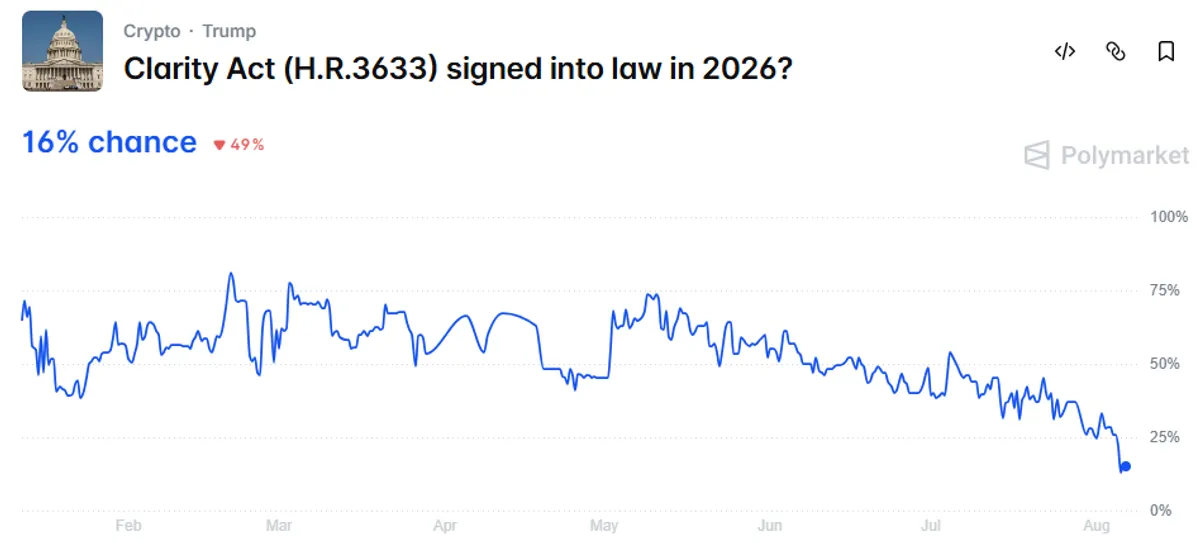
Source: Polymarket
However, proponents of the bill are optimistic about a last-gasp effort to pass the bill. US Senator Cynthia Lummis predicted that a floor vote for the bill will occur before the August recess, teeing up a route to passage in the near future.
However, the bill’s critics opine that key provisions on consumer protection and national security concerns have not yet been addressed. US President Donald Trump agreed to a raft of ethics provisions in an updated CLARITY Act text, but a handful of Democratic Senators say several loopholes still exist.