Key highlights:
- Solana’s supply reform proposals cleared the 15% validator support threshold and entered the discussion phase
- The proposals would increase SOL token burns and accelerate the network’s inflation reduction if approved
- Validators will vote after the discussion period ends on August 22
Solana validators are indicating support for two governance proposals that could significantly reduce the network’s token supply by increasing the amount of SOL burned via transaction fees. The proposals, if approved, will tighten SOL’s supply dynamics without immediately making the cryptocurrency deflationary.
What happens to $SOL price if both proposals pass?
At the base case of 9k burns a day there'd be 36.9M fewer SOL in 2032, making every coin worth 5.3% more at any valuation
Push burns to 27k a day and it's 11.7% instead of 5.3%
ATH it's +32$ more to price https://t.co/iTJj3sQE7e pic.twitter.com/ASFLUMEXH8— jussy (@jussy_world) August 4, 2026
Proposals target both sides of SOL supply
The proposals, known as SIMD-0553 and SIMD-0550, are seeking to reduce the amount of SOL entering circulation while increasing the amount permanently removed from the supply.
Solana Improvement Documents (SIMDs) define technical protocol changes, while Solana Governance Proposals (SGPs) enable stake-weighted voting on changes that could materially affect the network’s economics or operation.
SIMD-0553 introduces a resource-based fee model that charges users according to the computing resources consumed by their transactions. The proposal is eyeing raising the network’s daily token burn from around 650 SOL to between 7,500 and 9,000 SOL, a seismic 10x increase.
Meanwhile, SIMD-0550 focuses on token issuances. If passed, it will double Solana’s annual disinflation rate to 30%, allowing the network to reach its long-term inflation floor of 1.5% in 2029 instead of 2032. The proposed change will reduce token emissions by up to 18.9 million SOL over six days.
Despite the sharp increase in token burns, the proposals will allow Solana to continue issuing more SOL than it destroys. At the moment, the network produces roughly 60,000 SOL daily through inflation, meaning the burn proposal alone would not push the cryptocurrency into deflation.
Solana price remained muted amid reports of the proposal, with SOL price recording a less than 2% price change over the last day. At press time, SOL is trading at $73.71 after recording an uptick in daily transaction volume since the proposals became public knowledge.
Proposals move into discussion after clearing support threshold
Both proposals have now cleared Solana’s validator support threshold and entered into the discussion phase. Data from the Solana Validator Governance portal shows the proposals have secured 65.22 million SOL in support, representing 15.01 % of the 434.42 million staked SOL.
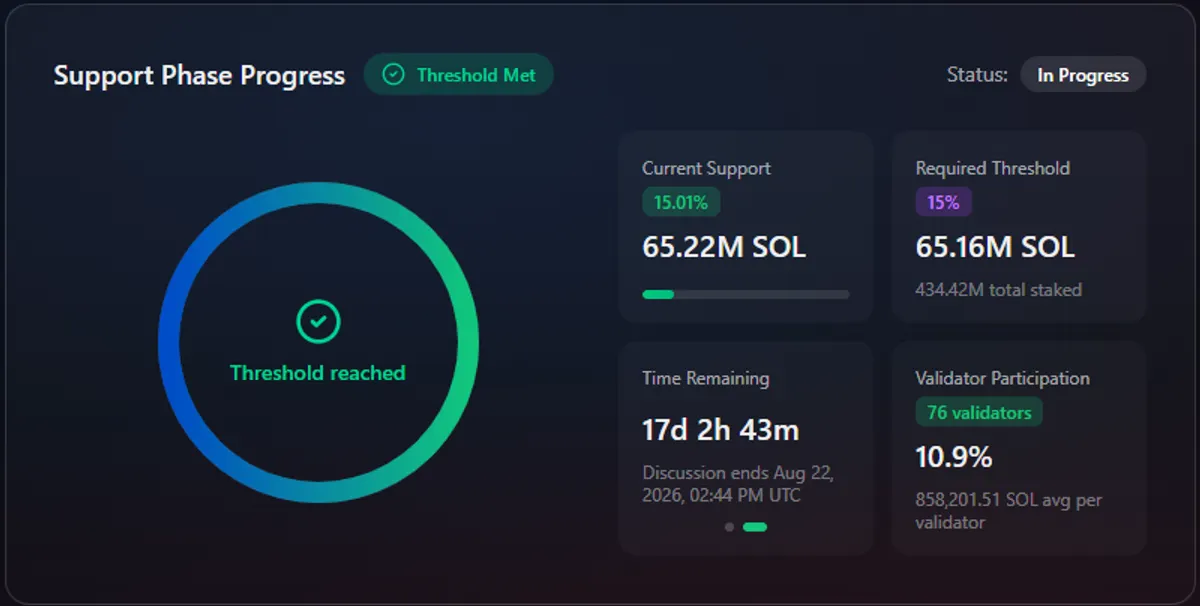
Source: Solana Validator Governance
The numbers narrowly exceed the required threshold of 65.16 million SOL needed to advance beyond the support phase, marking the next step before a formal on-chain vote. Meanwhile, validator participation has also increased significantly, with 76 validators representing 10.9% of the validator set signaling support.
The governance dashboard shows approximately 17 days remaining in the discussion period before the proposals move into the voting phase. According to the portal, the proposals will remain under discussion until August 22, after which validators will proceed to cast binding votes.Amid the push to improve the network, Solana’s institutional adoption has reached a record high. BlackRock, Securitize, PayPal and Franklin Templeton have launched products on Solana, with Morgan Stanley launching a Solana ETF with staking rewards.