
Key highlights:
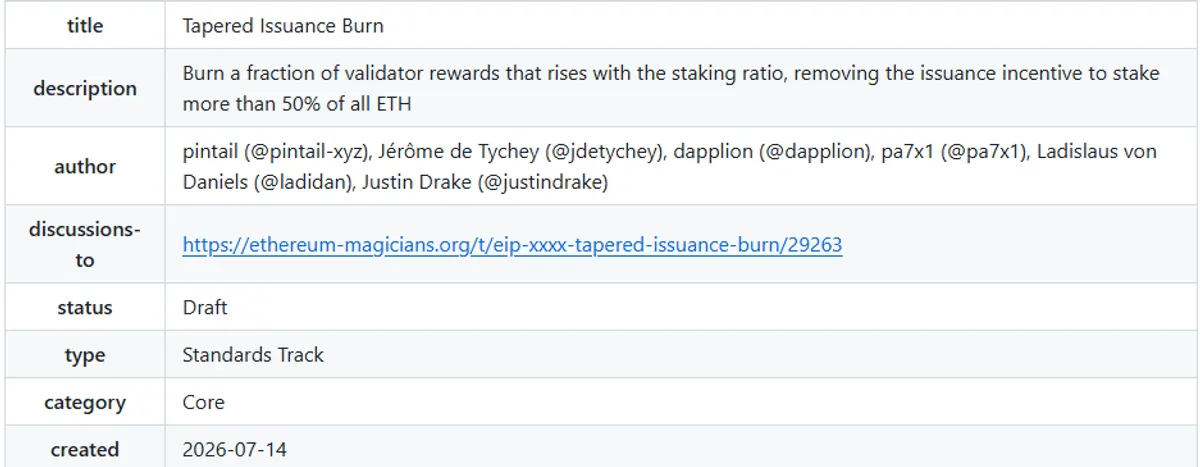
- Ethereum researchers have proposed EIP-8363, a proposal to gradually burn consensus-layer staking rewards as more ETH is staked
- Supporters argue the proposal will reduce ETH inflation and preserve its role as a neutral store of value
- Critics say the proposed changes will weaken institutional support and negatively affect solo stakers
A draft Ethereum proposal to reduce validator rewards has sparked intense debate across the network, with supporters arguing it will strengthen Ether’s long-term monetary policy. However, critics warn that the move will hurt solo stakers and hinder institutional adoption of Ethereum, raising questions about the timing of the proposal.
Proposal aims to curb Ethereum staking growth
Known as EIP-8363, the proposal would gradually burn a growing share of consensus-layer staking rewards as the amount of staked ETH increases. The long-term plan is to reduce net issuance to zero if staking reaches about 60.25 million ETH, or roughly half of Ethereum’s circulating supply.
Under Ethereum’s current issuance model, staking rewards decline as more ETH is staked but never fall to zero. The proposal’s authors argue that this creates a permanent incentive to stake, increasing issuance and encouraging the use of liquid staking derivatives over native ETH.
Source: GitHub
The authors argue that unchecked staking growth could concentrate Ethereum’s security in the hands of large custodians. Around 39 million ETH, or roughly one-third of Ethereum’s circulating supply, is currently staked, well below the proposal’s saturation threshold of 60.25 million ETH.
“A large operator that misbehaves can degrade consensus for its own gain and its delegators bear the loss if slashing follows,” read the proposal’s text.
Furthermore, they argued that burning part of validator rewards would make Ether’s supply more predictable and reduce inflation, complementing Ethereum’s existing token-burning mechanisms introduced through EIP-1559 and blob transaction fees.
If adopted, the proposal would phase in over 18 months, with annual issuance peaking at around 0.5% of ETH supply before declining toward zero as the staking ratio approaches the proposed threshold.
Critics warn of unintended consequences
The proposal has drawn criticism from several developers and staking providers who argue the reward reductions could disproportionately affect solo validators. In their submission, solo validators face higher operating costs than large institutional staking services..
Aave founder Stani Kulechov disclosed that the proposal will ultimately harm Ethereum rather than strengthen it. He hinged his argument on the claim that lowering staking yield could reduce borrowing activity across decentralized finance, setting off a grim chain of dominoes for the network.
Ether.Fi CEO Mike Silagadze echoed Kulechov’s concerns, noting that shrinking rewards will push independent validators off the network. However, backers of the proposal downplayed their concerns, stating that users of large staking providers must pay service fees, which will make the platforms less attractive as staking rewards decline.
Beyond the proposal itself, some Ethereum developers have quizzed the timing. The disgruntled developers questioned whether such a significant change to the network’s monetary policy should have been introduced days before the deadline for submitting proposals for consideration in the Hegotá upgrade.
Critics opined that the community needs more time to evaluate the potential impact of the proposal on Ethereum’s economics. Meanwhile, Ethereum is racing to make structural changes to the network with co-founder Vitalik Buterin eyeing a leaner, quantum-resistant blockchain.