Key highlights:
- FWA rose to the top of Ethereum's fee rankings in days.
The protocol processed over 10,000 ETH in trading volume.
Analysts said the biggest test will come after the token incentive program ends.
Fake World Assets (FWA) become one of Ethereum’s biggest fee generators in just weeks after its launch. The project launched a new version on July 21 and brought in thousands of new users. Within days, it started generating more fees than even the most established applications on the Ethereum network.
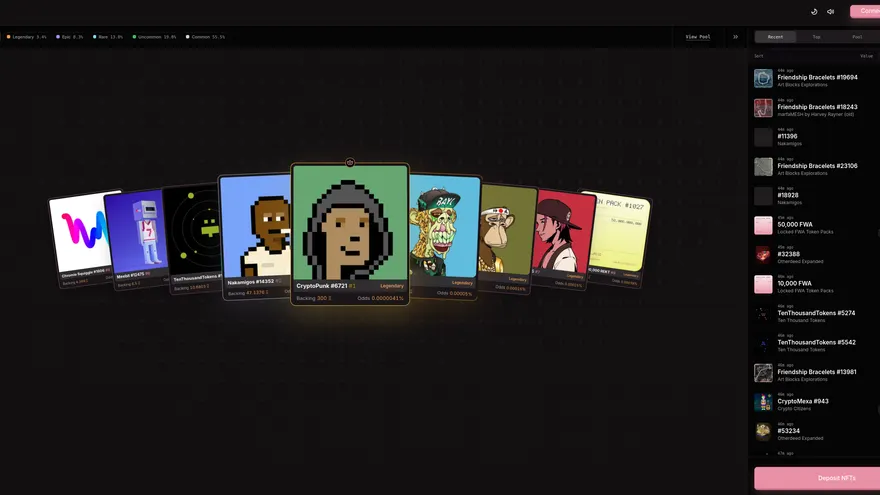
FWA is an Ethereum-based, fully onchain NFT “gacha” platform created by TokenWorks. Users spend ETH for a randomized chance to receive NFTs deposited by other participants, with prizes selected using Chainlink’s verifiable randomness technology.
Winners can keep or relist the NFT, exchange it for 85% of its ETH backing, or accept the equivalent payout in FWA tokens. Meanwhile, NFT depositors earn a share of platform fees and token rewards, creating a marketplace that combines NFT trading, yield generation and chance-based gameplay.
Fake World Assets climbs to the top on Ethereum
The rise of FWA has caught the attention of the crypto market. It reached the top of Ethereum's daily protocol fee rankings, according to DeFiLlama data.
By July 28, the platform had seen about $388,000 in revenue in a single day, placing it 11th among blockchain applications globally.
User activity was up during the period. The platform processed 76,000 NFT purchases, which generated at least 7,700 ETH in trading volume. It also locked about 1,950 ETH as backing for its system.
By August 1, trading volume had climbed to over 10,000 ETH, while total purchases reached 100,000. The protocol's total value locked (TVL) also jumped to over $6.15 million by July 31. It is now at $4.98 million, according to DeFiLlama data.
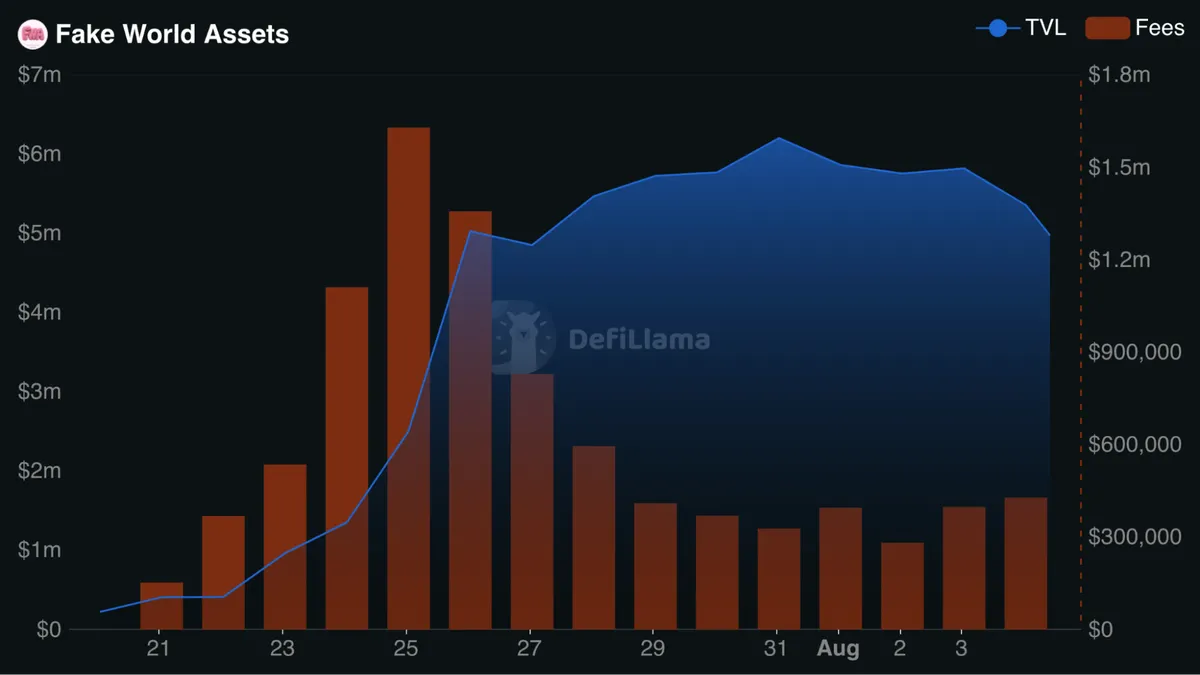
Fake World Assets total value locked chart. Source: DeFiLlama
Fake World Assets’ busiest day was July 25. It generated about $1.53 million in daily fees on that day. That briefly made it ETH’s largest gas consumer, surpassing names like Tether and Circle in blockspace usage. TokenWorks, the team behind the project, celebrated the win on X on said day.
4 days since launch.
Fake World Assets are the next big thing. pic.twitter.com/vsINITcr6e— TokenWorks™ (@token_works) July 24, 2026
Can the momentum continue after rewards end?
Even with the impressive numbers, some experts do not think it can sustain the momentum for too long.
Much of the activity happened during a 15-day token airdrop campaign. These type of reward programs usually encourages users to use a platform in the hope of getting free tokens. Once those rewards end, activity may fall rapidly.
That seems to be happening already. The protocol still sees around $350,000 in daily fees, but this is way below its peak of $1.53 million. However, it maintains an annualized revenue run rate of $228 million.
Simon Dedic, founder of Moonrock Capital, said gamified commerce has a future but has concerns on if the demand is genuine. In his words: “I’m very bullish on gamified commerce…my skepticism on FWA is specific.”
He added that many of the current users may just be chasing token rewards without plans to keep using the platform. He said that there would be more clarity when these incentives disappear.
Meanwhile, supporters of Fake World Assets said the new platform offers something different from traditional NFT marketplaces. Users pay to spin an on-chain "gacha" system that randomly awards NFTs backed by ETH instead of buying a specific collectible.
NFT owners can also deposit their collectibles into the system and earn a share of protocol fees while their assets stay available.
To add, Blockchain data suggests users are using other functions of the platform. At least 70% of participants in the airdrop chose to convert their winnings into FWA tokens instead of keeping the NFTs.