Key highlights:
- South Korea’s crypto exchanges have recorded a massive exit of retail investors to the equities market.
- KOSPI’s strong returns have attracted a wave of retail investors from cryptocurrency markets.
- Institutional investors are inching forward, buoyed by a clear legal framework for digital assets in the country.
Trading activity on South Korea’s largest cryptocurrency exchanges has slumped over the last year, underscoring a shift in investors’ interest. The decline in crypto trading volumes coincides with the surge of the Korea Composite Stock Price Index (KOSPI), South Korea’s S&P 500 equivalent.
KOSPI doubles as South Korean investors pivot from crypto
According to emerging data, the average daily trading volume across Upbit, Bithumb, Coinone, Gopax and Korbit slumped by 89% in the last 12 months. Back in July 2025, combined daily trading volume of the five largest exchanges stood at $2.82 billion, falling to a mere $305 million.
The fall in crypto trading comes amid a surge in KOSPI, signaling a growing appetite for South Korean stocks among investors. KOSPI climbed 114% over the last year, posting its strongest performance despite macroeconomic uncertainties and black swan days.
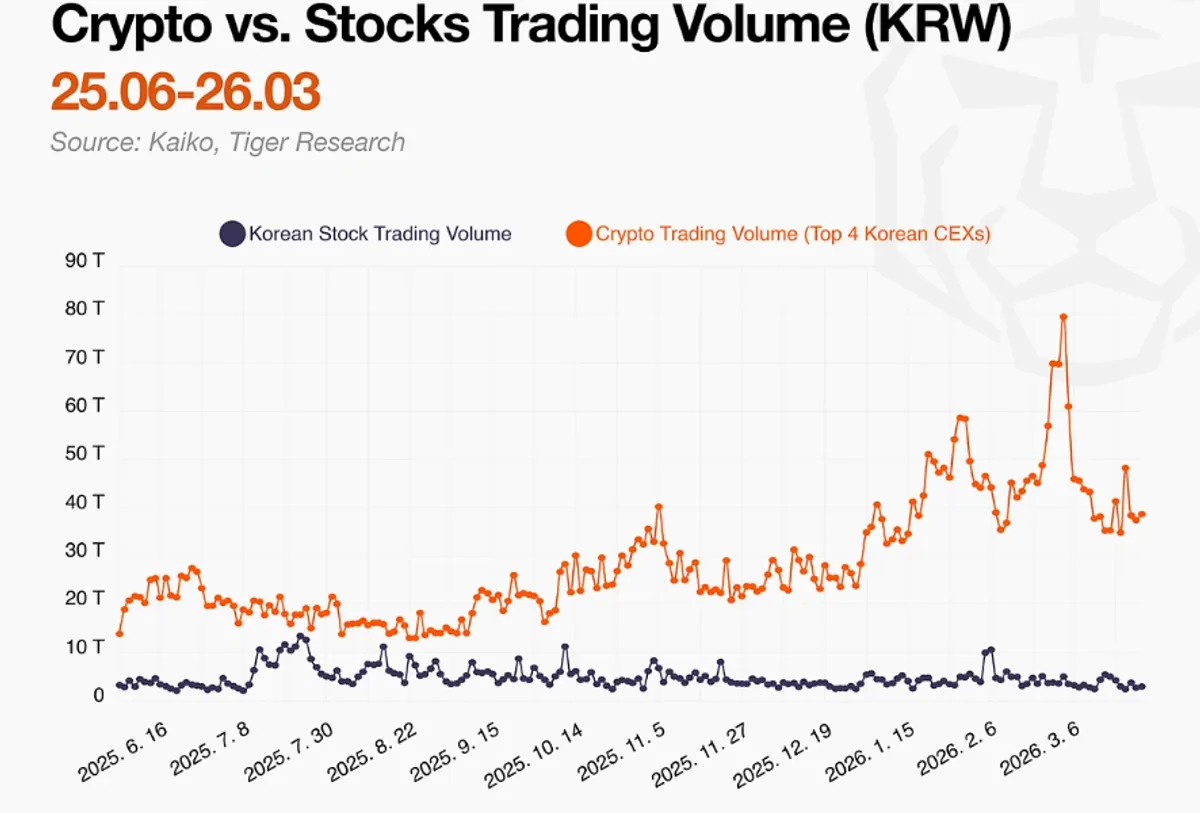
Source: Tiger Research
Meanwhile, KOSPI crashed by nearly 10% in a single day in June, with analysts blaming heavy margin trading and underperformance of US tech stocks for the massive decline. However, KOSPI recovered from the incident, with the index’s bellwethers Samsung and SK Hynix posting impressive numbers.
A paper from Tiger Research disclosed that investor fatigue is a key reason for the decline in cryptocurrency trading volumes. A streak of failed crypto projects and faltering prices has led to waning figures for the sector that once dominated the Asian market.
Furthermore, a 20% capital gains tax on cryptocurrencies scheduled to take effect at the start of 2027 has added bearish sentiment to the contracting sector. Meanwhile, Tiger Research analysts highlighted KOSPI’s year-on-year strong performance as a key reason for cryptocurrency investors jumping ship.
Not all hope is lost for South Korea’s crypto market
Despite the waning numbers in South Korea’s retail crypto trading, the institutional side of things is heating up. Tiger Research noted that South Korean institutions are wading into won-denominated stablecoins and tokenized real-world assets ahead of the rollout of official rules.
In Tiger Research’s own words, “the crypto sector is undergoing a structural transition,” hinting that retail investors will make a return. However, sustained KOSPI strong performance could delay the return of retail traders to cryptocurrency exchanges.
“Korea’s market is still large, and fast moving, but it no longer responds to the old playbook,” read the research paper. “Retail is fatigued, and institutions are still finding their footing.”
Already, local exchanges are bearing the brunt of the exit of retail capital. Korbit and other local exchanges have sold a portion of their crypto holdings to remain afloat as the fees from retail trading dry up.