Key highlights:
- Galaxy has rolled out a $5 million grant for developers and researchers working on quantum-proofing Bitcoin.
- A Quantum Advisory Council will evaluate grant proposals, with Galaxy Research publishing progress reports on studies.
- Experts say the earliest quantum threat may show up by the end of the decade.
Galaxy has announced the launch of a Bitcoin Quantum Readiness Initiative, committing $5 million in developer grants to prepare the network for advances in quantum computing. The initiative comes on the heels of a frenetic push by Bitcoin developers to secure the network, underscored by a series of proposals and counterarguments.
Galaxy’s Bitcoin Quantum Readiness Initiative goes live
The first arm of the initiative will see Galaxy commit $5 million in grant funding to developers and researchers working on quantum-proofing the Bitcoin network. Per the announcement, the grants will focus on research bordering the implementation and review of quantum-resistant transaction proposals.
Furthermore, developers and researchers working on integrating post-quantum signature schemes into Bitcoin will receive priority attention. Other priority areas include tooling for wallet and custodian migration and for security audits of proposed implementations.
Galaxy’s research arm will publish progress reports of the developers' effort under the initiative. Alongside the launch, Galaxy has established a Quantum Advisory Council to guide research and evaluate grant proposals in line with the “best available expertise.”
“There’s a gap between the quantum computing world, which is moving fast, and the Bitcoin development world, which is just beginning to engage with post-quantum cryptography in earnest,” said Alex Thorn, Head of Firmwide Research at Galaxy.
While Bitcoin leans on elliptic curve cryptography, there is a consensus that the network’s security architecture can be broken using advanced quantum computers. At the moment, there is no quantum computer capable of breaching Bitcoin’s cryptography, but the pace of development has triggered concerns.
Experts say a credible quantum threat to Bitcoin is expected in 2031, but technological advancement could see it come as early as 2028. The US government has its sights on a 2031 deadline to defend against quantum attacks on classical cryptography in the same class as Bitcoin’s.
A frantic race against time for Bitcoin
As the window closes for Bitcoin, Galaxy is pushing for a collaborative effort for key ecosystem players to protect the network. The company is open to co-funding grants with Bitcoin stakeholders while urging firms to contribute toward quantum research.
“As leaders in the digital assets space, we believe it’s important that we help be part of the solution to any potential threat quantum computing poses to Bitcoin,” said Galaxy CEO Mike Novogratz.
Already, BIP-361, a Bitcoin Improvement Proposal, seeking to protect the network from quantum-enabled theft, is inching forward. If approved, Bitcoin holders would have to move their holdings into quantum-resistant addresses before a deadline or risk having their funds frozen.
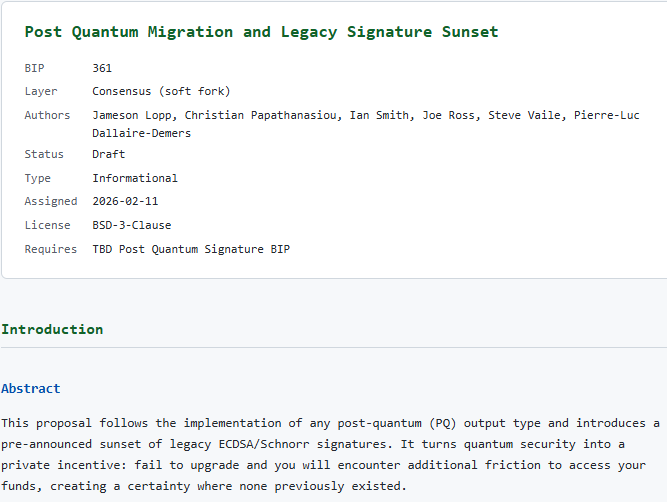
Source: BIP-361.org
To support the proposal, quantum security startup Project Eleven developed a zero-knowledge proof system to recover frozen Bitcoin. However, the solution will exclude Satoshi Nakamoto’s 1.1 million BTC and other early coins mined before the introduction of BIP-32 that created hierarchical deterministic wallets.