Key highlights:
- The CLARITY has reportedly missed the July 4 deadline
- The Senate now only has a limited window before the August 7 recess to pass the bill
- As three unresolved issues remain, the crypto bill fails to get backing from Democrats
The growing push to pass the landmark crypto bill, the CLARITY Act, is facing another major hurdle as it has missed the July 4 deadline. Despite White House advisor Patrick Witt’s strong optimism, the bill was not signed into law on the day.
Now, the attention has shifted to the August 7 recess. Before the Senate’s summer break, the lawmakers have only a limited window to pass the market structure bill. If they fail to pass the crypto bill before the next critical deadline, its path forward will be challenging as the focus shifts to the midterm election.
July 4 CLARITY Act deadline slipped
Chinese crypto reporter Wu Blockchain shared an X post earlier today, highlighting Congress’s failure to pass the CLARITY Act on the recent July 4 deadline. While the crypto bill has successfully cleared several major hurdles, it is still waiting for the final Senate vote.
White House has been optimistic about the bill’s possible passage on July 4. Advisor Patrick Witt previously stated:
“We're targeting July 4th. I think that would be a tremendous birthday present for America, celebrating our 250th.”
Notably, the market structure bill needs 60 votes in the Senate to pass the voting threshold. This is now the major obstacle for the CLARITY Act, as Republicans do not have enough support on their own. They need several votes from the Democrats, and negotiations are still continuing.
Why has the crypto bill not been passed yet?
There are mainly three unresolved issues that keep Democrats from backing the bill. The main debate is around the need for stricter ethics rules. This issue comes especially after the disclosure of President Donald Trump’s $1.4 billion in crypto-related income. While Trump defended this by saying that there is “nothing illegal” about crypto profits, the financial disclosure has raised conflict-of-interest concerns. Senator Elizabeth Warren has strongly opposed the bill:
“The crypto legislation heading to the Senate floor must prevent the president, vice president, senior administration officials, members of Congress and their families from profiting off the crypto industry. If it does not, it will only turbocharge Donald Trump’s brazen crypto corruption."
The second concern surrounds the clause on DeFi developers and their protection. Lawmakers remain divided on whether the provision could shield developers and make it challenging for enforcement groups to investigate crypto crime.
Disagreements over stablecoin reward programs have been one of the main issues since the introduction of the CLARITY Act. Now it is the third reason why the crypto bill missed its July 4 deadline. While the crypto industry believes stablecoin rewards are innovative, the banking sector argues that they could destroy the traditional financial space.
Why does August 7 emerge as the next key date?
As the CLARITY Act has failed to get passed on the July 4 deadline, August 7 is now emerging as the next key date. This is because August 7 is the Senate’s last working day before the lawmakers’ summer recess. Afterwards, their focus may change to the upcoming midterm elections.
Meanwhile, Congress will come back in between for a short session in September. However, during this period, lawmakers will have to prioritize other bills like the National Defense Authorization Act. Also, Trump has recently stated that he will not sign any legislation until Congress passes the SAVE America Act.
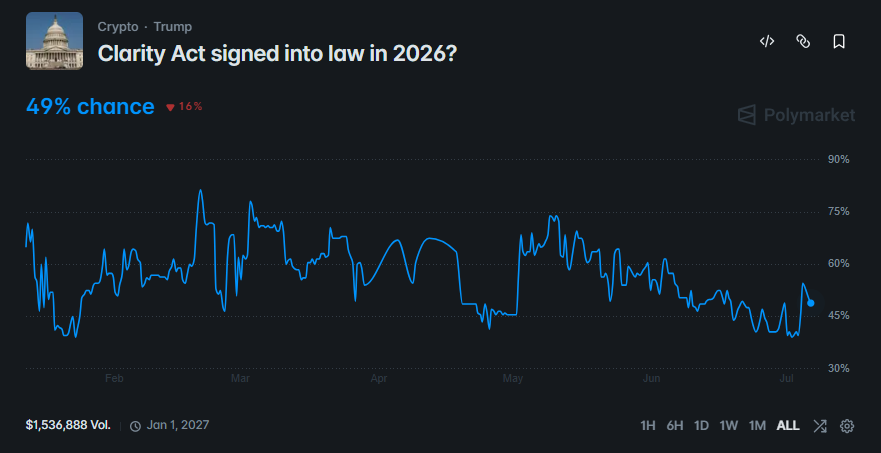
Source: Polymarket
Thus, if the Senate does not pass the crypto bill before August 7, its passage this year is less likely. On Polymarket, the odds of the CLARITY Act passing in 2026 have declined to 49%, down by 16%. Galaxy Research has also reduced the crypto bill passage odds to 50%, as CoinCodex reported.