Key highlights:
- StarkWare released the strongest post-quantum roadmap in the crypto industry
- The plan involves the transition of Starknet to quantum-ready cryptography
- The CEO is urging the whole blockchain industry to prepare for the quantum threats
As quantum computing is moving closer to reality, more blockchain platforms are preparing for the future security challenges. The latest to unveil a post-quantum security roadmap is StarkWare, which has outlined a three-phase plan for Starknet.
Notably, StarkWare’s plan focuses on Starknet’s transition to quantum-safe cryptography. The team wants to replace the network’s remaining elliptic-curve cryptography with quantum-resistant alternatives. This could protect the blockchain from future quantum computing threats.
Q Day is coming.
The cryptography securing crypto today has an expiry date.
Starknet has a head start: hash-based STARKs, Native AA that lets security evolve without protocol changes, and post-quantum wallets already deployable today.
Starknet's Post-Quantum roadmap is here: https://t.co/HhUbwqRCDY— Starknet (Privacy Arc) (@Starknet) June 30, 2026
How will StarkWare secure Starknet against quantum threats?
Joining a growing list of blockchain platforms already preparing for the quantum computing era, StarkWare has released its post-quantum security roadmap. The platform calls it the strongest post-quantum roadmap in the crypto industry.
With a three-phase plan, StarkWare intends to make Starknet quantum-ready by replacing its elliptic-curve cryptography. The move will also preserve compatibility with existing applications. While Starknet’s zero-knowledge STARK proofs are already resistant to quantum threats, some parts still rely on elliptic curve cryptography. Through the latest move, the team envisions addressing this. CEO Eli Ben-Sasson stated,
"This document says: here is how we'll do it for Starknet. It's our path to making Starknet a safe haven for funds whatever quantum may bring. And the subtext is that if we can do it by seizing on this cryptography, then anyone else can do it by choosing the right cryptography.”
Three-phase roadmap explained
As mentioned in the roadmap, the plan is divided into three phases. The first phase focuses on replacing Pedersen hashing with BLAKE2. While this replacement takes place across state commitments, contract addresses, and network settings, it aims at securing new transactions and contracts. It will also introduce post-quantum consensus signatures, like Falcon-512.
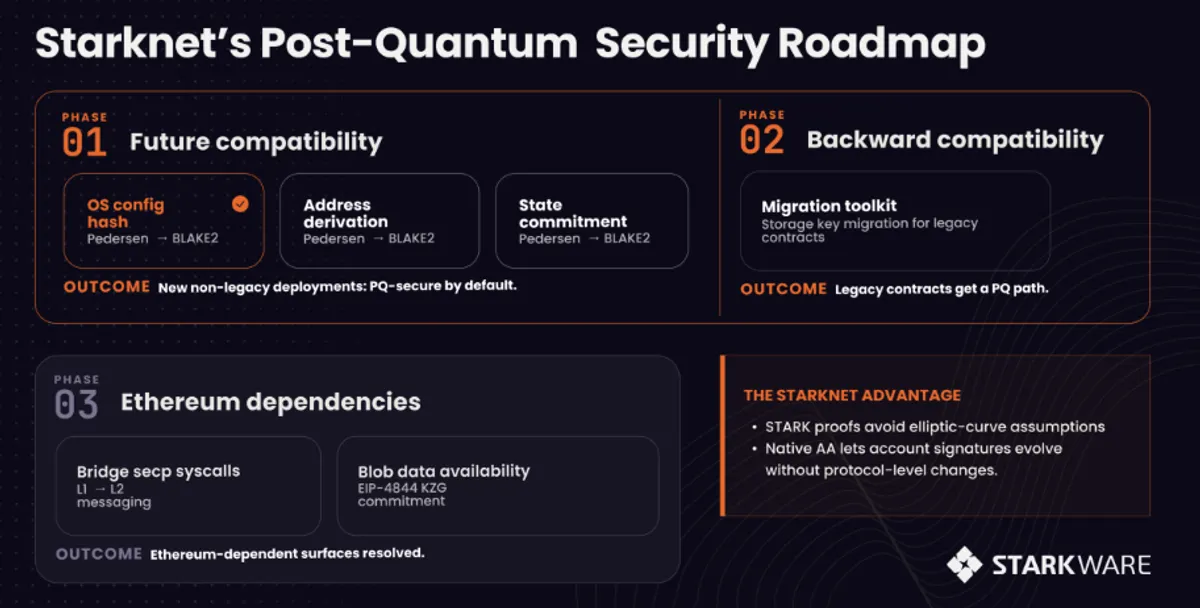
The second phase includes providing migration tools to upgrade current smart contracts. The main focus will be on the migration without disrupting applications. The migration will also not require manual data.
Finally, the third phase is all about external components. These include the Ethereum bridge infrastructure and blob data that Starknet cannot upgrade on its own. As they are tied to Ethereum, their transition depends on the blockchain’s own migration to quantum-resistant cryptography.
StarkWare CEO is urging the crypto industry to act now
Besides unveiling the roadmap, CEO Eli Ben-Sasson is urging the crypto industry to secure itself against potential quantum threats. According to him, the quantum era is now closer than ever. This means that the industry is cautioned to act now instead of waiting for quantum computers to become a real threat.
Elaborating on his point, Ben-Sasson shared an analogy between quantum security and everyday digital life. He stated,
“If your password leaks, you change your password. If someone invents a master key for the lock on your front door, you change to a different type of lock. The crypto industry shouldn’t need wake-up calls from the White House or anyone else. We should all be acting, and seizing on the best cryptography that exists.”
The CEO also warned against the idea of “elliptical illusion.” This is the belief that blockchains built on elliptic-curve cryptography will not be vulnerable to quantum computers. For him, this is an illusion and a false sense of confidence.
Many blockchains have already released their post-quantum roadmaps. As CoinCodex reported previously, Stellar is planning to go quantum-resistant by 2027. Similarly, Algorand also outlined its quantum-safe transition plans recently. Other major blockchains like Ethereum and Solana are also in the same line.