
Gold has always been more than just a shiny metal. It’s the world’s go-to safe haven when markets get shaky.
In 2026, with gold prices pushing record highs and demand holding steady, investors don’t just want physical bars and coins. They’re turning to gold mining stocks as a way to tap into the upside of rising gold prices while also gaining the benefits of dividends, growth potential, and global exposure.
Unlike holding bullion, buying shares in top gold mining stocks gives you leverage to the gold price. When gold climbs, gold miner stocks often outperform because their profit margins expand. Add in the fact that many of the largest producers and streamers pay regular dividends, and the appeal is clear.
In this guide, I’ll break down five of the best gold mining stocks to consider in 2026.
Each one stands out in its own category, from the biggest global producer to the best dividend payer, growth leader, value play, and royalty/streaming giant.
Let’s get started!
Quick overview of 6 best gold mining stocks in 2026:
- Newmont (NEM) – Best overall gold mining stock – unmatched scale, strong cash flow, global diversification.
- Barrick (GOLD) – Best for dividends – performance-based payouts and a net-cash balance sheet.
- Agnico Eagle (AEM) – Best for growth – record-breaking 2026 results and a robust project pipeline.
- Kinross (KGC) – Best value stock – undervalued, with strong free cash flow and stable U.S. operations.
- Franco-Nevada (FNV) – Best royalty/streaming play – record earnings, no mining risk, consistent dividend growth.
- Wheaton Precious Metals (WPM) – Best gold streaming company – asset-light model with strong margins and diversified gold exposure.
6 best gold mining stocks – Examining the top options in 2026
In the following sections, you’ll find a selection of the best gold mining stocks available on the market today. Keep in mind that my ranking is based on a combination of factors such as production output, financial stability, growth potential, and exposure to gold prices. Different investors may value other aspects, such as dividend yields or geographic diversification, so this list should be seen as a starting point for further research.
1. Best overall gold mining stock: Newmont Corporation (NEM)
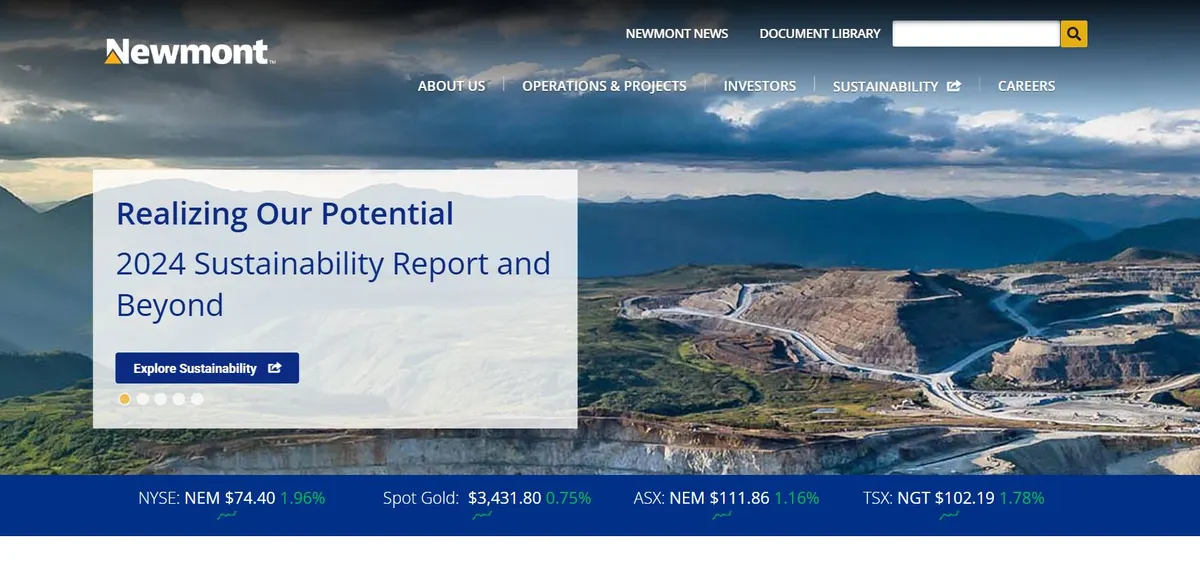
When I think about the heavyweight champion of gold mining stocks, Newmont (NEM) is the first name that comes to mind. It’s the largest gold producer in the world, with operations across six continents.
That kind of scale gives it something most miners don’t have: stability.
In 2026, Newmont is firing on all cylinders. The company pulled in $2.2 billion in net income in Q2 alone, while generating $2.9 billion in operating cash flow and a record $2.2 billion in second-quarter free cash flow. It ended the quarter with $9 billion in cash and $13 billion in total liquidity, giving Newmont a seriously strong balance sheet.
It’s also putting plenty of that cash back in shareholders’ pockets. Newmont returned $1.9 billion through dividends and share buybacks since its previous earnings call, including $1.7 billion in share repurchases, and declared another $0.26-per-share quarterly dividend.
What makes Newmont get its spot on this list is the combination of sheer production power and financial strength.
The company produced roughly 1.3 million ounces of gold in Q2 and remains on track for about 5.3 million ounces in 2026. Its gold by-product all-in sustaining cost came in at $1,621 per ounce, while its average realized gold price was $4,414 per ounce during the quarter. That leaves some seriously healthy margins.
If I could only pick one gold mining stock for my portfolio in 2026, this would be it.
Pros:
- World’s largest gold producer with a diversified portfolio of Tier-1 assets
- Strong balance sheet with $9B in cash and $13B in total liquidity
- Strong shareholder returns through dividends and aggressive share buybacks
- Record Q2 free cash flow of $2.2B, supported by strong gold margins
Cons:
- Dividend income may be less attractive than some gold-mining peers
- Large size means slower production growth compared to smaller miners
- Global operations expose it to geopolitical, regulatory, and operational risks
2. Best for dividends: Barrick Gold (GOLD)
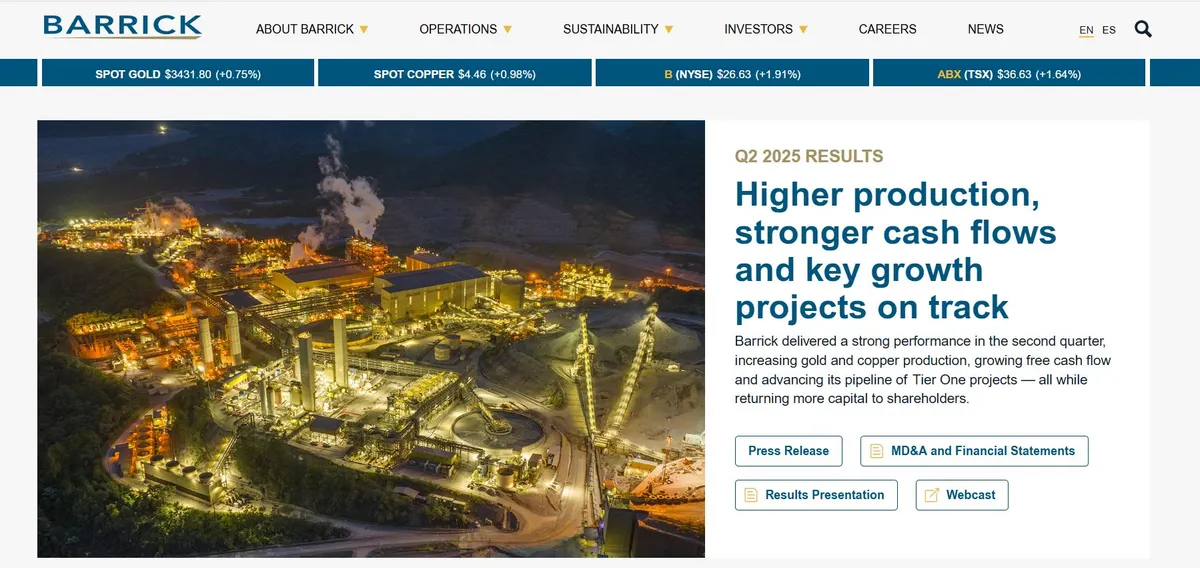
If you’re hunting for income in the world of gold miner stocks, Barrick Gold (GOLD) would be my recommendation.
Unlike most miners that simply pay a flat dividend, Barrick now targets a total annual payout equal to 50% of attributable free cash flow. That includes a fixed quarterly dividend plus the potential for an additional performance-based payout at the end of the year.
For Q2 2026, Barrick declared a $0.175-per-share dividend. But dividends are only part of the story. The company also spent a massive $1.2 billion on share buybacks during the quarter, bringing total shareholder returns to roughly $1.5 billion for Q2.
Barrick’s clean balance sheet is equally impressive. It ended the quarter with $5.9 billion in cash versus $4.7 billion in debt, leaving it with about $1.25 billion in net cash. That gives the company plenty of financial flexibility while it continues investing in its mines and returning capital to shareholders.
Add in 796,000 ounces of quarterly gold production, $1.7 billion in operating cash flow, and $515 million in free cash flow, and you’ve got a gold mining powerhouse with a strong mix of financial stability and shareholder returns.
If you want a gold mining stock that combines income, buybacks, and a rock-solid balance sheet, Barrick deserves a serious look.
Pros:
- Attractive dividend yield (~2–3%) with bonus payouts
- Performance-based dividend policy rewards shareholders when cash builds up
- Net-cash balance sheet with strong free cash flow
- Significant U.S. operations (Nevada Gold Mines JV with Newmont)
Cons:
- Lower production than Newmont
- Heavy exposure to politically sensitive regions (Africa, Latin America)
- Dividend can fluctuate with gold prices and cash flow levels
3. Best for growth: Agnico Eagle Mines (AEM)
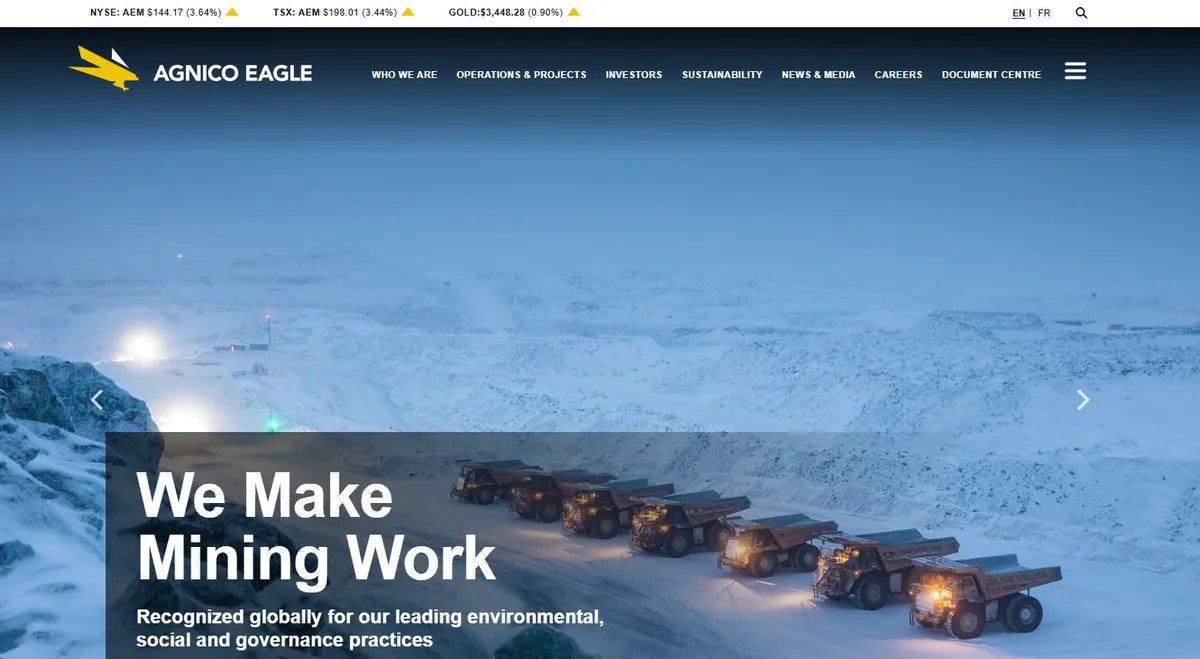
If you want a gold stock with real upside, Agnico Eagle (AEM) is a top pick. This company has quietly built one of the strongest growth pipelines in the entire sector, and 2026 is showing exactly what that means.
Just last quarter, Agnico posted a record $1.6 billion in net income and generated $1.34 billion in free cash flow. Operating cash flow also topped $2.1 billion, helped by solid production, disciplined cost control, and an average realized gold price of $4,483 per ounce.
What I personally really like is that Agnico isn’t coasting on its existing mines. Projects like Odyssey and Detour Lake continue to move forward. At Odyssey, the first phase of shaft sinking was completed in July, with first production through Shaft #1 still scheduled for Q2 2027. Development of the Detour Lake underground project is progressing too, while exploration continues to uncover promising results.
The beauty of Agnico is that it mixes stability with growth. The company produced 856,000 ounces of gold in Q2, finished the quarter with $3.27 billion in net cash, and returned a record $625 million to shareholders through dividends and buybacks. It also declared a $0.45-per-share quarterly dividend.
If you want exposure to a top gold mining stock that can expand while returning serious cash to shareholders, Agnico Eagle is a great option.
Pros:
- Record-breaking 2026 earnings and cash flow
- Strong project pipeline driving future production growth
- Safe jurisdictions (Canada, Finland, Australia) reduce political risk
- Dividend in place, with room to grow as cash flow expands
Cons:
- Dividend yield (~1.2%) is fairly modest
- Higher capital spending as it develops new projects
- Growth comes with execution risks on large projects
4. Best for value: Kinross Gold (KGC)
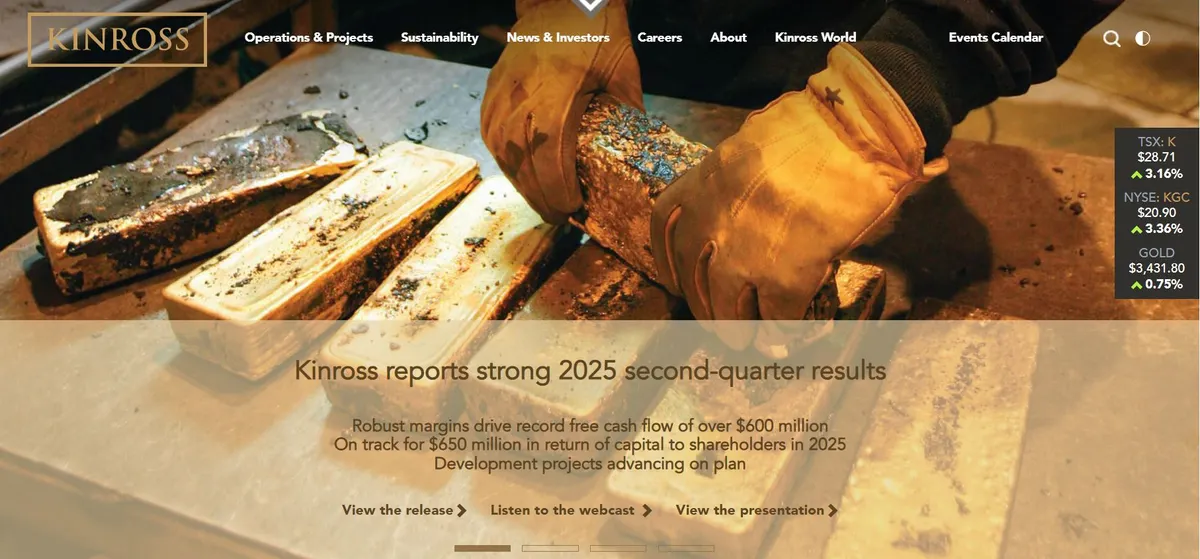
If you’re looking for a cost-effective option, Kinross (KGC) is excellent. It doesn't get the same headlines as Newmont or Barrick, but that’s exactly why I see it as undervalued.
In the first half of 2026, Kinross produced nearly 1 million attributable gold-equivalent ounces and generated more than $1.56 billion in attributable free cash flow. In Q2 alone, it earned $844 million and generated $727 million in free cash flow, helped by strong gold prices and disciplined cost management.
On top of that, management has been buying back stock aggressively. Kinross repurchased roughly $230 million of shares in Q2 and around $520 million year-to-date, while continuing to pay its quarterly dividend. Since April 2025, the company has bought back about $1.1 billion worth of stock, reducing its share count by roughly 4%.
Kinross also has a seriously strong balance sheet, ending Q2 with $2.7 billion in cash and $1.9 billion in net cash. And its growth pipeline is moving forward, with projects including Great Bear in Canada and expansions at Round Mountain and Bald Mountain in Nevada.
For me, Kinross is still a compelling value play among gold mining stocks: strong cash generation, aggressive shareholder returns, a healthy balance sheet, and plenty of room for future growth.
Pros:
- Strong free cash flow generation ($1.56B in H1 2026)
- Strong balance sheet with $1.9B in net cash
- Aggressive buybacks plus a reliable quarterly dividend
- Attractive development pipeline across Great Bear, Round Mountain and other projects
Cons:
- Smaller production scale than Newmont or Barrick
- Less geographic diversification than larger peers
- Costs are rising: Q2 attributable AISC increased to $1,821/oz, from $1,493/oz a year earlier
5. Best royalty/streaming play: Franco-Nevada (FNV)
For exposure to gold without the headaches of running mines, Franco-Nevada (FNV) is the stock.
Unlike traditional gold miners in the USA or global producers, Franco-Nevada doesn’t dig the gold itself. Instead, it finances mining projects in exchange for royalties and streams on production. That gives it exposure to rising gold prices with much less direct exposure to operating costs, labor issues, or mine-level disruptions.
And it’s working. In Q2 2026, Franco-Nevada reported $581 million in revenue, up 57% from the year before, while net income jumped 43% to $354 million. The company also generated $483 million in operating cash flow during the quarter.
The first half was even more impressive, with Franco-Nevada setting new half-year records for revenue at $1.23 billion, operating cash flow at $1.00 billion, and net income at $823 million.
What’s great about Franco is that it benefits when gold prices go up, but it’s insulated from many of the headaches that come with actually operating a mine. It’s highly diversified and ended Q2 with $4.3 billion in available capital, giving it plenty of firepower to fund new royalty and streaming deals.
Franco-Nevada is one of the cleanest ways to play the upside in gold mine stocks without taking on all the operational risks that come with digging in the ground.
Pros:
- Record-breaking 2026 revenue and profits
- 18+ years of consecutive dividend growth
- No direct mining risk, royalty model provides stable margins
- Debt-free with strong capital reserves
Cons:
- Dividend yield (~1.2%) is modest
- Less direct leverage to gold prices compared to producers
- Trades at a premium valuation due to its lower risk model
6. Best gold streaming company: Wheaton Precious Metals (WPM)
If you want exposure to gold without actually running mines, Wheaton Precious Metals (WPM) is one of the strongest options in the sector.
Like Franco-Nevada, Wheaton operates a streaming model. Instead of mining gold itself, it provides upfront financing to mining companies in exchange for the right to buy a portion of their future production at a predetermined price. That means Wheaton benefits when precious metals prices rise while avoiding much of the direct operational risk miners face.
And the model is producing some serious margins. In Q2 2026, Wheaton’s average cash cost was just $568 per gold-equivalent ounce, while its cash operating margin reached $3,875 per ounce. That helped the company generate a record $929 million in quarterly revenue, $543 million in net earnings, and $650 million in operating cash flow.
The first half was even stronger, with Wheaton posting record $1.8 billion in revenue, $1.1 billion in net earnings, and $1.4 billion in operating cash flow. Attributable production also reached a record 414,755 gold-equivalent ounces, up nearly 14% year over year.
Another reason I like Wheaton is diversification. Its portfolio now includes streaming and royalty agreements covering 22 operating mines, 20 development projects, and 15 exploration and other-stage projects, giving it exposure to 57 assets in total.
For investors who want a cleaner way to invest in gold and precious metals without taking on all the cost overruns, labor issues, and other operational headaches that come with running a mine, Wheaton Precious Metals is one of the best picks.
Pros:
- High-margin streaming business model
- Exposure to multiple major gold mines globally
- Lower operational risk than traditional miners
- Strong cash flow and long-term production agreements
Cons:
- Less direct leverage to gold prices than producers
- Relies on partner mining companies for production
- Dividend yield (~1%) is relatively modest
Gold market outlook for 2026
Why gold is on fire right now
- Record-breaking gold prices: Gold surged past $5,000 per ounce in January 2026, hitting an all-time intraday high of around $5,592. Analysts’ gold price forecast sees even more upside ahead, with potential targets well above current levels.
- Central banks are on a buying spree: Since 2023, global central banks have shifted from being net sellers to aggressive buyers. In 2025, they purchased around 860 metric tons of gold, the fourth year in a row. 95% of central banks plan to boost their gold reserves within a year, and 43% intend to increase holdings imminently, due to inflation fears, sanctions risks, and dollar uncertainty.
- Macro shifts and de-dollarization: Global moves away from the U.S. dollar, including rising use of local currencies, have strengthened gold’s appeal. In Q2 2026 alone, central banks added 289 metric tons of gold to reserves, taking gold’s share of global reserves close to 20% as the dollar weakens below 47% of reserve holdings.
- Geopolitical and economic volatility: Political tensions have sparked safe-haven inflows. Investor sentiment has tilted heavily toward gold as traditional fiat systems look shakier by the day.
What it means for gold mining stocks
All this institutional and macro momentum is turbocharging gold miner stocks. Higher gold prices widen profit margins, ramp up free cash flow, and give miners the luxury to invest, pay dividends, and buy back shares. That massive level of support from central banks and investors is why gold mining stocks are getting so much attention.
The bottom line
Gold has been on a tear in 2026, and the momentum doesn’t look like it’s slowing. For investors who want more than just the shine of physical bullion, gold mining stocks offer real leverage to rising prices. Plus, there’s the added bonus of dividends, growth, and global diversification.
Each of the five companies I’ve highlighted stands out in its own lane. Newmont is the heavyweight champ, Barrick pays the best dividends, Agnico brings growth, Kinross offers value, and Franco-Nevada delivers stability through its royalty model.
There isn’t a one-size-fits-all “best” gold stock. But by blending these categories, you can build a portfolio that captures the upside of top gold mining stocks while balancing income, growth, and risk. If you’re bullish on gold in 2026, these five names deserve a spot on your watchlist.